

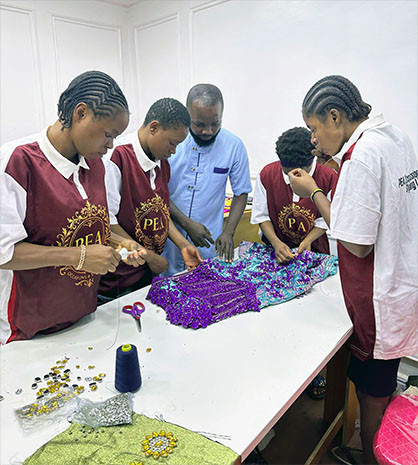
In a nation where millions of young people grapple with the twin burdens of joblessness and a lack of marketable expertise, a quiet revolution is unfolding—one that challenges the notion that poverty stems from a deficit of talent. Instead, it posits that the real deficiency lies in access to opportunity. The PEA Group, steered by Dr. Princess Ezinne Agwu, is rewriting the narrative by transforming idle and untrained Nigerian youth into skilled creators of high-end fashion pieces that hold their own against the finest offerings in the luxury apparel industry.
At the heart of this endeavor lies a deceptively simple conviction: every young person deserves a fair shot at learning, earning, and building lasting wealth. Through a strategic alliance between Royalty Signatures by Ezinne Ltd and Dr. Princess Ezinne Agwu’s Charity Initiative, underprivileged young Nigerians are welcomed into a comprehensive, no-cost skills acquisition program. However, what truly sets this initiative apart is that the training itself is merely the starting point.
Participants are not only taught but are also sustained throughout their journey. They receive regular stipends to incentivize consistent attendance, enjoy complimentary meals during each training session, and, when necessary, are provided with accommodation to ensure that financial hardship does not derail their progress. The overarching mission is not simply to impart a trade but to systematically dismantle every barrier standing between a young person and their economic independence.
After months of rigorous hands-on instruction, the program produces far more than graduates—it produces master artisans. These newly minted craftspeople are capable of producing premium, meticulously detailed garments that showcase exceptional skill and precision. From ornately beaded evening wear to opulent bridal couture, structured corseted masterpieces, and bespoke ceremonial outfits, the finished creations rival those of established luxury fashion houses. Many of these items command premium prices on the market, offering tangible proof that hands once idle from unemployment can now generate significant commercial value.
Young individuals who once scoured the job market in vain are now acquiring competencies that enable them to create employment—not just for themselves, but eventually for others. They are discovering that prosperity is not exclusively found in corporate employment; it can also be forged through creativity, craftsmanship, and the self-assurance to build something of worth.
Industry watchers have noted that this initiative signals a departure from palliative measures toward enduring empowerment. Instead of offering fleeting financial relief, the program endows participants with lifelong skills that yield consistent income long after their formal training concludes. For Dr. Agwu, this philosophy has remained a constant throughout her humanitarian journey. The commercial entities within the PEA Group are deliberately structured to serve a purpose beyond profit generation; their revenues sustain initiatives that restore human dignity, expand access to opportunity, and forge pathways out of poverty.
The luxury garments emerging from Royalty Signatures by Ezinne Ltd have thus transcended their status as fashion statements. They stand as living proof that with the right investment in human potential, talent can flourish irrespective of background or circumstance. Each completed gown is a testament to the transformative power of opportunity—demonstrating that unemployment can give way to enterprise and that untrained hands, when properly cultivated, can produce items of extraordinary value.
Dr. Agwu’s approach directly confronts the conventional vocational training model prevalent across Nigeria. The launch of this expanded initiative comes at a pivotal moment, as youth unemployment continues to rank among the nation’s most urgent socioeconomic dilemmas. While vocational programs are frequently championed as a viable route to self-reliance, the standard framework typically burdens prospective trainees with tuition fees, daily transportation costs, and the need to secure their own meals and lodging. For millions of young Nigerians living below the poverty line, these baseline expenses create an insurmountable obstacle. Many who manage to enroll are eventually compelled to abandon their studies, prioritizing immediate survival over long-term skill acquisition.
Agwu’s operational model is designed to eliminate these friction points entirely by shifting the financial load away from the trainee. As one associate familiar with the initiative’s operations observed: “Many young Nigerians genuinely want to learn a trade, but they are forced to choose between learning and eating. This model confronts those harsh economic realities head-on. By removing every logistical barrier and financial excuse, we restore dignity and allow trainees to focus entirely on building sustainable careers.”
The framework established by the PEA Group addresses the physical and financial needs of its participants through four primary pillars: tuition-free vocational instruction covering market-driven technical and entrepreneurial courses; direct monetary stipends to offset lost income during training; three fully funded meals provided on-site daily; and housing arranged and paid for on behalf of vulnerable participants or those traveling from remote regions.
While the current training initiative has drawn renewed public attention, it actually represents the continuation of a fifteen-and-a-half-year philanthropic track record by Dr. Agwu. A filmmaker, corporate executive, and legal professional by background, Agwu has spent over a decade channeling private capital into targeted social interventions. One observer of her foundation’s work remarked: “What distinguishes her approach is intentionality. It is not publicity-driven philanthropy. It is a strategic investment in human capital designed to produce measurable economic independence.”
As developmental experts continue to debate the most effective strategies for mitigating poverty across sub-Saharan Africa, Agwu’s intervention is increasingly cited as a case study in practical welfare design. By demonstrating that humanitarian compassion can be seamlessly integrated with structured operational planning, the initiative offers a replicable blueprint for public and private organizations seeking to maximize the impact of vocational development funds.
For the growing number of beneficiaries currently participating in the PEA Group’s programs, this framework represents far more than an educational opportunity—it is a direct passage out of systemic poverty and into lasting economic self-sufficiency. They depart with a profession and, in many cases, the ability to generate wealth with their own hands. What began as a search for an opportunity has culminated in the acquisition of a future.
