
Close Menu
  • Home
  • About
  • News
  • Articles
  • Events
  • Spotlight
  • Insights
    • Business Trends Report (2026)
    • Private Security Report (2026)
    • Olodo Uprising Report
  • Tools
    • Grant Finder
    • Cashflow Tracker
    • Entrepreneurial Scorecard™
    • Loan Readiness Checklist
    • Export Readiness Checklist
    • Investor Readiness Checklist
    • NAFDAC Readiness Checklist
  • MINE 1000
  • Contact
ADS

Subscribe to Updates

Get the latest business news, articles, tips and interviews to develop your business IQ!

What's Hot

Nigeria’s Airlines Face Extinction Within 30 Days Unless Government Acts, Says AON Boss

August 6, 2026

NSC Says Regulatory Reforms Prevented $90 Billion Capital Flight, Seeks Maritime Sector Partnerships

August 6, 2026

Moove Achieves Unicorn Status as Nigerian Fintech Expands Autonomous Vehicle Division

August 6, 2026
Facebook X (Twitter) Instagram YouTube LinkedIn TikTok
  • Home
  • About
  • Articles

    Nigeria’s Airlines Face Extinction Within 30 Days Unless Government Acts, Says AON Boss

    August 6, 2026

    NSC Says Regulatory Reforms Prevented $90 Billion Capital Flight, Seeks Maritime Sector Partnerships

    August 6, 2026

    Moove Achieves Unicorn Status as Nigerian Fintech Expands Autonomous Vehicle Division

    August 6, 2026

    The Self-Taught Tech Visionary Who Built a Fintech Empire from Scratch

    August 6, 2026

    Afia Media’s Obuzo Grant Opens TV and Radio Doors for South-East SMEs

    August 6, 2026
  • Insights
    • Business Trends Report (2026)
    • Private Security Report (2026)
    • Olodo Uprising Report
  • Tools
    • Grant Finder
    • Cashflow Tracker
    • Entrepreneurial Scorecard™
    • Loan Checklist
    • Export Checklist
    • Investor Checklist
    • NAFDAC Checklist
  • MINE 1000
  • Contact
    • Login
Facebook X (Twitter) Instagram YouTube TikTok LinkedIn
naijapreneur™
Get Featured!
  • News

    Nigeria’s Airlines Face Extinction Within 30 Days Unless Government Acts, Says AON Boss

    August 6, 2026

    NSC Says Regulatory Reforms Prevented $90 Billion Capital Flight, Seeks Maritime Sector Partnerships

    August 6, 2026

    Moove Achieves Unicorn Status as Nigerian Fintech Expands Autonomous Vehicle Division

    August 6, 2026

    The Self-Taught Tech Visionary Who Built a Fintech Empire from Scratch

    August 6, 2026

    Afia Media’s Obuzo Grant Opens TV and Radio Doors for South-East SMEs

    August 6, 2026
  • Events

    August 2026 Nigeria Business Events Roundup

    August 1, 2026

    July 2026 Nigeria Business Events Roundup

    July 1, 2026

    June 2026 Nigeria Business Events Roundup

    June 1, 2026

    May 2026 Nigeria Business Events Roundup

    May 1, 2026

    Lagos To Host The 6th Africa Finance Festival 2026 , Unite The Finance Ecosystem Accros Africa

    April 20, 2026
  • Spotlight

    The Psquare Saga: A Business Masterclass in Disguise – 7 Lessons Every Nigerian Entrepreneur Must Learn

    August 5, 2026

    Take the Block Nobody Wanted: The Famfa Oil Case Study – The Reinvention of Folorunso Alakija

    June 10, 2026

    From the Boot of a Car: The Ruff ‘n’ Tumble Case Study – How Adenike Ogunlesi Turned Children’s Pyjamas Into a National Brand

    June 3, 2026

    Make, Don’t Trade: The Dangote Case Study – How Aliko Dangote Broke Nigeria’s Commodity Trap

    May 27, 2026

    Built From Nothing: The Coscharis Case Study – How Cosmas Maduka Transformed ₦200 Into A Conglomerate

    May 20, 2026
  • Entrepreneurship

    The Psquare Saga: A Business Masterclass in Disguise – 7 Lessons Every Nigerian Entrepreneur Must Learn

    August 5, 2026

    The Franchising Wave in Africa

    July 23, 2026

    Your Kairos Moment: How Smart Entrepreneurs Know When It’s Time to Act

    June 15, 2026

    FROM NAIJA TO THE WORLD: THE 3 MINDSHIFTS NEEDED TO TAKE NIGERIAN BRANDS GLOBAL

    April 29, 2026

    Africa Has the Minerals. Someone Else Has the Margin.

    March 5, 2026
  • Marketing
    1. e-Marketing
    2. View All

    A Christmas GIFT For Entrepreneurs!

    December 17, 2013

    Free Website CONTENT Review: Does your website SPEAK the language of your TARGET customers?

    September 30, 2013

    e-Commerce FAQs: 8 Frequently Asked Questions About Selling Online

    July 15, 2013

    CASE STUDY: How I Made Close To 1Million In Sales Within 3 Months Of Selling Online!

    May 13, 2013

    The Cost of Invisibility: How African SMEs Lose Revenue Online

    May 5, 2026

    Brand Promises: Pact or Poetry?

    September 4, 2025

    ROI in a Ribbon: Culture, Connection, and Corporate Gifting Rooted in Respect

    July 3, 2025

    Using Customer Data and Insight to Fuel Business Success

    May 22, 2025
  • Start Up
    1. Tech
    2. View All

    Top 5 Tech Blogs in Nigeria

    April 1, 2026

    Top 5 Most Followed Nigerians on Bluesky

    April 1, 2026

    5 Mindset Shifts That Turned Me From Product Manager to Founder

    November 24, 2025

    Enter for the Aurora Tech Award by inDrive for Female Tech Founders

    November 3, 2025

    How Investors Read a Founder’s History of Failure

    July 23, 2026

    Your Pitch Deck Is Not a Sales Document. It Is a Risk Reduction Document.

    May 24, 2026

    You Are Not Just Building a Company. You Are Building an Asset

    May 6, 2026

    The First Cheque Is Easy. Follow-On Capital Is Earned.

    April 28, 2026
  • Management
    1. Finance
    2. Legal
    3. Profitability
    4. Leadership
    5. View All

    55 Grants & Funding Opportunities for Nigerian SMEs in 2026 (Verified List)

    June 3, 2026

    Not Everyone Has the DNA

    May 28, 2026

    The Trip from Curiosity to Cheque: Building the Infrastructure of Trust

    April 28, 2026

    Your Bank Is Changing: What Recapitalisation Means for Your Business Accounts, Loans and Insurance

    March 29, 2026

    The Data Protection Law Most SMEs Don’t Know They’re Breaking — and the Fines That Scale With Your Turnover

    April 6, 2026

    The 2026 CBN Fintech Report; Defining The Future Of Fintech In Nigeria

    February 27, 2026

    Recapitalization In The Nigerian Banking Sector: Legal Considerations And Strategic Options

    February 27, 2026

    Decoding The Insurance Reform Act: New Rules, New Realities for Intermediaries

    February 15, 2026

    Africa Has the Minerals. Someone Else Has the Margin.

    March 5, 2026

    5 Strategies for Reinvesting Profits to Grow Your Business

    March 20, 2015

    The MOST IMPORTANT Word In Business

    March 31, 2014

    5 Ways To Reduce Inventory Costs And Boost Profitability

    February 21, 2014

    How Patrick Doyle Transformed Domino’s Pizza: From a $3 Stock to $500

    June 20, 2025

    LEADERSHIP CHECKLIST: 4 Critical Things Every Leader Needs To Do For Their Team

    November 25, 2013

    Business Mastery: The Unusual Qualities Of Highly Successful Entrepreneurs

    October 31, 2011

    The Golden Rule Of Business

    July 18, 2011

    The Psquare Saga: A Business Masterclass in Disguise – 7 Lessons Every Nigerian Entrepreneur Must Learn

    August 5, 2026

    Nigeria Business Regulations For SMEs: NAFDAC, NCC, SON and the Rest And How To Leverage Them

    May 10, 2026

    The Floating Naira and Your Business: How to Price, Plan and Survive When the Exchange Rate Moves

    March 2, 2026

    CAC in 2026: How to Register for as Little as ₦11,000 — and the New Ownership Rule You Can’t Ignore

    February 10, 2026
  • Strategy

    How to Stay Competitive in the Digital Era

    March 25, 2025

    Nigeria Cement Market Review 2019-2024 and Forecasts 2025-2029.

    March 14, 2025

    Eight prudent ways to invest your 13th-month pay

    January 6, 2025

    Catching Them Young: A CSR Guide for Brands Building Lifelong Connections with Youth

    October 28, 2024

    The SHOW UP Strategy: How to Attract Paying Clients in Tough Economic Times

    October 15, 2024
  • Interviews

    Meet Funmilola Adedeji-Bajulaiye – From a Desk Chair Startup to Building a Global Franchise Ecosystem, ACR Global Consulting

    April 16, 2026

    Meet Olufemi Omotayo – From Lagos Hustle to Building a Legacy-Driven Storytelling Brand, Entplus Digital

    April 9, 2026

    Meet Kehinde Ajose – From Journalism to Building a Media Visibility Business, Visibility Solutions Media Ltd.

    April 6, 2026

    Meet Eloho Zoe Tanho-Attah – From ₦50,000 to Building a Performance Ecosystem, aeea Design Company

    April 1, 2026

    Meet Marvellous Bolarinwa – From ₦45,000 to a Rising Beauty Brand, “Nailedit by Maran”

    March 23, 2026
naijapreneur™
Home»Spotlight»Industry Icon»Take the Block Nobody Wanted: The Famfa Oil Case Study – The Reinvention of Folorunso Alakija
Industry Icon

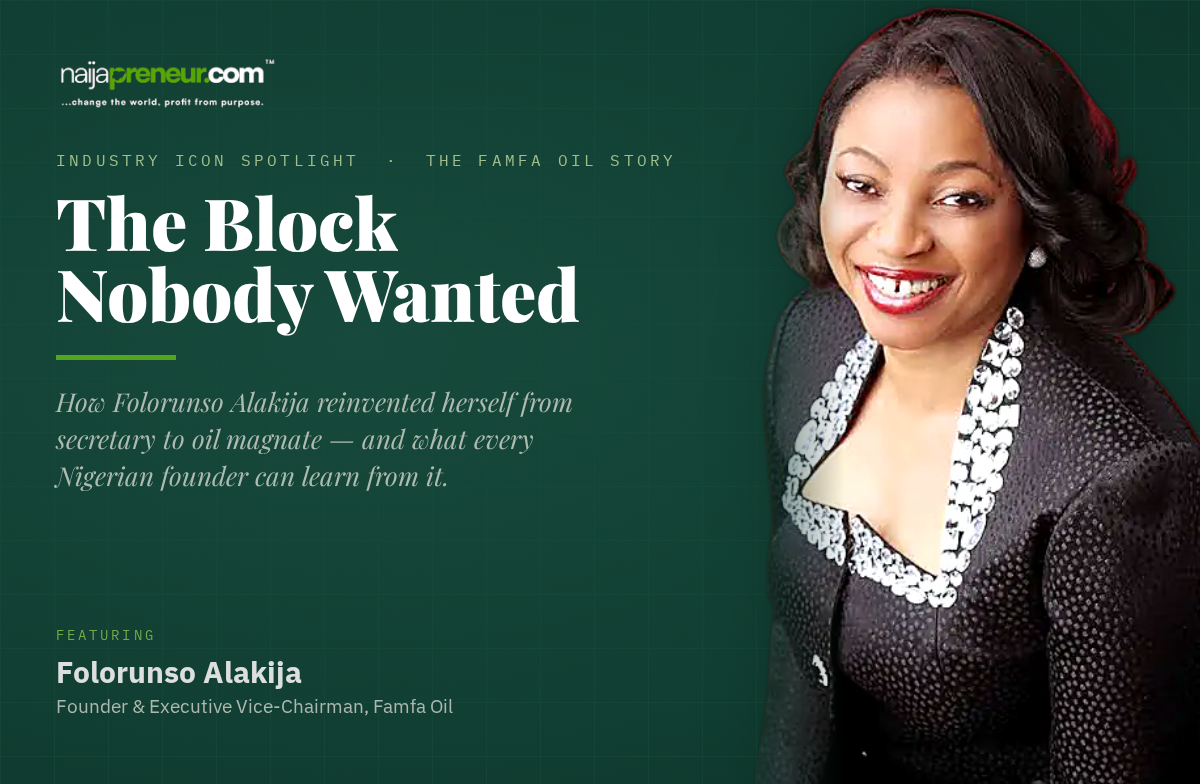
Take the Block Nobody Wanted: The Famfa Oil Case Study – The Reinvention of Folorunso Alakija

Tito PhilipsBy Tito PhilipsJune 10, 2026011 Mins Read
Share Facebook Twitter Pinterest Copy Link LinkedIn Tumblr Email Telegram WhatsApp
Follow Us
Facebook X (Twitter) Instagram YouTube LinkedIn TikTok
Share
Facebook Twitter LinkedIn Pinterest Email Copy Link WhatsApp

She was a secretary who became a banker who became a fashion designer who became an oil magnate — and her fortune came from the deep-water block every major had rejected as too hard. Folorunso Alakija’s story is a masterclass in reinvention, in taking the asset nobody else wants, and in fighting to keep it.

The Famfa Oil Case Study · A naijapreneur Insights feature

The Application Nobody Expected

Some time in the early 1990s, a successful Lagos fashion designer — by her own description, “only a stylist at the time” — sat down and applied for an oil prospecting licence. A friend in London had asked Folorunso Alakija to help open a door to Nigeria’s petroleum ministry for an oil deal; when the friend was rebuffed, Alakija asked herself a different question. If there was money and access in this industry, why was she brokering it for other people instead of securing a contract of her own and diversifying her income?

So she applied — and, characteristically, she hedged. “When I was making the application, I listed several blocks,” she recalled. “I didn’t want to risk someone else taking my block. I applied for several blocks, and the one I was allocated was the one nobody wanted, because it was deep offshore and exploring it was too expensive with the technology available at the time.” She had just been handed a 617,000-acre block in deep water that the international majors considered uneconomic. It would take her seventeen years to prove them wrong.

Meet Folorunso Alakija: Three Lives In One Career

That a fashion designer could win an oil block at all makes sense only against the shape of Alakija’s career, which reads like three different lives. Born in 1951, she began as an executive secretary, moved into banking — rising through the Nigerian arm of the First National Bank of Chicago — and then, in 1985, left salaried work entirely to build a fashion house. Supreme Stitches, later Rose of Sharon, dressed Nigeria’s elite and earned her the national presidency of the country’s fashion designers’ association.

Any one of those chapters would count as a full career. Most people, having reached the top of Nigerian fashion, would have stopped there. Alakija reinvented again — into an industry with nothing in common with couture.

The first and most transferable lesson is therefore not about oil, or fashion, or banking. It is that reinvention itself is a skill, and a rare one. Founders who fuse their identity to a single business tend to miss the next opportunity, because pursuing it would mean admitting the current chapter is over. Alakija kept proving willing to close a good chapter in order to open a better one — carrying the judgement, the relationships and the nerve she had built into each new arena.

The Block Nobody Wanted

The block was not a gift in any practical sense; it was a liability that happened to be sitting on a fortune. Deep-water exploration was, and remains, one of the toughest environments in the industry, and the licence carried a price tag of around $1.5 million. Alakija and her husband spent all their savings to secure it — and it still wasn’t enough. When their first technical partners backed out, they spent three more years hunting for new ones, finally striking a joint-venture deal in 1996 with Star Deep Water Petroleum, a Chevron subsidiary, which took a 40 percent interest and the technical lead.

That is the strategic heart of the story, and it is widely portable. The value was hiding inside the asset that everyone more experienced had dismissed as too hard. Contrarian bets look reckless right up until the moment they look obvious — and the window to make them is open only while the consensus still says no.

The lesson: the asset others reject can be the prize, but only if you will bear the risk and the cost they won’t. Being early means being doubted, under-resourced and often alone. Alakija’s willingness to stake everything on a block the majors had passed over is the entire difference between a fortune and a footnote.

The Long Game

Then came the waiting — the part most people skip when they tell this story. The first well was drilled on 15 July 1998, in roughly 4,700 feet of water, the deepest in Nigeria at the time, and it found the Agbami field, with recoverable reserves estimated north of a billion barrels. But a discovery is not production. Agbami did not begin producing until 2008 — some fifteen years after the licence was granted, and closer to seventeen from application to first commercial oil.

Fifteen years. Sit with that number. Patient capital, in Alakija’s case, meant tolerating a decade and a half between the bet and the payoff, through the collapse of partnerships and the sheer risk of deep water. A founder expecting a quick return would have broken, sold out or given up long before Agbami ever flowed.

The lesson is unglamorous but essential: the best assets can take a decade or more to mature, and the discipline to wait — funded, patient, unpanicked — is itself a competitive advantage. Most people cannot do it. Those who can inherit the rewards the impatient forfeit.

The Fight To Keep It

Ownership, it turned out, was not the end of the struggle but the start of a new one. Once Agbami was producing, the Nigerian government moved to take a stake in the block — first 40 percent, then a further 10, seeking half of what Alakija had built. She refused, and fought it through the courts. In 2012 the Supreme Court ruled in her favour. “We felt like it was unfair,” she said. “We had taken the sole risk and invested everything we had in the business. It had become a family business.”

Honesty requires naming the other half of this story, because it is contested. Critics have long alleged that Alakija was a front for the military regime of the day and that the block was effectively a political gift, pointing to her relationship with Maryam Babangida, the then first lady. Alakija has called the attribution “painful,” acknowledging that the first lady helped facilitate meetings with the petroleum minister but insisting that she “had to put in all the work needed to secure the licence.” Defenders note that the award followed the discretionary-allocation guidelines of the era, carried none of the later Malabu-style scandal, and that no mere front would have poured a personal fortune into fifteen years of deep-water risk on a block everyone else had rejected.

The reader can weigh that. But two lessons survive whichever way you lean. The first is that in Nigeria, as everywhere, proximity to power opens doors — it is naïve to pretend otherwise — but a door is not a producing oil field; someone still had to take the risk, raise the capital, wait out the years and build the company. The second is blunter: ownership must be defended. What you build, someone more powerful may try to take — and you had better be ready to fight for it, to the Supreme Court if that is what it takes.

Wealth As A Tool, Built To Last

Alakija became, for a time, the richest woman in Africa, with a fortune that has risen and fallen with the oil price — enough that Forbes dropped her from its billionaires list in 2021 when crude prices pushed her below the threshold. What she has done with the wealth is the part worth emulating. Through the Rose of Sharon Foundation, established in 2008, she has directed resources to widows and orphans and funded thousands of scholarships. Wealth, in this frame, is scaffolding for others rather than a number to be admired.

There is also a quiet build-to-last discipline in how Famfa is structured. It is a genuine family business — her husband, a senior lawyer of almost fifty years’ standing, chairs the board — deliberately built and governed to outlive its founders rather than die with them. For a company born of a single audacious bet, that institutional patience is its own kind of achievement.

The lesson: reinvention and risk get you the asset; stewardship and structure are what let it endure and mean something beyond the founder.

What The Fashion House Really Built

It is worth returning to the fashion years, because they were not merely a colourful prelude to oil — they were the foundation that made oil possible. As the designer behind Supreme Stitches and later Rose of Sharon, and as national president of Nigeria’s fashion designers’ association, Alakija spent years dressing the country’s most powerful women and moving easily in their circles. She built a brand at the very top of a market where reputation and relationship are the currency.

Those are precisely the assets an outsider needs to win, hold and defend a major oil concession: access to the rooms where allocations are discussed, the credibility to be taken seriously, and the relationships to assemble partners and survive a legal war. The competencies compounded across chapters. Alakija did not become an oil magnate in spite of her years in fashion; she became one, in meaningful part, because of the network and standing those years had quietly built.

The lesson for founders is that reinvention is rarely a clean break, and its real value is cumulative. The brand you build, the relationships you earn and the reputation you accumulate in one arena are portable capital in the next. Nothing you build well is ever truly wasted — not even when you walk away from the industry that built it.

What Nigerian Founders Should Take From Alakija

A case study earns its place only if it transfers, and Alakija’s — political controversy and all — transfers more than it first appears. Here is what her story recommends.

Treat reinvention as a skill. Don’t marry your identity to one industry; be willing to close a good chapter to open a better one, and carry the judgement, relationships and nerve you built into the next.

Take the block nobody wants. The asset others reject as too hard or too expensive can be the prize — if you will bear the risk and cost they won’t. Being early means being doubted; do it anyway when your read is strong.

Play the genuinely long game, and refuse to panic-sell what you know is valuable — the best assets can take a decade or more to mature. Defend what you build, because ownership is not the end of the fight. And use whatever access you have, but never mistake the open door for the work: turn success, in the end, into structure and purpose that outlast you.

The Playbook: 8 Lessons for Nigerian Founders

01  Treat reinvention as a skill.  — Don’t marry one industry — close a good chapter to open a better one.

02  Take the block nobody wants.  — The asset others reject as too hard can be the prize.

03  Bear the risk others won’t.  — Being early means being doubted, under-resourced and alone — do it anyway.

04  Play the genuinely long game.  — Fund for a decade of patience; the best assets take years to mature.

05  Refuse to panic-sell what you know is valuable.  — Discipline to wait is a competitive advantage most people lack.

06  Defend what you build.  — Ownership isn’t the end of the fight — protect it, to the Supreme Court if need be.

07  Use access, but do the work.  — A door is not a producing field; someone still has to build the company.

08  Turn success into structure and purpose.  — Build to outlast yourself; aim wealth at more than a scoreboard.

Folorunso Alakija’s story is often reduced to a single, contested question about how she got her block. It is a fair question, and an honest account holds it. But look past the origin and what remains is a discipline anyone can study: the willingness to start over, again and again; to take the asset everyone else avoided; to wait out fifteen years of deep-water risk; and to fight to the Supreme Court for what she owned. Access may have opened the door. Everything on the other side of it, she built. Those are choices — and choices, unlike luck, can be learned.

Share. Facebook Twitter Pinterest LinkedIn Email Copy Link WhatsApp
Previous ArticleCascador Deploys US$5 Million in Debt and Equity to Seven High-Growth African Startups
Next Article Federal Government Disburses ₦700bn to Settle Contractor Debts, Underwrites ₦501bn Bond to Clear Power Sector Arrears
Tito Philips
  • Website
  • Facebook
  • X (Twitter)

Hi! My name is Tito Philips, an unusual Nigerian that is MAD – Making A Difference. I'm the Chief Community Leader here and this is where we raise the bar of entrepreneurship. We are a TRIBE of Unusual Entrepreneurs, we are not your every day entrepreneurs who go into business to put food on the table and pay bills. For us, business is more than making ends meet [survival]. It is our means of doing what we love [passion], changing the world [purpose] and being financially rewarded for it [profit]™. Want to become ONE of us?

Related Posts

The Psquare Saga: A Business Masterclass in Disguise – 7 Lessons Every Nigerian Entrepreneur Must Learn

August 5, 2026

#71ForTheNextGeneration: Tomi Davies Celebrates 71st Birthday by Fundraising for Public School Children

June 9, 2026

Zedvance To Triple Lending after Disbursing N120bn To SME’s in 2025

June 3, 2026
Add A Comment

Comments are closed.

ADS
MINE 1000

SME Toolkit

Book

NBTR
Business Events in Nigeria
Nigeria Business Events Roundup
naijapreneur TV
https://www.youtube.com/watch?v=KC01cJZBJoE&t=34s
Latest Posts

Nigeria’s Airlines Face Extinction Within 30 Days Unless Government Acts, Says AON Boss

August 6, 2026

NSC Says Regulatory Reforms Prevented $90 Billion Capital Flight, Seeks Maritime Sector Partnerships

August 6, 2026

Moove Achieves Unicorn Status as Nigerian Fintech Expands Autonomous Vehicle Division

August 6, 2026

The Self-Taught Tech Visionary Who Built a Fintech Empire from Scratch

August 6, 2026

Afia Media’s Obuzo Grant Opens TV and Radio Doors for South-East SMEs

August 6, 2026
1 2 3 … 963 Next
ADS
Stay In Touch
  • Facebook
  • YouTube
  • TikTok
  • Instagram
  • LinkedIn

Subscribe to Updates

Get the latest business news, articles, tips and interviews to develop your business IQ!

Most Trending

Innocent Ike Takes the Helm as Group CEO of Access Holdings

August 29, 2025

The Psquare Saga: A Business Masterclass in Disguise – 7 Lessons Every Nigerian Entrepreneur Must Learn

August 5, 2026

From Unemployment to Entrepreneurship: FG Empowers 5,500 Nigerians with Startup Support

March 25, 2025
1 2 3 … 1,605 Next
Latest Posts

Nigeria’s Airlines Face Extinction Within 30 Days Unless Government Acts, Says AON Boss

August 6, 2026

NSC Says Regulatory Reforms Prevented $90 Billion Capital Flight, Seeks Maritime Sector Partnerships

August 6, 2026

Moove Achieves Unicorn Status as Nigerian Fintech Expands Autonomous Vehicle Division

August 6, 2026
1 2 3 … 1,605 Next
SME Toolkit

NBTR
Facebook X (Twitter) Instagram YouTube LinkedIn TikTok
  • Entrepreneurship
  • Interviews
  • Marketing
  • Start Up
  • Strategy
  • Management
  • Profitability
  • Leadership
© 2026 naijapreneur™. Powered by Differentiate.Online.

Type above and press Enter to search. Press Esc to cancel.