

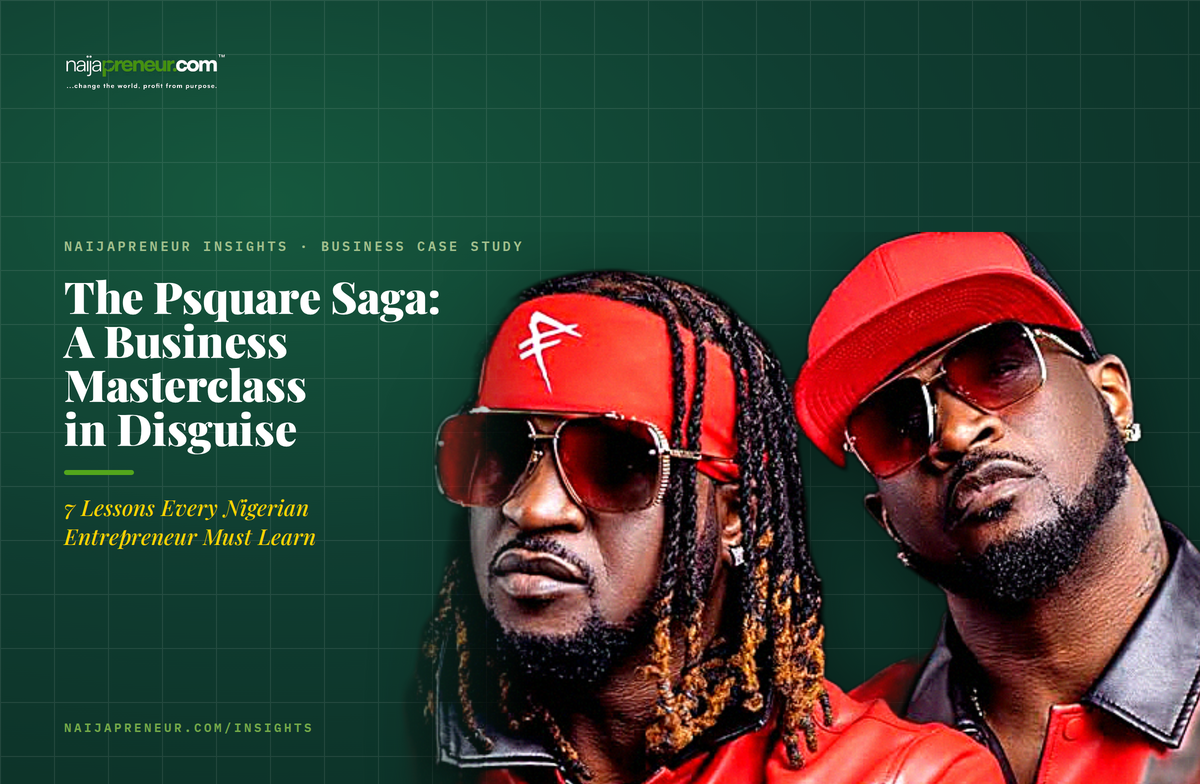
Strip away the celebrity, and the public war between Peter, Paul and Jude Okoye is not a music story at all. It is an ordinary Nigerian business tragedy — a partnership that never wrote down who owned what, who controlled the money, or who owned the brand. And it is playing out in full public view, which is the only unusual thing about it.
For weeks now, Nigerian timelines have been consumed by Mr P’s serialised “tell-all,” Jude’s video rebuttals, and the drip of court reporting from an EFCC prosecution that has been running since 2024. Most of the conversation has been about who is lying and who is loyal. At naijapreneur, we read the news for a different reason: we read it for what it teaches. And the Psquare saga teaches more about how Nigerian businesses live and die than any seminar you will attend this year.
Here is our starting conviction. Effort was never Nigeria’s shortage. Walk through any market from Onitsha to Balogun and you will meet some of the hardest-working people on earth — and yet roughly 82% of our small businesses fail. The gap is not hustle. The gap is Business IQ: the unglamorous machinery of ownership, agreements, financial controls and governance that turns a hot streak into a company that outlives its founders. The Psquare saga is the most expensive lesson in that gap that any of us has watched unfold in public.
First, A Word On Fairness: Allegations Are Not Verdicts
This is a live legal matter. As at the time of writing, Jude Okoye has pleaded not guilty to every charge, denies all wrongdoing, and no Nigerian court has convicted anyone in this dispute. Peter Okoye’s public videos and courtroom testimony are his account. Jude’s rebuttals and his lawyers’ submissions are his. Under Nigerian law, every accused person is presumed innocent until proven guilty, and we hold that line throughout this article.
Where a claim has been tested in court and did not hold up under cross-examination, we say so plainly — even when it complicates the popular narrative. That is our house rule: verify, don’t guess. This reporting draws on public court proceedings and the EFCC’s own statements as covered by Nigerian outlets including Punch, Vanguard, TheCable, Channels TV, Tribune, Premium Times and Leadership, alongside the parties’ own published videos between July and August 2026.
And here is the point that makes this piece useful no matter how the trial ends: the governance failures we are about to diagnose are visible in what both sides already agree happened. Overlapping companies, blurred signatories, verbal splits, a manager who sat closest to the money. You do not need a verdict to learn from that. You only need to make sure it is never the structure of your business.
What Actually Happened — The Psquare Saga In Brief
Psquare were the twin brothers Peter Okoye (“Mr P”) and Paul Okoye (“Rudeboy”), managed for most of their career by their elder brother, Jude Okoye. For over a decade they were one of Africa’s biggest acts, releasing roughly six albums and close to a hundred songs. Three human beings, one bloodline, one enormous business — and, crucially, none of the three ever cleanly separated from the others on paper.
The group broke up in 2017 amid a bitter public fallout, reunited in 2021, and disbanded again in 2024 over money and management. On 22 January 2024, Peter petitioned the EFCC, alleging that group funds had been diverted, that undeclared bank accounts existed, and that the shareholding of their jointly-owned company had been manipulated. That petition set everything else in motion.
In March 2025, Jude Okoye and his company, Northside Music Ltd, were arraigned before a Lagos State court on a four-count charge over the alleged theft and conversion of about $1,019,763.87 and £34,537.59 in royalties from digital distribution and publishing. He pleaded not guilty and was granted ₦50m bail. A separate seven-count case at the Federal High Court, citing sums around ₦1.3 billion and $1 million, is also proceeding. Peter testified as the prosecution’s first witness through 2025; from 30 July 2026 he began releasing the multi-part “tell-all” that reignited public interest.
The Two Companies At The Heart Of It All
Almost every strand of this dispute traces back to two similarly-named companies — and a third name that surfaced in court. When entities blur, so does the money trail, and that single fact explains most of the fight.
NORTHSIDE ENTERTAINMENT LTD — “THE ONE WE OWNED TOGETHER”
Described in court as the jointly-owned Psquare company. By Peter’s own testimony, Jude held roughly 40% and each twin about 30%, though Peter said he was not certain of the exact figures. Peter initially told the court Jude was the sole signatory to its account — a claim the defence would later challenge.
NORTHSIDE MUSIC LTD — “THE ONE I FOUND LATER”
Jude’s company, and the co-defendant in the criminal trial. By Peter’s testimony, Jude’s wife, Ifeoma, held 80% (800,000 shares) and Jude 20%. Peter told the court he only became aware of this company in 2024 and alleges royalties were routed through it. Jude maintains that all distributions followed existing agreements and were properly documented.
If you cannot draw your own business as one clean diagram in sixty seconds, neither can a judge.
The Allegations — And The Rebuttals
A responsible case study shows both columns of the ledger. Here is what Peter alleges, set against what Jude, the defence, and the court record say. Read them together — the gap between them is where the business lesson lives.
- Diversion. Peter alleges more than $1.2m in royalties was redirected into Northside Music without his consent. Jude says distributions followed existing agreements and cites a 2016 email in which Peter himself instructed how a payment be split.
- Signatory access. Peter alleges he was removed as a signatory and locked out of the accounts. The defence produced a bank mandate showing Peter and Paul as Category B signatories, and under cross-examination Peter admitted he was in fact a co-signatory, saying he never personally signed cheques.
- 47 accounts and an 80% stake. Peter alleges Jude operated 47 undeclared bank accounts and manipulated shareholding. The EFCC told the court it did not have records of 47 accounts, and the defence tendered CAC records contradicting the 80%-stake claim on Northside Entertainment.
- The $800,000. Peter testified that Jude and Paul withdrew and shared over $800,000. Under cross-examination the timeline shifted, and the EFCC conceded it could not tender evidence to support the figure: “We do not have it.”
None of this proves Jude did nothing wrong — the core criminal charges are still being tried. But it proves something every founder must sit with: when the books are messy, even a genuinely wronged partner struggles to prove it. Emotion and memory are not evidence. Documents are.
The 2026 Tell-all: When The Boardroom Moved To Instagram
From 30 July 2026, Peter began releasing a serialised video account: that the celebrated 2021 reunion was “fake,” that he was frozen out of accounts, that there were threats and a physical altercation, and that a legal letter demanded he stop performing Psquare songs — with Jude reportedly claiming to own the “Psquare” name. Jude answered with his own videos and documents, accusing Peter of trying to sway public opinion while the case sits before a judge.
We deliberately do not adjudicate the personal allegations — threats and family conduct are serious, contested, and properly a matter for the courts, not a business article. But notice what the public fight is actually about: ownership of the name, the catalogue, the property and the accounts. Every single flashpoint is a governance document that was never signed. The drama is downstream of the paperwork.
The Business Diagnosis: Seven Fractures
Behind the headlines sit seven structural failures — each one common in Nigerian partnerships and family businesses, each one avoidable, and each one carrying a lesson you can apply before Friday.
1. Family first, business never — the two were never separated
Brotherhood, talent and enterprise were fused into one unit from day one. There was no line between “we are family” and “we are shareholders and officers of a company.” So when the family relationship broke, it took the business down with it — and vice versa. In Nigeria, this is the default setting for family firms, and it is exactly why succession and disputes are so lethal here.
The lesson: Love is not an operating agreement. Run the family as a family and the company as a company — with separate meetings, separate records, and separate rules that survive a bad Christmas.
2. Nobody owned the ownership — the cap table was a rumour
In court, Peter could not state his own shareholding with certainty, said he only learned of a key company in 2024, and was surprised to find a sister-in-law holding the majority of it. Whether or not that structure was proper, the deeper failure is that the owners did not know the ownership. A cap table you cannot recite is a cap table someone else controls.
The lesson: Every founder must be able to name — from memory — every company they own a piece of, their exact percentage, and every other shareholder. If you can’t, pull your Corporate Affairs Commission records this week.
3. One hand on the tap — control of the money was concentrated
The manager-brother sat closest to the cash: the accounts, the distributions, the aggregator relationships. Even with others listed as signatories, one person held the visibility and the day-to-day control. In any partnership, whoever controls the money controls the business — and eventually controls the narrative about the business.
The lesson: Separate duties. The person who receives money should not be the only one who can move it, and never the only one who can see it. Dual signatories, shared bank access, and monthly statements to every owner are non-negotiable.
4. Two companies, one blur — entities and money were commingled
Northside Entertainment. Northside Music. A “Northside Inc” credit on an artist’s albums. When near-identical entities coexist and cash flows between them, no one — not even the owners — can trace which naira belongs to whom. That ambiguity is precisely what makes diversion possible and what makes it hard to prove or disprove.
The lesson: One business, one clean structure. If you must run multiple entities, give them distinct names, distinct accounts, written inter-company agreements, and a diagram every owner has signed off. Commingling is where trust goes to die.
5. The crown jewels were unguarded — nobody nailed down the IP
The most valuable assets here were never physical: the “Psquare” brand name and the music catalogue of nearly a hundred songs. Years in, the brothers are fighting over who owns the name, and a catalogue sale reportedly stalled when prospective buyers couldn’t get clean ownership data on the “back-end.” Un-clarified intellectual property is a landmine that detonates at the exact moment you try to cash out.
The lesson: Your brand, trademarks, domains, formulas, code and customer data are the company. Register them, assign them in writing to the company rather than to a person, and keep clean records of who owns and controls them — before they become valuable.
6. Trust instead of controls — there was no audit, ever
By Peter’s own account, problems were only “discovered” years later, by accident, when he chased a statement of account. For over a decade, apparently, there was no independent audit, no shared monthly reporting, no reconciliation. Trust is a beautiful thing between brothers. It is a catastrophic substitute for financial controls.
The lesson: Trust and verify. Controls are not an accusation — they are how honest partners stay honest and protect each other. Insist on them precisely because you trust each other.
7. Reunion without repair — they reconciled the feelings, not the firm
The 2021 comeback briefly fixed the relationship but left the broken structure untouched: the same undocumented splits, the same account arrangements, the same unowned IP. Predictably, it collapsed again by 2024. A reconciliation that doesn’t renegotiate the terms is just a countdown to the next breakup.
The lesson: Any time partners get back together — or bring in a new partner, or pivot — treat it as a brand-new deal. New agreement, refreshed cap table, clean books. Repair the firm, not just the friendship.
The Okoyes didn’t lack talent, money, or even love. Every fracture is the absence of a single document — and the discipline to keep it.
The Cost Of Litigating In Public
Even if a court eventually vindicates one brother completely, look at what the method of this fight has already cost — costs an SME can rarely afford.
- Brand value, torched jointly. “Psquare” is a shared asset. Every episode of public warfare devalues the very name both sides are fighting to own. Airing a partnership dispute in public is often both parties setting fire to the thing they’re fighting over.
- The frozen catalogue. Reported buyers reportedly walked when ownership couldn’t be cleanly verified. Disputed, contested assets don’t sell at full value — or at all. The feud has effectively locked the vault.
- Credibility under oath. When claims made loudly in public are contradicted in court, it is the accuser’s credibility that takes the damage — even where the underlying grievance is real. Big public numbers that can’t be evidenced don’t win cases; they lose them.
- Years and family, unrecoverable. Litigation consumes years of focus and earning power, and some things — a bond between twins, a family’s peace — no verdict can restore. The opportunity cost dwarfs the sum in dispute.
For your own business, build the off-ramp before the crisis: a dispute-resolution and mediation clause, a buy-sell agreement with a valuation formula, and a rule that partners resolve disputes in a room, or in arbitration, before they resolve them online. The goal is to make a clean exit possible — so a fight never has to become a fire.
The naijapreneur Partnership Playbook: 8 Moves That Would Have Saved The Okoyes
Do these while everyone still likes each other. That is the whole trick.
- Sign a Founders’ / Partnership Agreement on day one. Roles, decision rights, and what happens if someone leaves, dies, or under-performs. The best time was at the start; the second-best time is today.
- Build a real cap table — and file it at CAC. Exact percentages, every shareholder, matching your filings. No “roughly 30%.” If reality and CAC disagree, fix it now, not in a courtroom.
- Separate duties over the money. Dual signatories for outflows above a threshold, and read-access to every account for every owner. Whoever earns it shouldn’t be the only one who can move it or see it.
- Keep one clean structure — no shadow companies. Kill or formalise any second entity that touches your revenue, with written inter-company agreements and a structure diagram every owner has seen.
- Own your IP in the company’s name. Trademark the brand, register the domains, and assign key assets to the company in writing — not to an individual.
- Report monthly, audit yearly. A simple monthly numbers pack to every owner, and an independent annual review. Controls are how honest partners stay protected and disputes stay small.
- Put a buy-sell and dispute clause in place. Agree in advance how a partner exits, how the stake is valued, and that disputes go to mediation or arbitration — not to Instagram.
- Re-paper every reunion, pivot, or new partner. Any major change is a new deal. Refresh the agreement and the cap table so you never inherit yesterday’s ambiguity.
The Verdict: An Independent Editorial Assessment
Scoring the design of the partnership — not the guilt of any party — naijapreneur’s independent editorial assessment rates the Psquare business structure at 2.1 out of 10 on governance and Business IQ. Ownership clarity, financial controls, entity separation, IP ownership, documentation and dispute-resolution design all score in the low single digits. Only one dimension scores near-perfect: raw talent and market value.
That contrast is the whole tragedy in one line: a world-class asset wrapped in a structure that would fail a first-year governance check. The problem was never a shortage of value. It was a value this large left almost entirely unprotected. (This assessment scores the structure as publicly reported; the conduct and guilt of any individual remain before the courts.)
What To Do Monday Morning
Insight you don’t act on is just entertainment. Here is the founder’s checklist — the same one that would have changed the Okoye story. Work down it this week.
- Pull your CAC records for every company you’re part of, and confirm your exact shareholding and every co-owner.
- Write down who controls each bank account — and who can see it. Add a second signatory for large outflows; give partners view-access.
- Map every entity and how money moves between them on a single page. If you can’t draw it in 60 seconds, simplify until you can.
- Trademark your business name and assign key IP to the company in writing.
- Start a monthly numbers pack to all partners and book a small external accountant for a yearly review.
- Draft or refresh a founders’ agreement with buy-sell and mediation clauses — especially if anything has changed since the last one.
- Agree one rule with your partners: disputes go to a room, never to the timeline.
The Bottom Line
The Okoyes had everything a business needs except the boring paperwork that keeps a business alive. So here is the least glamorous, most important advice you will read this year: do the boring paperwork. Structure your partnership while the love is still there, because structure is not a sign of distrust — it is how you protect the people you trust, and the thing you built together.
That is the entire reason naijapreneur exists: to close the Business IQ gap so that fewer Nigerian founders — and fewer Nigerian families — end up as someone else’s case study. Start with our free SME Toolkit, the Cashflow Tracker and the Entrepreneur’s Scorecard to pressure-test your own structure, then formalise it with a professional. Hustle is how you start. It is not how you last.
Frequently Asked Questions
Q: What is the Psquare saga about?
A: It is the public and legal fallout between former Psquare members Peter Okoye (Mr P) and Paul Okoye (Rudeboy) and their elder brother and former manager, Jude Okoye, over royalties, company ownership and control of the Psquare brand. Peter petitioned the EFCC in January 2024, leading to criminal charges against Jude, who denies wrongdoing and has pleaded not guilty.
Q: Has anyone been convicted?
A: No. As at publication the matter remains before the courts and every accused party is presumed innocent until proven guilty.
Q: What can Nigerian entrepreneurs learn from it?
A: Separate family from business; document ownership in a real cap table; never let one person alone control the money; keep entities and accounts clean; own your IP in the company’s name; replace blind trust with controls and audits; and re-paper every reunion, pivot or new partnership.
Disclaimer
This is an educational business case study, not legal advice. All allegations described are unproven and the subject of ongoing legal proceedings; every accused party is presumed innocent until proven guilty. Reporting is drawn from public court coverage and the parties’ own statements between July and August 2026.
