

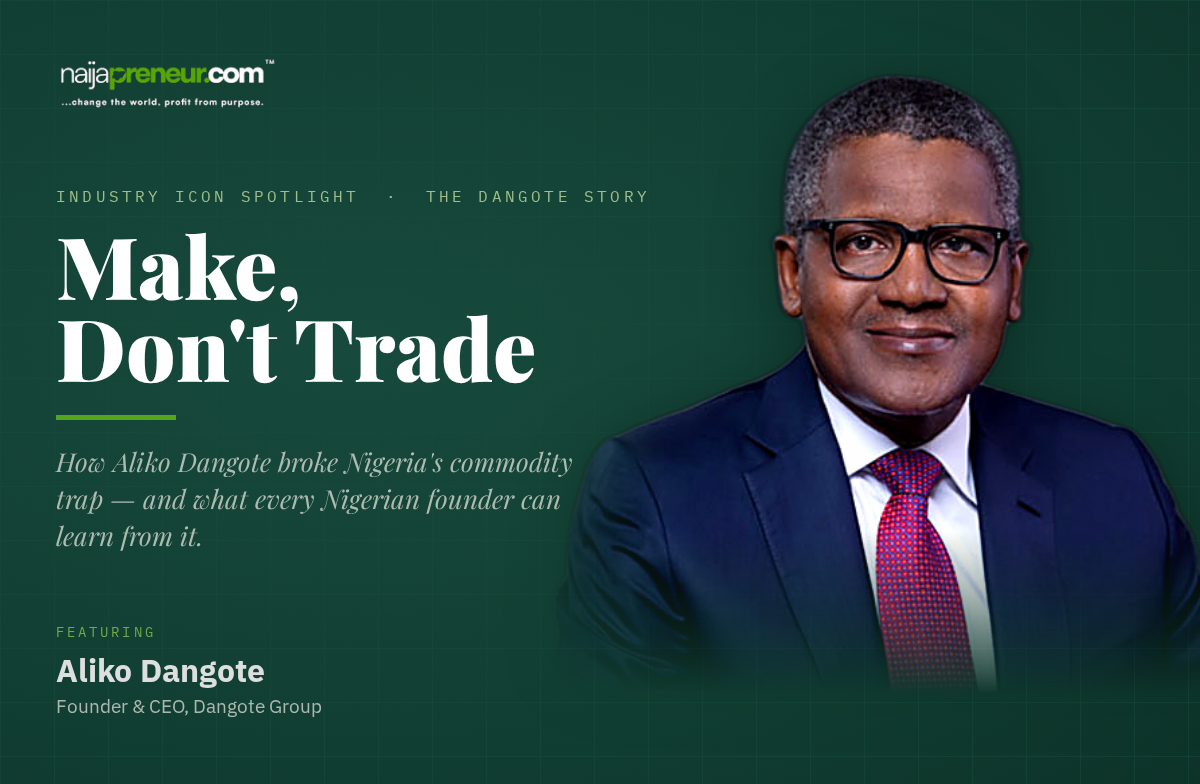
For decades Nigeria pumped crude and imported the fuel refined from it. In 2026 Aliko Dangote reversed that — but the more useful story for founders isn’t the refinery’s size. It’s a loan he handed back in three months, and a single rule he has run for fifty years: move up the food chain.
The Dangote Case Study · A naijapreneur Insights feature
The Loan He Gave Back in Three Months
When Aliko Dangote finished school and started trading cement in Lagos in the late 1970s, his family staked him the capital to begin. He barely needed it. His uncle allocated him truckloads of cement — four a day — at a time when cement was scarce across Nigeria, and customers paid him up front, months before they came to collect. Cash piled up faster than he could deploy it. Three months in, he handed the money back to his grandfather. “I had too much cash,” he later explained. “I returned his cash.”
Hold that image, because it is the whole man in miniature. Before he was Africa’s richest person, before the cement plants and the sugar refineries and the largest oil refinery on the continent, Aliko Dangote was a young trader who understood two things most people never do: that margin and cash flow — not revenue — are what a business actually runs on, and that the real money is not in trading a thing but in controlling how it is made. Five decades later, the second idea would lead him to bet more than twenty billion dollars on breaking Nigeria’s oldest economic trap.
Raised On Trade
He was born in Kano in 1957 into a family that had traded for generations. His maternal great-grandfather, Alhassan Dantata, was reportedly the richest man in West Africa at his death, his fortune built on kola-nut and groundnut trade. When Dangote’s father died young, he was raised — as tradition dictated for a first grandchild — by his grandfather, Sanusi Dantata, a prosperous Kano commodities trader. “I was actually raised by my grandfather,” he says. “I had a lot of love, and it gave me a lot of confidence.”
He inherited, in his own telling, not a fortune but a temperament and a trade. After a business degree at Al-Azhar University in Cairo he came home at twenty, went briefly into his uncle’s cement business, and then, in 1977, struck out on his own with a family loan of a few thousand dollars, trading cement, sugar and flour. By 1981 the operation had a name: the Dangote Group.
The lesson is quiet but real. Dangote’s edge began as inherited infrastructure — a network, a reputation, a working knowledge of how commodities move. Most founders start with far less. But the principle generalises: whatever advantage your background hands you — a skill, a contact, a trade you grew up around — is capital. The only question that matters is whether you compound it or waste it.
Move Up The Food Chain
Ask Dangote to compress fifty years of decisions and he reduces them to one phrase. “I always tried to move up the food chain,” he says. “I started with cement, and then moved into textiles and banking. When I was trading sugar, I added salt and flour, so that then we could do pasta.”
Read plainly, that is a description of relentless integration. He refused to stay a trader. He moved from importing and selling a commodity to manufacturing it, and from one product to the adjacent products that shared its inputs and its customers. The defining example is cement: Nigeria and much of Africa once imported vast quantities of it, and Dangote built local plants until Dangote Cement had all but ended cement imports across the continent — and turned the country into an exporter.
The lesson is the one this series keeps returning to, because Nigeria needs it most: make, don’t trade. Trading is buying low and selling high on someone else’s product — the margin is thin and anyone with a container can copy you. Making is owning the value chain: the capacity, the inputs, the distribution, all of which are hard to build and hard to take away. Every input you buy finished from someone else is margin and control you have handed to them.
The Commodity Trap
Which brings us to the refinery, and the trap it was built to break. For a generation Nigeria embodied an absurdity: one of the world’s larger crude-oil producers, importing almost all of its refined petrol. The country shipped out the raw material cheaply and bought back the finished product dearly — exporting its margin, its jobs and its industrial capability along with the crude. Most Nigerians treated this as immovable, like the weather.
Dangote treated it as a business to be taken. He built a 650,000-barrel-a-day refinery near Lagos — reported to be the single largest private investment in Nigerian history, roughly half self-funded — and in early 2026 it reached full operation and Nigeria became a net exporter of petrol for the first time in decades. He was blunt about why the gap had lasted so long: “The people who were supposed to invest in refineries, who understand the market, are benefiting from there being no refineries.” The importers, in other words, had every incentive to keep Nigeria importing.
The lesson for founders at any scale: the most valuable opportunities are often the inefficiencies everyone has stopped questioning. An entire economy had quietly accepted importing what it could make. Capturing the value chain you already sit inside — refining the crude you pump, processing the crop you grow, finishing the good you assemble — is frequently the largest opportunity hiding in plain sight.
Tested
None of it has been smooth, and honesty demands saying so. Building the refinery set Dangote against both the government and the oil industry; he has spoken of a “cabal” obstructing his access to crude, of a regulator slow to license, and, through 2026, of feedstock shortfalls that forced processing units to slow. At one low point he noted, wryly, that a friend who had warned him against investing in Nigeria and moved his money abroad was now laughing at him.
His response is instructive precisely because it is unsentimental. “If I had challenges in my company, I would not hesitate to sell assets to remain afloat, to get to the better times,” he has said, “because it doesn’t make any sense for me to keep any assets and then suffocate the whole organisation.” When foreign exchange dried up, he shut marginal plants rather than let them bleed the group.
The lesson: scale does not remove risk; it only changes its size. The goal is not to eliminate shocks — you cannot — but to build an enterprise robust enough to absorb them, and to keep the discipline to cut fast when one part threatens the whole. Report the hard parts and manage them. Do not pretend they aren’t there.
The Discipline Underneath
For all the scale, the operating temperament is conservative. Dangote is famously frugal — up at 5:30, a morning walk, meals taken at home — the habits of a man who still thinks like the young trader who returned his capital early. He keeps firm rules, and states them plainly: “The most dangerous thing for an entrepreneur to do is to go into a business that he does not understand fully.” And he names the constraint most Nigerian founders underrate: “The number one thing that kills businesses in Africa is power — the lack of power.”
Two further things matter for this series. He has believed in Nigeria when others did not, continuing to invest at home while peers moved capital offshore. And he is, deliberately, trying to build a company that outlasts him — planning to list the refinery, widening ownership, and institutionalising the group beyond its founder. For all the focus on one man, the stated ambition is to make the enterprise independent of him.
He Builds The Road, Then Drives On It
There is a hidden line item in every Dangote project that most business plans never have to carry: the infrastructure the state did not provide. To operate at scale in Nigeria, Dangote’s companies have had to build much of their own enabling environment — power plants to keep the lights on, a private port and jetties to move materials, a vast fleet of trucks to distribute cement where road and rail could not. He names the constraint plainly: ‘the number one thing that kills businesses in Africa is power — the lack of power.’
This is the tax of operating where public infrastructure is thin, and it is a tax nearly every Nigerian founder pays in miniature — the generator behind the shop, the borehole in the yard, the diesel bill that dwarfs the rent. Dangote’s response was not to wait for the state to fix it, but to internalise it: to build the road and then drive on it, and to price the cost of doing so into the business from the very start.
The lesson scales down cleanly. Do not build a plan that assumes reliable power, roads or ports you do not control. Assume you will have to provide some of your own enabling infrastructure, budget for it honestly, and treat the ability to keep operating independently of a failing grid as part of your competitive moat rather than as an unfair burden.
What Nigerian Founders Should Take from Dangote
A case study earns its place only if it transfers, and Dangote’s scale can make it feel as though it doesn’t. It does. Here is what his story recommends.
Compound the advantage you were handed. Dangote began with a trading network; you began with something — a skill, a trade, a relationship. Treat it as capital and build on it, rather than waiting for a blank-slate idea to arrive.
Move up the food chain, deliberately. Don’t stay a trader if you can become a maker; don’t stay in one product if the next one shares your inputs and your customers. Integrate one adjacent step at a time.
Run on margin and cash, not revenue. The young Dangote returned capital he didn’t need because he understood his cash cycle cold. Most failures are cash-flow failures wearing a revenue disguise — know yours.
Engineer for shocks, and cut fast. Keep the group able to survive any single part failing, and when a unit threatens the whole, close it without sentiment. And bet on the inefficiency everyone accepts as permanent — in Nigeria, that is usually the biggest opportunity in the room.
The Playbook: 8 Lessons for Nigerian Founders
01 Compound the advantage you were handed. — A skill, a network, a trade you grew up around is capital — build on it.
02 Make, don’t trade. — Own the value chain, not the markup; the margin and the moat are in making.
03 Move up the food chain. — Integrate into your inputs and into the products that share them.
04 Run on margin and cash flow, not revenue. — Most failures are cash-flow failures in disguise — know your cycle cold.
05 Bet on the inefficiency everyone accepts. — The thing a whole economy imports or does badly is the opportunity.
06 Only enter businesses you understand fully. — The most dangerous move is scale in a business you don’t truly know.
07 Engineer for shocks — and cut fast. — Keep the whole alive; close a failing part before it suffocates the group.
08 Build to outlast yourself. — Institutionalise and widen ownership beyond the founder.
The refinery will be argued over for years — its economics, its politics, its very real strain. But the instinct behind it is the same one that made a young cement trader hand back his capital after three months: an almost physical understanding that the money is in controlling how value is made, not in passing it along. Nigeria has no shortage of traders. What it is short of — and what this platform exists to multiply — is builders. Make, don’t trade. It scales from a single shop to a refinery, and the arithmetic is the same.
