

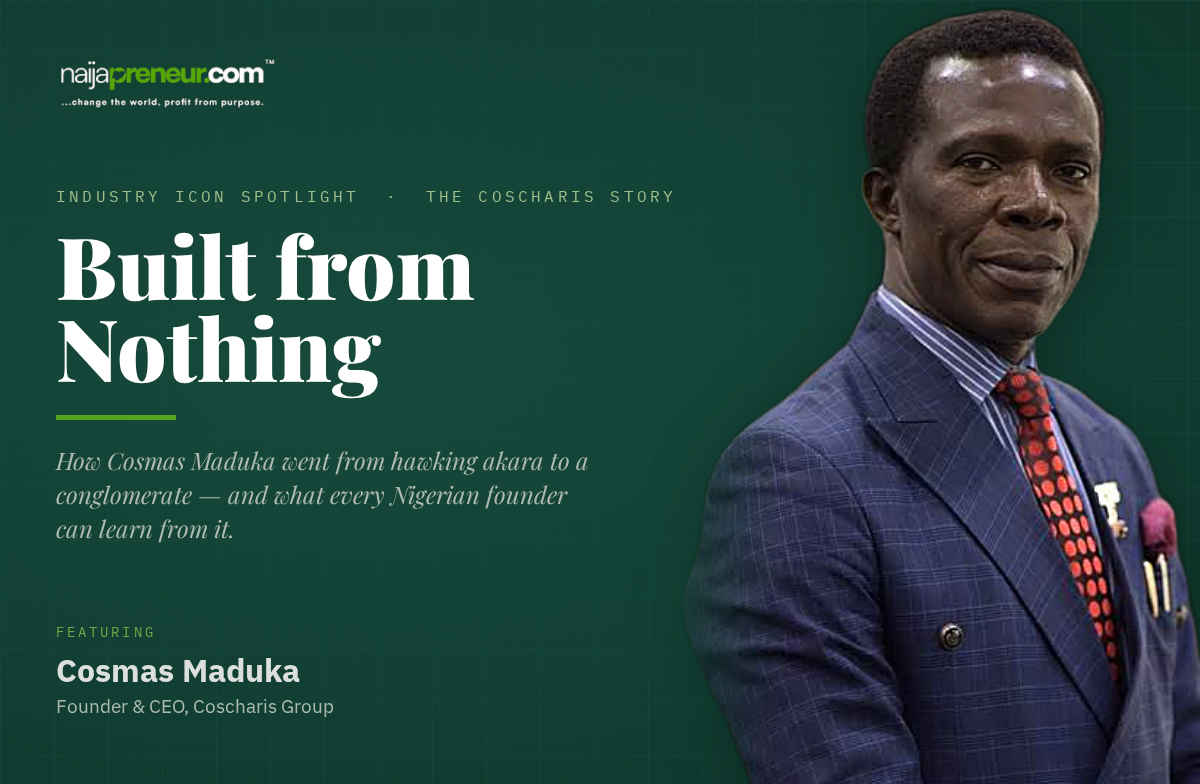
He was thrown out of his apprenticeship with ₦200 in his hand and a warning that his boss would live to regret it. Five decades later Cosmas Maduka runs a conglomerate — and the capital lesson he paid $200 million to learn is the one every Nigerian founder needs before they lend a single naira.
The Coscharis Case Study · A naijapreneur Insights feature
The Severance That Started Everything
Some time in the 1970s, in a spare-parts shop in the trading town of Nnewi, a teenage apprentice was handed ₦200 and told his service was over. The sum was a severance — worth less than a dollar today — and by the unwritten rules of the Igbo apprenticeship system, nothing about it was negotiable. His own brother told him not to take it. The young man took it anyway, looked at the uncle who had raised and then dismissed him, and made a promise he intended to keep.
“I deserve something better than this,” he said. “Five years from now, you will regret making this decision.”
That apprentice was Cosmas Maduka. He had no schooling past the age of six and no capital beyond the notes in his hand. What he had was a relationship with every major auto-parts wholesaler in the market, an almost unreasonable confidence, and a grievance he meant to convert into an empire. He did. But the more useful part of the story is not how he rose from ₦200 — it is the $200 million mistake he made once he had risen.
Meet Cosmas Maduka: A Breadwinner Before He Was Seven
Maduka was born in Jos on Christmas Eve, 1958. One of his happiest early memories is his father driving him to a colonial-era bakery to buy bread. Then, when Cosmas was four, his father died, the family returned to the village, and, in his own telling, life became rough. By six he had dropped out of primary school. By seven he was a breadwinner, hawking akara — bean cakes — that his mother fried and loaded onto trays.
He was, even then, a salesman. “On each occasion I would sell two trays before my brother could sell one,” he has said, “because if you refused to buy from me, I would hold your cloth. If you insisted you wouldn’t buy, I would tell you my mother said nobody says no to me.” His mother had told him he was the kind of person people struggle to refuse, and he believed her without reservation. “I have been living with that optimism that no door closes before me.”
The lesson is not the cliché that hardship builds character; hardship often just breaks people. It is that Maduka converted one specific disadvantage into one specific skill. A hungry child learned, at the actual point of sale, that confidence and relationship are what close a deal. He never unlearned it, and it is worth asking what the equivalent hard-won skill is in your own beginning — because that, not your disadvantage, is the asset.
What The Apprenticeship Really Gave Him
At around seven he was sent to serve as an apprentice — the ‘igba-boi’ system that has quietly produced more Nigerian industrialists than any business school on the continent — under an uncle who traded in motorcycle and automobile spare parts. He slept on the shop floor. He advocates the arrangement to this day: “Apprenticeship,” he says flatly, “is something I strongly advocate.”
What those years gave him was not only discipline. It was the supply side of the business. “In business, knowing where to buy is just as important as selling,” he has said. “You need to buy well to sell well, and I had a good relationship with all the major wholesalers.” When the apprenticeship ended with that ₦200, those relationships walked out of the door with him — the one part of the settlement his uncle could not claw back.
The lesson for founders is easy to miss because everyone is looking the other way. Most entrepreneurs obsess over customers and treat suppliers as interchangeable. In a trading economy, privileged, trusted access to stock — on the right terms, from people who know you — is frequently the entire margin. Your network of suppliers is an asset you are building whether or not you are paying attention to it.
From ₦200 to Coscharis
The rise was not a straight line, and it is more honest for it. He first went home and formed a venture with his brother. A later spare-parts partnership, CosDave, failed. Then, in 1977, Maduka founded Coscharis Motors with a few hundred naira, selling motorcycle spare parts. The name fused his own with his wife’s — Cosmas and Charity — whom he had married at twenty-one.
The breakthrough came in 1982, when the Nigerian government issued import licences to ten motor firms and Coscharis was among them. Maduka turned that single permit into one of the country’s most disciplined distribution operations, eventually becoming the authorised dealer for BMW, Ford, Range Rover and Jaguar, and later building a group spanning automobiles, ICT, petrochemicals, agriculture and healthcare across more than ten countries. In 2015 Forbes Africa put him on its cover as the man who turned a dollar into five hundred million.
The lesson hides under the licence, and it is not the licence. The permit was fortune as much as merit; plenty of the other nine firms are forgotten. What Maduka owned was the machinery around the product — sourcing, financing, service — run more reliably than anyone else’s. Distribution excellence is a moat no clever idea can jump, and it is the competence that later let a spare-parts trader credibly run a healthcare and petrochemicals group.
The $200-Million Lesson
Here the story turns, because the most expensive thing Cosmas Maduka owns is a mistake. Long after he was wealthy, he advanced roughly $200 million to a man he regarded as a younger brother — on the strength of relationship rather than security. The money did not come back. The loss nearly unwound decades of building, and it forced him to change, permanently, how he handled both capital and the people he loved.
Sit with the symmetry. The man whose fortune began with a ₦200 severance almost lost everything to a $200-million loan. The first taught him that relationship is an asset. The second taught him the harder, opposite truth: that relationship and capital are not the same thing, and that confusing the two is one of the most common ways good Nigerian businesses quietly die.
The lesson may be the single most useful one in this entire series. Separate the founder’s generosity from the company’s capital. Money lent on sentiment, without terms or security, is not a loan — it is a gift you have decided to pretend is coming back, and when it does not, it takes working capital, credibility and sometimes the whole enterprise with it. Lend like a bank, even to a brother, or plan to lose it. In an economy where ‘family and friends’ money flows in both directions and boundaries are blurry by default, that single discipline is the difference between generosity and ruin.
Faith, Frugality, And Staying In The Game
Two things kept the enterprise upright — through the loss, and through Nigeria’s serial currency shocks. The first is frugality: the reflex of a man who once slept on a shop floor, and the mechanism by which a business generates its own capital when external money is expensive and unreliable. The second is faith. Born Catholic and now a committed Pentecostal, Maduka preaches publicly and is entirely unembarrassed about it. “I’m comfortable preaching on the streets despite being a billionaire,” he says; his mother’s morning prayers, by his account, instilled the hunger that carried him.
Diversification does the same defensive work at the level of the group. A conglomerate spread across autos, ICT, petrochemicals, agriculture and healthcare can absorb a shock in any single sector — a devaluation, an import-policy reversal, a collapse in demand — without going under. In a stable economy, focus is a virtue; in Nigeria’s, deliberate spread is often a survival strategy. Charity, the other half of the name over the door and his partner for four decades, died in 2021.
A word on figures, in keeping with our standard: published estimates of Maduka’s net worth vary widely, and we deliberately avoid asserting a single number. The verifiable story — apprentice to industrialist, a couple of hundred naira to a multi-sector group, and the capital discipline forged by a catastrophic loss — is instructive regardless of the scoreboard.
What Nigerian Founders Should Take From Coscharis
A case study earns its place only if it transfers. Here is what Maduka’s story actually recommends.
If you are starting with almost nothing: begin anyway, with the asset you already have — a skill, a relationship, a reputation for closing. Maduka’s ₦200 was seed, not salary, and the confidence was worth more than the cash. Treat an apprenticeship — serving under someone who already does what you want to do — as the fastest and cheapest business education available, and mine it for the supply-side relationships that will outlast the role.
If you are already trading: build the supply side as deliberately as the sales side, because knowing where to buy, on trusted terms, is often the real margin. Master distribution — how a product is sourced, financed and serviced — before you chase diversification, then carry that competence into new categories rather than starting each one from scratch.
And once you have money to lose: separate generosity from capital. Write the terms, take the security, and be willing to say no to people you love. Diversify against a volatile economy so that no single shock can sink you, and let frugality — not vanity — be the engine that funds your growth. Character, in Maduka’s telling, is not a nice-to-have bolted onto the business. Over a long enough horizon, it is the business.
The Playbook: 8 Lessons for Nigerian Founders
01 Start with the asset you already have. — A skill, a relationship, a reputation for closing beats waiting for capital you don’t have.
02 Treat apprenticeship as an education. — Serving under someone who does what you want to do is the cheapest business school there is.
03 Know where to buy, not just how to sell. — In a trading economy, trusted access to stock is often the whole margin.
04 Master distribution before you diversify. — Own how a product is sourced, financed and serviced — then carry that competence into new categories.
05 Separate generosity from capital. — Lend like a bank, not a brother — write terms, take security, or plan to lose it.
06 Diversify against volatility. — Spread across sectors so no single shock can sink the group.
07 Make frugality your engine. — Internal discipline funds growth when external money is dear and unreliable.
08 Convert grievance into work. — Answer doubt with output, then outlast the people who wrote you off.
Five years after his uncle handed him ₦200 and showed him the door, Cosmas Maduka was, by his own account, doing well enough that the promised regret had arrived on schedule. But the number to study is not the ₦200 he rose from; it is the $200 million he nearly fell on. The first is a story about ambition, and ambition is common. The second is a lesson about money — and money, handled without discipline, is precisely how ambition ends. Take the inspiration by all means. But take the discipline first.
