

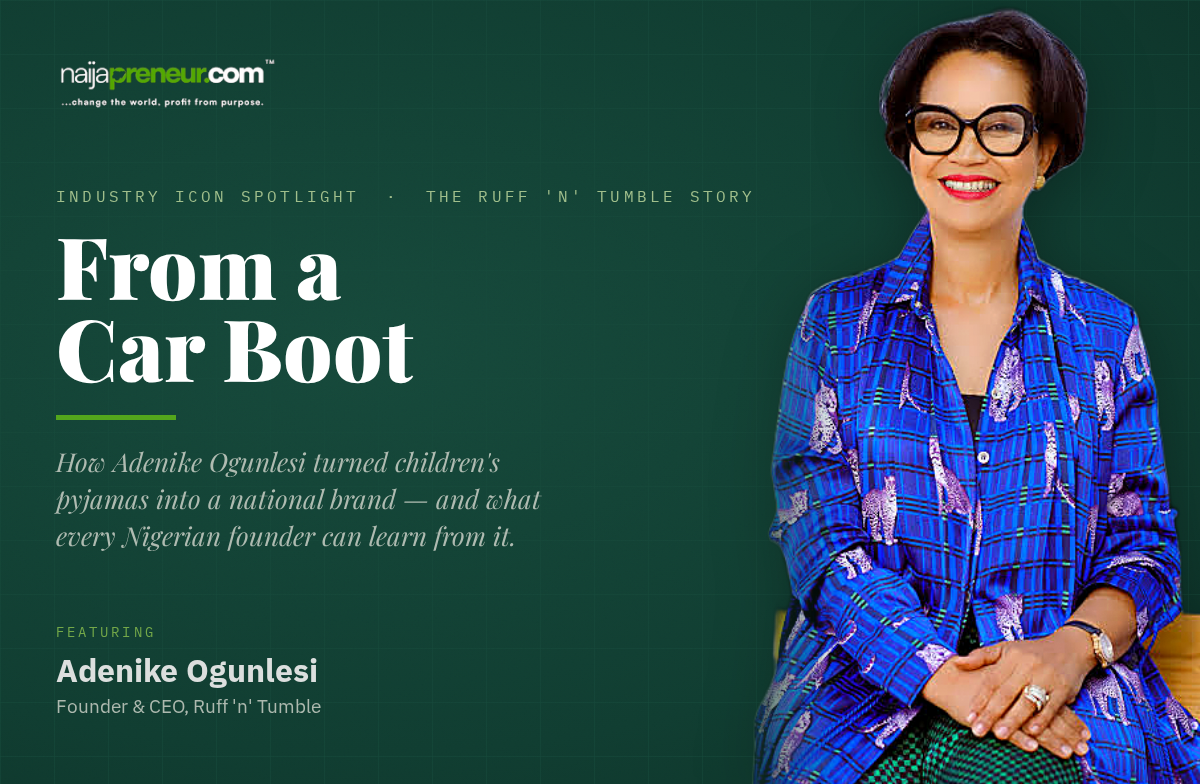
She made pyjamas for her three children in the rainy season of 1996 and sold them from the boot of her car. Three decades later Ruff ‘n’ Tumble clothes more than a million children — and of every story in this series, hers is the one an ordinary Nigerian founder can most readily copy.
The Ruff ‘n’ Tumble Case Study · A naijapreneur Insights feature
The Pyjamas That Started A Company
In the rainy season of 1996, Adenike Ogunlesi sat down to make her three young children a set of pyjamas. They were cotton, colourful, trimmed with lace and finished with a Peter Pan collar — and, as she noticed with a mother’s eye, there was nothing like them in the Nigerian market. Her sister-in-law saw them and ordered seven pairs. That single order was the entire beginning.
Ogunlesi began sewing more, and selling them the only way she could: from the boot of her car, at bazaars and local markets, showing her designs to anyone who would look. There was no inheritance, no licence, no investor and no grand plan — a mother, a sewing skill, a car, and a gap in the market. Three decades later, Ruff ‘n’ Tumble clothes more than a million children and runs stores across the country. Of every story in this series, hers may be the most replicable — which is precisely why it repays close study.
Whatever Your Hand Finds
She did not come to it from nowhere. Adenike Ogunlesi was born in Ijebu-Ode in 1959 to a Nigerian doctor and a Scottish mother, Betty Okuboyejo, who had come to Nigeria, fallen for the indigo-dyed adire cloth, and built a fashion label — ‘Betti-O’ — making distinctive men’s and women’s clothing from local fabric at a time when Western dress was in vogue. Adenike grew up as her mother’s apprentice, learning to cut and sew, absorbing what she calls her mother’s courage, standards and ‘creativity to build something from nothing.’
Her mother also handed her a line she still hears. “Whatever thy hand findeth, do with all thy might,” she would say — and, Ogunlesi has said, “my mother’s voice still echoes in my head today.” The work ethic came early and practical: at fourteen she took herself off to a family friend’s biscuit factory to earn pocket money. She went on to study law at Ahmadu Bello University in Zaria, and dropped out in her second year, unsure what to do with her life.
The lesson inverts the usual advice. Ogunlesi’s real inheritance was not the law degree she abandoned; it was the tailoring skill and the work ethic her mother had already given her. Most founders possess some equivalent — a craft, a discipline, something they can do with their hands or their head — and undervalue it precisely because it came easily, or came from home. That overlooked competence is very often the seed of the whole business.
She Found A gap, Not Just A Passion
It would be neat to say Ogunlesi simply followed her passion for sewing. What actually built the company was colder and more useful: she studied the market. Nigerian children’s clothing, she found, was either poorly made locally or imported and extremely expensive. Between shoddy and unaffordable sat a wide-open gap — well-made children’s clothes at a price aspirational Nigerian parents could pay — and she aimed the business straight at it.
That is the difference between a hobby and a company. A hobby is something you love to do; a business is something you love to do that also solves a specific, felt problem for a specific customer. Ogunlesi loved making clothes, but she built Ruff ‘n’ Tumble on a gap she had verified, for a customer she understood intimately — because she was that customer: a Nigerian parent who wanted better for her children than the market offered.
The lesson for founders is that passion keeps you going, but a verified gap is what you build on. Before you fall in love with your product, find the specific person whose specific problem it solves, and make sure that problem is real, felt, and currently unserved. Ogunlesi’s advantage was not only that she could sew — it was that she knew exactly who she was sewing for.
Build It To Be Passed Down
From the start the product carried a promise that doubled as a strategy: durability. “As a mother, durability is key,” Ogunlesi has said. “I didn’t want clothes that after two or three washes are finished.” Ruff ‘n’ Tumble built a reputation for clothes sturdy enough to be handed down from one child to the next — an unusual thing to promise in an industry that often quietly profits from things wearing out.
It was also a deliberately Made-in-Nigeria bet. Ogunlesi manufactures locally; the group’s production arm, Gatimo, is a working factory rather than a marketing line, in a market where the easy money is in importing. That choice is harder and slower, but it builds something an importer never owns: control of quality, local jobs, and a genuinely home-grown brand that parents come to trust.
The lesson: in a market flooded with cheap, disposable imports, quality and durability are not merely virtues — they are a defensible position. Make something built to last, manufacture it where you can, and back it with a local brand people trust, and you occupy ground that a container of cheap goods cannot take from you.
The Choice To Grow Slowly
There is a decision in Ogunlesi’s story that cuts against almost everything hustle culture preaches, and it deserves real attention. For years she deliberately slowed the growth of her company in order to be a present mother to her children. She could have scaled faster; she chose not to. “But I am glad and thankful for those years,” she says.
This is not a sentimental footnote. It is a strategic choice, honestly made — and the business did not merely survive it, it endured and then thrived, expanding steadily once her children were grown. In a culture that valorises the founder who sacrifices everything and burns out by forty, Ogunlesi is living evidence that a company can be built at a sustainable, human pace and still become a national brand.
The lesson fits this platform’s whole thesis: the goal is a business that lasts, not a sprint that consumes you. A slower compounding you can sustain for thirty years beats a frantic one that breaks you in five. Build the company around the life you actually want to live — not the other way around.
What Keeps Her Up At Night
Ask Ogunlesi what is genuinely hard, and she does not talk about design or demand. “The cost of finance and the running costs of a business as you grow — those are the things that primarily keep me up at night.” It is the most honest sentence a Nigerian manufacturer can utter. The gap she spotted was real and the product was right; the true constraint on scaling it has been the brutal cost of capital and the expense of running a real factory in Nigeria.
She has scaled anyway — to more than a dozen stores, over three hundred employees, an online presence, and, by the brand’s own count, more than a million children clothed — enough that Harvard Business School recorded her among the entrepreneurs who built Africa’s emerging markets. And she has stayed adaptable: when the pandemic shut the clothing trade, her factory pivoted to producing face masks.
The lesson: know your true constraint. For most Nigerian product businesses it is not demand or ideas — it is finance and the cost of operating. Plan for it deliberately. Price for it, manage cash tightly, keep the operation lean enough to survive dear money, and hold the flexibility to repurpose your capacity when the market shifts underneath you.
The Long, Unglamorous Middle
It is tempting to compress thirty years into a tidy arc — pyjamas, car boot, national brand — but the truth of Ruff ‘n’ Tumble is the long, unglamorous middle that the summary erases. For years Ogunlesi grew store by store, tailor by tailor, in an economy that offered her almost no help. As a young woman with no track record, she has said, no bank would lend her money, and she was constantly hamstrung by inadequate machinery. There was no venture capital, no viral launch, no overnight anything.
What there was, instead, was compounding — the slow, patient accumulation of a few more customers, a few more staff, a slightly larger workshop, year after year, decade after decade, until a company begun from a car boot employed hundreds and clothed millions. During the pandemic, when the clothing trade seized up, the same instinct kept her alive: her factory simply pivoted to producing face masks until the storm passed.
The lesson runs directly against the culture of overnight success. Most durable Nigerian businesses are not built in a dramatic sprint; they are compounded, quietly, over a very long time, by a founder stubborn enough to keep going when it is neither glamorous nor fast. Ogunlesi’s three decades are the point, not a delay before the point. Endurance is the strategy.
What Nigerian Founders Should Take From Ruff ‘n’ Tumble
A case study earns its place only if it transfers, and Ogunlesi’s transfers more cleanly than almost any other in this series — precisely because she started with so little. Here is what her story recommends.
Start with the skill you already have. Ogunlesi’s capital was a craft her mother taught her and a car to sell from. Audit what you can already do well, and begin there, now, at whatever scale you can afford — the first customer can be one sister-in-law and seven pairs of pyjamas.
Build on a verified gap, not just a passion, and know your customer because you are your customer. Then make durability and local trust your moat: where the market is full of cheap and disposable, being the quality, home-grown, trusted option is a position no importer can take from you.
Choose a pace you can sustain — a business you can run for thirty years without breaking will out-build a sprint that consumes you. And plan for the real constraint, which is finance: price for the cost of capital, guard your cash, keep the operation lean, and keep the flexibility to adapt your capacity when the market turns.
The Playbook: 8 Lessons for Nigerian Founders
01 Start with the skill you already have. — Your overlooked craft — the thing that came easily — is capital. Begin there.
02 Build on a verified gap, not just a passion. — Find the specific, felt, unserved problem before you fall in love with the product.
03 Know your customer because you are your customer. — Ogunlesi built for the Nigerian parent she already was.
04 Make durability and local trust your moat. — Quality that lasts beats a container of cheap imports.
05 Manufacture where you can. — Own quality, jobs and brand instead of reselling someone else’s goods.
06 Choose a sustainable pace. — Build to last, not to burn out — design the business around the life you want.
07 Plan for the real constraint: finance. — Price for the cost of capital and guard your cash.
08 Stay adaptable. — Repurpose your capacity when the market shifts — masks when clothes won’t sell.
Ruff ‘n’ Tumble began with a set of children’s pyjamas and the boot of a car, and that is the whole reason it matters. There was no oil block, no import licence, no family fortune — only a woman with a skill her mother gave her, a gap she took the trouble to verify, and the patience to build at a pace she could sustain. Most Nigerian founders will never have Dangote’s capital or Alakija’s luck. Almost all of them could start exactly the way Adenike Ogunlesi did. “Whatever thy hand findeth,” her mother told her, “do with all thy might.” It remains the most practical business advice in this entire series.
