

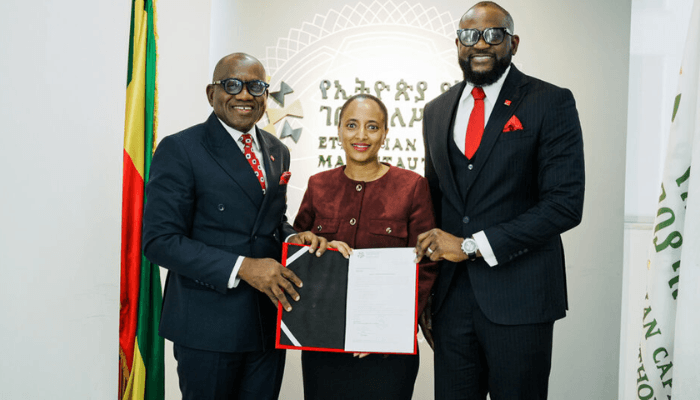
The structural barriers dividing Africa’s capital markets are beginning to dissolve. In a landmark development for cross-border financial expansion, the Ethiopian Capital Market Authority (ECMA) has officially granted an investment banking license to Nigerian financial powerhouse United Capital Group.
The license, formally issued on June 5, 2026, and announced by regulators on June 8, 2026, authorizes the Nigerian firm to operate through its newly formed, wholly-owned local subsidiary: United Capital Financial Services PLC, based in Addis Ababa.
The move marks the first time in modern history that Ethiopia has permitted a foreign financial institution to set up an investment banking subsidiary. This development signals a major shift in Prime Minister Abiy Ahmed’s long-term strategy to liberalize the country’s tightly controlled, state-backed economy.
The Capital Committal and Regulatory Clearance
Breaking into a newly liberalized financial market requires significant capital commitment and strict corporate alignment. To back its entry into East Africa, United Capital Group has deployed an initial capital pool of over $1.5 million USD directly into its Addis Ababa operations.
The licensing process was not just a simple application, but required months of cross-border regulatory vetting involving the ECMA, the Ethiopian Investment Commission, and the Securities and Exchange Commission (SEC) of Nigeria.
ECMA Director General Hana Tehelku noted that the authority conducted extensive due diligence, including deep compliance checks with Nigerian financial authorities, before approving the firm to operate under its investment banking category. Additionally, the regulator approved five incoming board directors and four authorized representatives to manage local market operations.
Deepening a Nascent Capital Market
Ethiopia’s capital market ecosystem is in its early stages of development but expanding rapidly. The formal setup of the Ethiopian Securities Exchange (ESX) has gained momentum with high-profile listings, including state-owned monopoly Ethio Telecom alongside commercial entities like Wegagen Bank, Gadaa Bank, and Awash Bank.
The entry of a seasoned operator like United Capital is expected to provide essential financial architecture for this young exchange:
-
Sovereign and Corporate Debt Issuance: Structuring local currency corporate bonds and municipal debt instruments to finance infrastructure.
-
Equity Underwriting Pipelines: Managing the upcoming wave of Initial Public Offerings ($\text{IPOs}$) as state-owned enterprises move toward privatization.
-
Asset and Wealth Management: Building structured investment products, including collective investment schemes (mutual funds) to mobilize domestic retail savings.
To ensure this entry supports the local economy, the license includes a knowledge-transfer mandate. United Capital Group, led by CEO Peter Ashade, has committed to hiring, training, and upskilling local Ethiopian analysts and compliance officers, helping build a stronger pool of local investment banking talent.
The Broader Financial Liberalization Landscape
United Capital’s entry brings the total number of licensed capital market service providers in Ethiopia to 18, with investment banks climbing to seven. This initial opening is part of a broader macroeconomic overhaul designed to dismantle decades of financial isolation.
This market opening is spreading to other sectors as well. In April 2026, the National Bank of Ethiopia proposed a regulatory framework to open up the insurance industry, setting foreign equity ownership caps at 40% to 49%.
By allowing a premier pan-African firm like United Capital to build a base in the country, Ethiopia is sending a clear message to global investors. The country is moving away from closed, state-managed systems toward an open, integrated financial ecosystem capable of attracting the international capital needed to drive long-term economic growth.
