

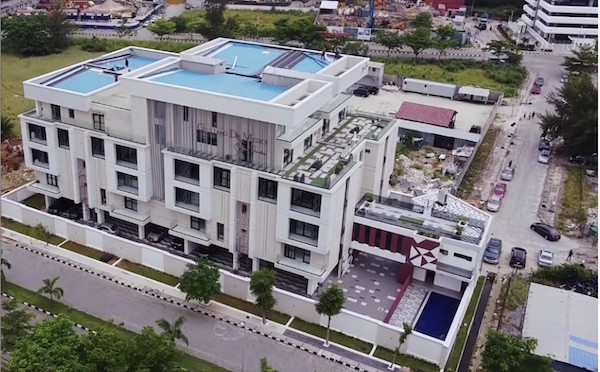
In the global landscape of luxury real estate, institutional capital and high-net-worth individuals ($\text{HNWIs}$) are increasingly diversifying their property portfolios away from legacy Western enclaves like Calabasas, Beverly Hills, and Palm Beach. Instead, a significant volume of luxury capital is flowing toward the West African seaboard—specifically to a highly exclusive, man-made crescent of sand off the coast of Lagos, Nigeria: Banana Island.
Nestled within Lagos’ highbrow Ikoyi district, this ultra-exclusive enclave has evolved into one of the most expensive and secure pieces of real estate on the planet. The island stands as a physical manifestation of concentrated private equity, elite corporate networks, and the scaling of Africa’s industrial wealth.
The Architecture of a Sovereign Sandfill
Banana Island is an engineering marvel that highlights the potential of public-private land reclamation. The landmass has no single corporate owner, operating instead under standard Lagos State real estate regulations and private title allocations.
The master plan was originally conceived in the early 1980s by the late Nigerian civil engineer and developer, Chief Adebayo Adeleke, under the working title “Lagoon City.” After legal and boundary friction left the project temporarily frozen, a major international business conglomerate, the Chagoury Group, stepped in.
Partnering with Nigeria’s Federal Ministry of Works and Housing, the Chagoury Group executed a massive sand-filling operation that reclaimed approximately 1,630,000 square meters of land from the Lagos Lagoon, transforming a swampy stretch into Africa’s most secure financial sanctuary.
The Utility Premium: Infrastructure over Aesthetics
While the island features high-end architectural designs, its true real estate premium is driven by its self-sustaining infrastructure. Unlike other parts of the Lagos metropolis that struggle with municipal service gaps, Banana Island was engineered as an autonomous utility zone:
-
Underground Grid Subsystems: All electrical and satellite telecommunications cabling are routed entirely underground, eliminating the overhead wiring systems common in sub-Saharan urban centers.
-
Autonomous Utility Plants: The estate runs on an independent water supply network and a dedicated central sewage treatment infrastructure.
-
Zoning Discipline: Strict building codes prevent residential structures from exceeding three stories, preserving high property valuations and preventing neighborhood overcrowding.
The HNWI Ecosystem: Corporate and Media Capital
The island’s master layout is divided into 536 heavily guarded plots, creating an elite residential concentration that minimizes security risks for its high-profile occupants. Its resident profile serves as a directory of West Africa’s primary capital drivers:
-
Aliko Dangote: The billionaire Chairman of the Dangote Group utilizes his presence in the enclave to anchor an aggressive industrial vision, which includes the massive Dangote Petroleum Refinery in Lagos—currently scaling up its production capacity.
-
Mike Adenuga: The telecom and oil tycoon operates his multi-billion-dollar empire, including Globacom and Conoil Plc, from Lagos. His infrastructure achievements include independently laying the Glo-1 transatlantic submarine fiber-optic cable, linking West Africa directly to the United Kingdom.
-
David Adeleke (Davido): The global music icon and entrepreneur represents the monetization of Africa’s creative economy. Alongside his multi-million-dollar real estate holdings on Banana Island, the artist is actively expanding his asset portfolio by constructing a massive 16-bedroom waterfront palace in the neighboring Eko Atlantic City development.
-
Dr. Iyabo Obasanjo & Linda Ikeji: Representing high-level investment diversification, Obasanjo has channeled capital into premium hospitality and real estate projects within the zone, while media tech pioneer Linda Ikeji converted early digital blogging revenues into fixed-asset wealth by acquiring a multi-million-dollar mansion inside the estate.
The Macro Valuation Ceiling
The intense concentration of domestic and international billionaires keeps property valuations exceptionally stable, insulating the island from broader macroeconomic fluctuations. While a luxury flat on the island can easily command over $400,000 USD at launch, the peak of Lagos’ luxury market sits just across the water in Ikoyi proper.
There, the continent’s most expensive private residence—a massive corporate and residential skyscraper owned by Africa’s richest woman, oil tycoon Folorunsho Alakija—is valued at an estimated $165 million to $700 million USD (representing over ₦100 billion).
As international developers like Sujimoto Construction continue to launch high-rise luxury towers like the Lucrezia and the Leonardo on the island, Banana Island continues to solidify its role as a key financial asset class for global real estate investors.
