

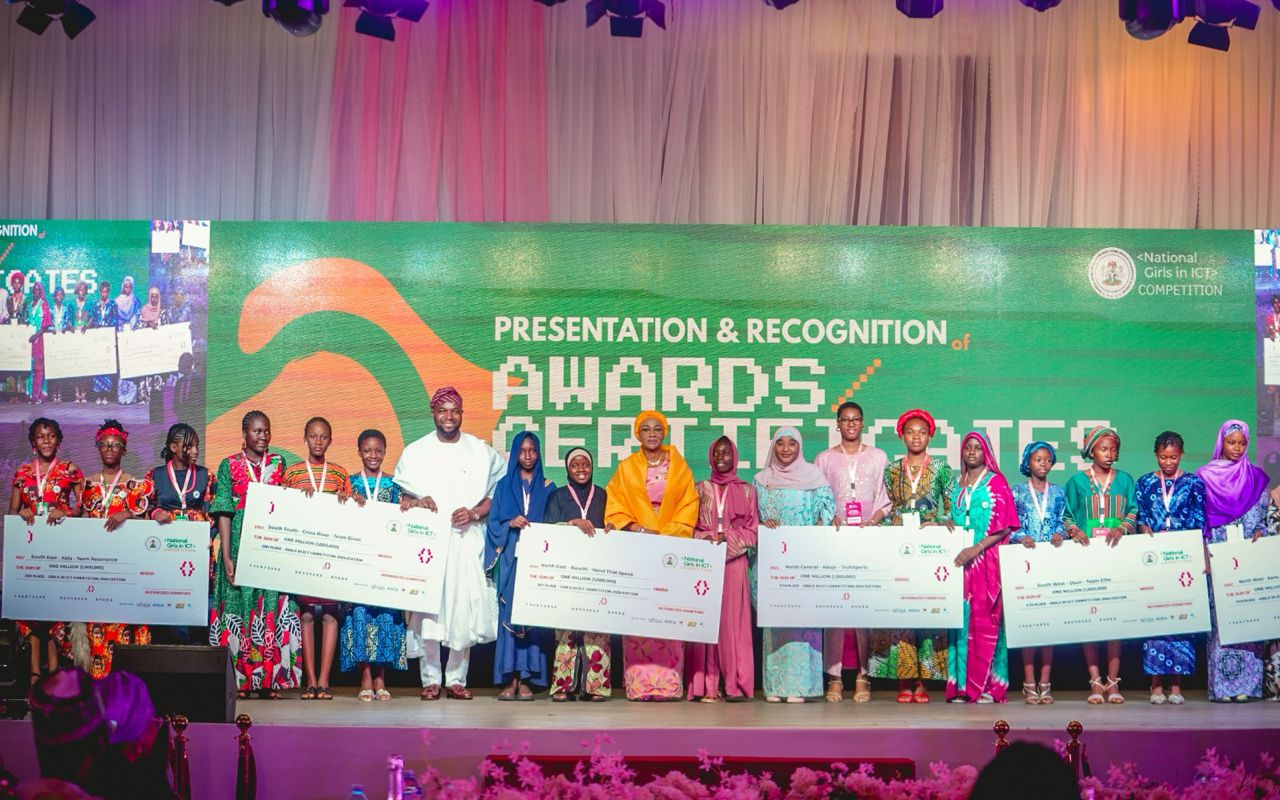
Nigeria’s strategic push to build a highly competitive digital economy has reached a new milestone. In a coordinated effort to bridge the digital gender divide and scale the country’s domestic tech talent pool, the Federal Ministry of Communications, Innovation & Digital Economy has successfully trained and empowered over 3,700 young women through the 2026 National Girls in ICT Competition.
The nationwide tech tournament, now in its fourth edition, concluded its grand finale at the Nigerian Communications Commission (NCC) Annex in Abuja. The event culminated in a celebratory dinner at the Presidential Villa, where First Lady Senator Oluremi Tinubu and the Minister of Communications, Innovation & Digital Economy, Dr. ‘Bosun Tijani, gathered to review the digital solutions developed by the participants.
The Winning Innovation: Digital Health Accessibility
The competition featured regional finalist teams from all six geopolitical zones. These teams advanced through months of rigorous technical training, product mentoring, and hackathon challenges aimed at building functional software applications to solve real-world problems in healthcare, agriculture, education, and public service.
At the end of the technical pitch sessions, “Hands that Speak”—a team representing the North East from the Special Education Centre in Bauchi State—emerged as the overall national champion.
The team secured the top spot by developing SignCare, a digital health accessibility platform. The software functions as a real-time translation bridge, removing communication barriers between deaf patients and healthcare providers to ensure accurate medical diagnoses and treatment.
The Macroeconomic Imperative: Talent Redistribution
For Nigeria’s technology sector, closing the gender gap is a vital economic goal. Industry data indicates that expanding female participation in Science, Technology, Engineering, and Mathematics (STEM) fields could significantly accelerate gross domestic product (GDP) growth.
Addressing the delegates, Minister ‘Bosun Tijani emphasized that the widespread geographic participation proves that high-level innovation is not confined to traditional tech hubs like Lagos or Abuja:
“The depth of these presentations reminds us of a core economic reality: talent is evenly distributed across every region of Nigeria, but opportunity is not. Building an inclusive digital economy is both a social responsibility and a commercial necessity if we want our tech ecosystem to compete globally.”
Scaling the National Code Clubs Initiative
To sustain the momentum generated by the competition, First Lady Senator Oluremi Tinubu highlighted the federal government’s ongoing deployment of the Code Clubs initiative. Run in partnership with the Ministry of Communications, Innovation & Digital Economy, this program integrates early-stage computer science, data analytics, and software engineering clubs into primary and secondary schools across the country.
By building a predictable, structured pipeline of young female software engineers, product designers, and tech entrepreneurs, Nigeria is laying the groundwork to lower youth unemployment, boost domestic software production, and solidify its position as Africa’s primary capital destination for digital innovation.
