

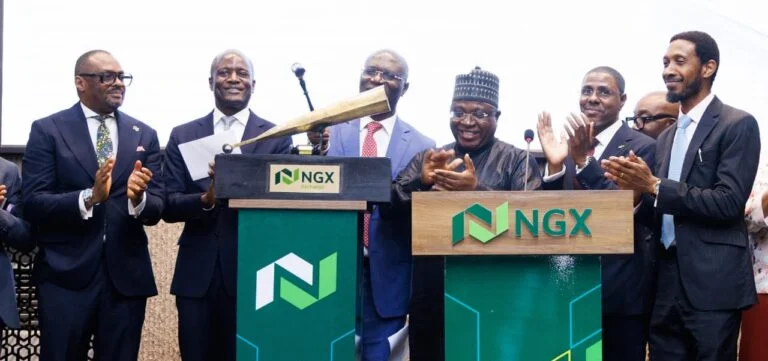
Nigeria’s financial ecosystem has secured a major competitive advantage in the race for global investment. The Nigerian capital market has successfully executed a structural transition from a $T+2$ to a $T+1$ settlement cycle, making it the very first securities market on the African continent to deploy the shortened post-trade framework.
Announced at an industry ceremony in Lagos, the transition means that trades executed on the local exchange will now settle—meaning the final transfer of cash to the seller and securities to the buyer—in just one business day after the transaction date ($T+1$), instead of two ($T+2$).
The Mechanics of the Shortened Cycle
The rapid migration was completed in a tight six-month timeline, requiring a total overhaul of processing windows across the entire capital market network.
The Director-General of the Securities and Exchange Commission (SEC), Dr. Emomotimi Agama, characterized the launch as a definitive turning point for the nation’s financial architecture. Agama emphasized that adopting $T+1$ aligns Nigeria with elite global financial hubs—such as the United States, Canada, and India—which have shortened their settlement timelines to lower market risks, remove transaction friction, and boost international investor confidence.
Eliminating Systemic and Counterparty Risk
In capital markets, time equals risk. The longer a transaction hangs in a pre-settlement limbo, the higher the probability of market fluctuations, broker defaults, or systemic shocks disrupting the trade.
Shehu Shantali, Managing Director and CEO of the Central Securities Clearing System (CSCS) Plc, explained that this transition is a massive upgrade to the core architecture of the post-trade ecosystem. By cutting the settlement window by 50%, the market drastically reduces overall settlement exposure, prevents capital from being locked up in clearing pipelines, and frees up billions in daily transactional liquidity.
A Coordinated Institutional Leap
This market milestone was achieved through intensive, industry-wide preparation. For six months, a technical steering committee synchronized operational systems across multiple market participants:
-
Regulators & Exchanges: SEC Nigeria and NGX Group aligned oversight frameworks.
-
Depositories & Custodians: CSCS Plc upgraded its clearing engines to handle compressed clearing windows.
-
Registrars & Brokers: Local broker-dealers automated their middle-office and compliance workflows to prevent trade fails.
Alhaji Umaru Kwairanga, Group Chairman of NGX Group, noted that the upgrade proves the collective capability of Nigeria’s financial institutions to pull off complex structural reforms. Concurrently, Temi Popoola, Chairman of CSCS Plc, stated that while the $T+1$ launch is a historic win, it serves as a stepping stone toward building a deeper, highly liquid, and globally competitive capital market capable of driving long-term economic growth.
