

The Federal Government has moved to aggressively de-risk and promote made-in-Nigeria products across the continent.
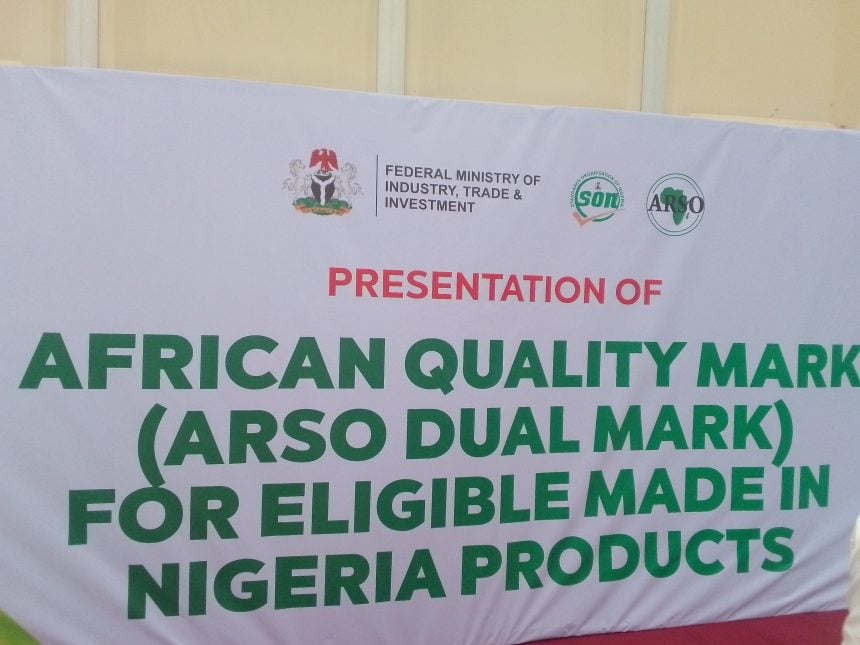
In a coordinated push to eliminate non-tariff barriers, the Standards Organisation of Nigeria (SON) and the African Organisation for Standardisation (ARSO) have presented the prestigious Africa Quality Mark (AQM) certification to 131 domestic companies, covering 220 manufactured goods.
The joint certification serves as an official regulatory endorsement, validating that these verified domestic products comply with harmonized African industrial standards. This alignment allows local manufacturers to confidently export their output under the African Continental Free Trade Area (AfCFTA) agreement without facing disruptive customs delays or duplicate testing protocols at foreign ports.
Eliminating the Multiple Certification Penalty
Historically, one of the most severe financial headwinds facing West African exporters has been the lack of unified product testing. A manufacturer exporting from Lagos to Accra or Nairobi was routinely forced to pay for separate, expensive product certifications in each destination country due to inconsistent national quality frameworks.
Dr. Ifeanyi Chukwunonso Okeke, Director General and Chief Executive of SON, explained that standard harmonization is the primary mechanism required to dismantle these technical barriers to trade.
By implementing the AQM framework, African regulatory bodies are providing a single, unified blueprint for production and conformity assessment. This ensures that a product certified in Nigeria gains immediate regulatory clearance and market acceptance across all participating AfCFTA member states.
The Macro Strategy: Scaling Local Value Addition
Speaking at the high-level award ceremony in Abuja, the Minister of Industry, Trade and Investment, Dr. Jumoke Oduwole, emphasized that industrial competitiveness relies heavily on cross-border confidence.
The administration of President Bola Ahmed Tinubu is anchoring its economic policy on four core industrial pillars:
-
Manufacturing Expansion: Providing a stable environment to increase factory utilization rates.
-
Investment Promotion: Attracting foreign direct investment () into local manufacturing hubs by demonstrating high compliance capabilities.
-
Local Value Addition: Shifting the economy away from exporting raw materials and toward processing finished, consumer-ready goods.
-
Continental Market Domination: Positioning Nigerian businesses to capture a dominant share of the single continental market.
Strengthening the National Quality Infrastructure
To maintain this export momentum, the Chairman of the Standards Council of Nigeria, Hon. Yahuza Ado Inuwa, confirmed that the council is increasing capital deployment toward the country’s national quality infrastructure.
SON is currently expanding its nationwide awareness and compliance training programs to help more rural and urban small-scale manufacturers achieve export readiness. By instilling strict quality discipline across local supply chains, the agency aims to build a highly competitive, quality-driven economy capable of boosting non-oil export revenues and driving sustainable industrial growth.
