

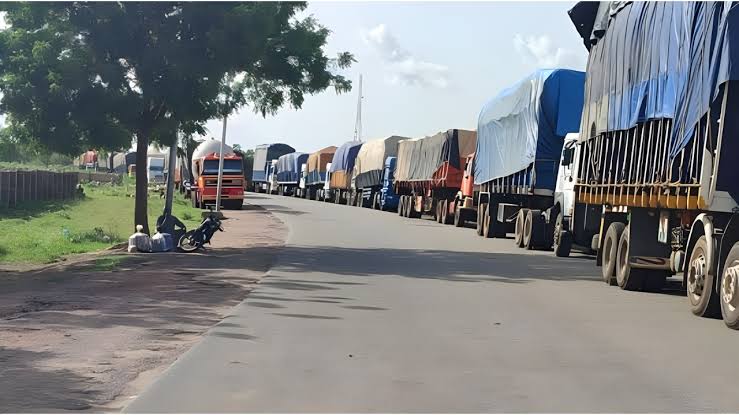
The National Boundary Commission (NBC) of Nigeria has intensified its diplomatic push for complete border delimitation along the West African transit corridor. The commission stated that finalizing structured border governance is critical to unlocking formal cross-border trade, strengthening sub-regional security, and stabilizing the informal trade ecosystems that support frontier communities.
The declaration was made by the Director-General of the NBC, Adamu Adaji—represented by the Head of Cross Border Cooperation, Dr. Farouk Tarfa—during a high-level, two-day Cross Border Cooperation Programme held along the Nigeria-Benin and Benin-Togo borders. The bilateral exercise was hosted and coordinated by the Director-General of the National Boundary Commission of the Republic of Benin, Dr. Yousouf Adams.
Deconstructing Colonial Gaps to Enable Formal Commerce Adaji pointed out that the structural ambiguity of many African borders inherited from the colonial era continues to act as a significant non-tariff barrier to intra-African trade. By leaving international lines unclarified, West African states inadvertently restrict formal commercial freight while allowing informal, unregulated extraction loops to thrive.
The bilateral program emphasized that clear demarcation is not a tool for economic separation, but rather the foundation for institutional trade integration:
-
Sovereignty Reaffirmation: Operating within African Union protocols, both nations reaffirmed their commitment to colonial-era treaties while using modern geographic information systems (GIS) to resolve outstanding territorial disputes peacefully.
-
Community Resilience Pipelines: Shifting the role of border towns from neglected security zones into active, structured Special Economic Zones (SEZs) capable of hosting shared markets and manufacturing facilities.
Mobilizing International Development Capital A key financial focus of the summit was an appeal to the German International Cooperation (GIZ). The NBC called for sustained financial and technical support from the German agency to complete the physical and digital demarcation of the Nigeria-Benin international boundary.
By securing GIZ funding, the boundary commissions intend to deploy high-precision tracking pillars and establish harmonized border posts. This infrastructure upgrade is designed to eliminate illegal transit checkpoints, reduce customs processing times under the African Continental Free Trade Area (AfCFTA) framework, and lower cross-border logistics costs for micro, small, and medium-sized enterprises (MSMEs) operating along the Lagos-Abidjan highway corridor.
