

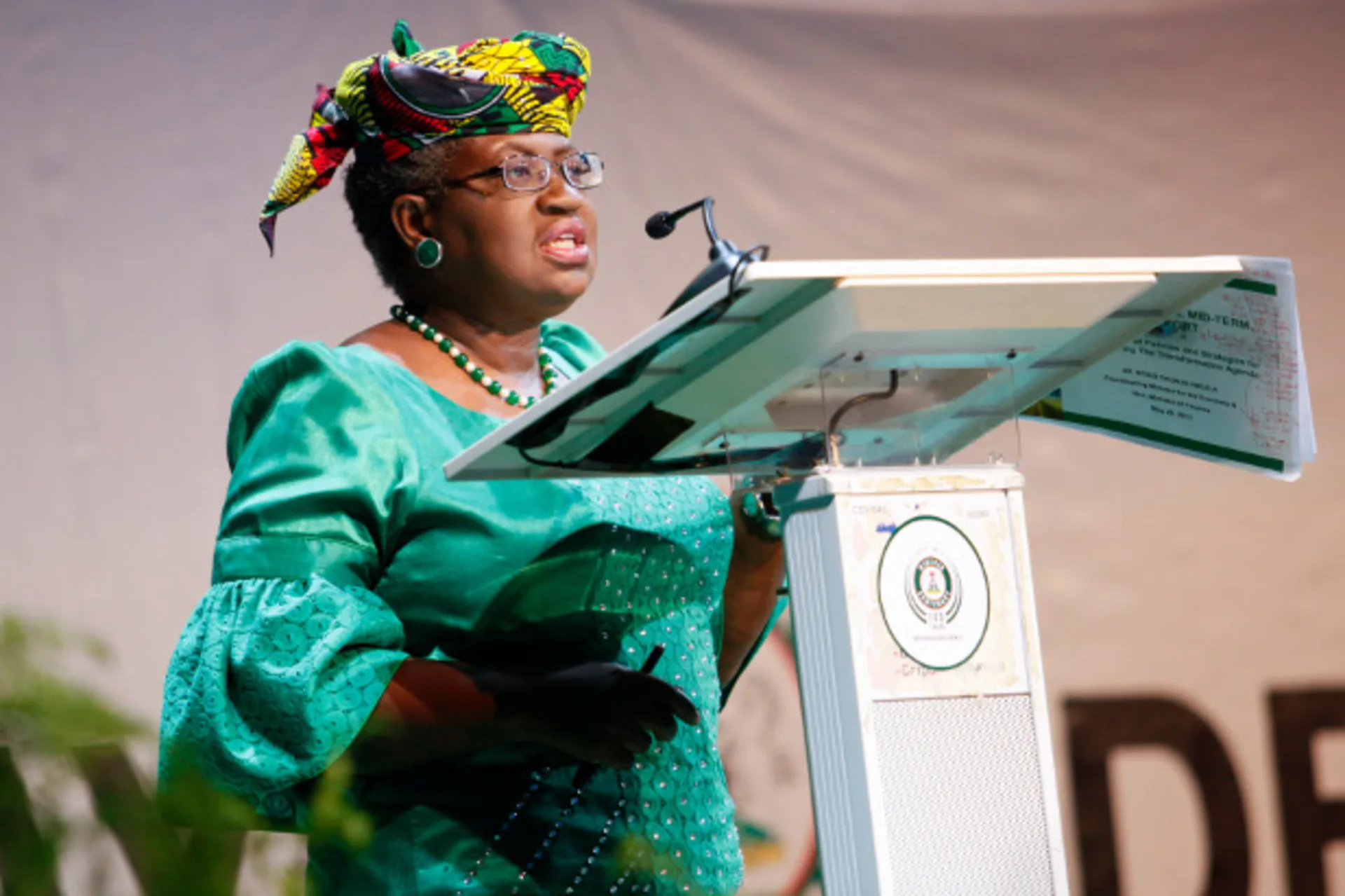
Nigeria’s economic revival hinges on staying the course with current policy overhauls while treading carefully on new debt obligations, according to the World Trade Organization’s chief, Dr. Ngozi Okonjo-Iweala. Speaking at a high-level gathering in Abuja, the WTO Director-General emphasized that fiscal discipline must go hand-in-hand with tangible improvements in the daily lives of ordinary citizens.
The former Nigerian finance minister made these remarks during an intimate fireside dialogue with Central Bank Governor Olayemi Cardoso at the 7th Africa Emerging Markets Forum. The event, hosted by the CBN in partnership with the Emerging Markets Forum and the Centre for the Study of the Economies of Africa, carried the theme Building Resilience Amidst Geoeconomic Uncertainties.
While applauding the Central Bank’s ongoing monetary and exchange-rate policy shifts, Okonjo-Iweala sounded a clear note of caution: Nigeria must not lose sight of the human dimension of its reform agenda. “The nation must persist with its broad macroeconomic restructuring, but always with a watchful eye on fiscal prudence, how it takes on new loans, and how it manages existing liabilities,” she stated. “Above everything else, the priority must be generating employment and unlocking economic doors for a restless, youthful population. The dividends of these changes must become visible and felt in the real economy—not just on spreadsheets.”
Shifting to the global stage, the WTO chief offered a surprisingly upbeat assessment of international commerce. Despite ongoing geopolitical friction and policy whiplash, she revealed that the combined value of global trade in goods and services hit an unprecedented $34.65 trillion in 2025—a robust seven-percent jump from the prior year. She pushed back against doomsday predictions of a fractured trading world, pointing out that roughly 72 percent of all merchandise trade still operates within the framework of WTO rules.
For Africa, she identified a golden window of opportunity. As multinational corporations scramble to diversify their supply chains away from traditional hubs, the continent’s vast deposits of critical minerals position it as a prime beneficiary. However, she warned that simply digging up resources and shipping them abroad is a losing strategy. “The extract-and-export model is outdated,” she argued. “The real prize lies in graduating to higher-value production, boosting productivity, and knitting together sub-regional industrial networks that process raw materials right here at home.” She cautioned that if Africa hesitates, this window could slam shut permanently.
Echoing her sentiments, CBN Governor Cardoso reframed the current global turbulence as a launchpad rather than a liability. He noted that shifting trade blocs, increasingly selective foreign investment, and the lightning-fast rise of artificial intelligence are redrawing the economic map. “For emerging markets like ours, the pressing question is no longer whether the world order is transforming—it is whether we can convert that transformation from a vulnerability into a shared prosperity,” he declared.
Cardoso also zeroed in on a persistent sore point: intra-African commerce barely scratches 16 percent of the continent’s total trade. To change this, he called for urgent upgrades to transportation corridors, synchronized customs procedures, frictionless cross-border payment systems, and a genuine push to operationalize the African Continental Free Trade Area (AfCFTA) in a way that delivers measurable results.
