

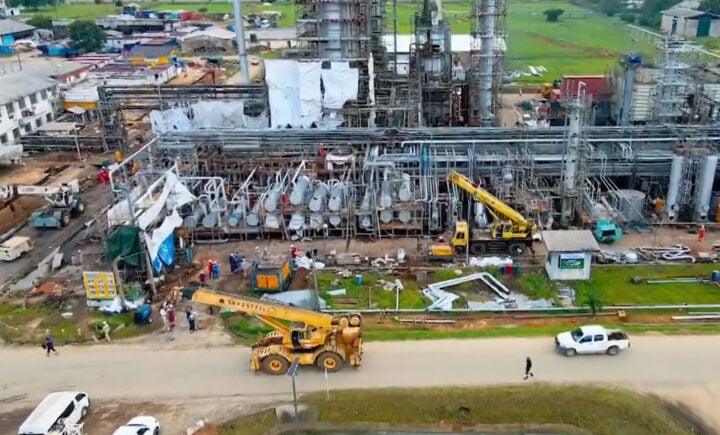
Following a series of costly, failed historical Turnaround Maintenance (TAM) initiatives—which saw the Federal Government sink a staggering $1.5 billion into the Port Harcourt refinery and $897 million into the Warri facility in 2021 with little to no commercial product output—the Nigerian National Petroleum Company Limited (NNPC Ltd) is testing a new strategy.
The state oil firm, under the leadership of Group Chief Executive Officer Engr. Bashir Bayo Ojulari, has bypassed traditional service contract models by signing a landmark Memorandum of Understanding (MoU) with two Chinese consortiums: Sanjiang Chemical Company Limited and Xinganchen (Fuzhou) Industrial Park Operation and Management Company Ltd.
The agreement establishes a framework for a potential Technical Equity Partnership. Under this model, the Chinese partners are expected to bring both engineering expertise and direct investment capacity, tying their ultimate corporate returns directly to the operational efficiency and daily processing output of the refineries.
The Looming ₦5 Trillion Creditor Overhang
While policy analysts debate whether the state-owned facilities should be completely privatized or scrapped, the NNPC faces an immediate financial hurdle: a massive ₦5 trillion accumulated debt stock owed to an extensive network of local contractors, engineers, and secondary creditors who worked on previous rehabilitation phases.
Reports indicating that previous funding lines were suspended due to chronic project delays have fueled deep anxiety among local contractors. For these cash-strapped domestic service providers, ongoing public debates regarding the ultimate fate of the refineries are a distraction; their immediate priority is the liquidation of this massive debt overhang.
The decision by Ojulari’s executive team to bring in fresh international technical partners serves as a clear acknowledgment that the legacy contracting frameworks failed to deliver on time or within budget.
Moving from ‘Political Refining’ to Cash-Driven Asset Utility
The skepticism of the Nigerian public regarding further state spending on these moribund assets is heavily shaped by the emergence of a new, highly efficient private refining landscape. The mega-scale Dangote Refinery along with a growing cluster of agile, modular refining plants across the country have radically altered domestic supply dynamics. These private facilities are already demonstrating they can meet local fuel demands while producing higher-value products for international export.
Consequently, the NNPC-China alliance cannot simply mimic basic fuel processing. To justify their rehabilitation, the state-owned refineries must switch from a model of “political refining”—where assets are kept on life support to protect bureaucratic jobs—to a highly commercialized “refining for cash” business model.
Modern downstream energy economics dictates that standalone fuel processors face highly volatile margins. To ensure long-term commercial viability, the Chinese technical partners will need to expand the structural utility of the Port Harcourt and Warri complexes by transforming them into integrated energy hubs. This strategy requires building out co-located petrochemical plants, capturing secondary liquid fractions, and establishing gas-based industrial zones.
Host-Community Symbiosis and the Localization Mandate
Beyond pure process engineering, the revived downstream architecture must address a long-standing structural failure: the lack of local economic integration.
When the Port Harcourt refinery was built in the Eleme area in 1965, it operated as an insular corporate enclave. Over sixty years later—and despite the passage of the landmark Petroleum Industry Act (PIA) of 2021—very few businesses in the host community enjoy functional down-stream supply links or raw material off-take agreements with the plant. The incoming technical equity framework must operationalize the host-community trust funds mandated by the PIA, building local industrial clusters that turn regional oil production into direct community wealth.
Ultimately, this Chinese-backed intervention presents a dual test for the Ojulari-led NNPC directorate:
-
Asset Recovery Proof: Demonstrating to highly skeptical financial markets that these legacy state assets can be successfully recovered and operated at a profit.
-
The Sovereign Technology Transfer: Ensuring that this reliance on multinational engineering firms is the definitive final chapter. The operational framework must include strict knowledge-transfer clauses, guaranteeing that the long-term maintenance, digital control room operations, and future turnaround servicing are handled entirely by upskilled, highly capable Nigerian engineers.
