

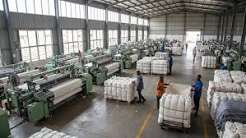
Nigeria’s struggling garment and textile sector is showing early signs of a turnaround, recording a 45% increase in domestic production.
Driven by rising local demand, expanding small-and-medium enterprises (SMEs), and public policy support, local factories are expanding their lines to produce workwear, T-shirts, trousers, and jerseys. Central to this resurgence is the Federal Government’s National Cotton, Textile and Garment Industrial Transformation Program (NCTG-ITP)—a structured initiative designed to rebuild the complete “farm-to-fashion” value chain and curb the nation’s multi-billion dollar apparel import bill.
The Pilot Proof of Concept
To prove that domestic manufacturing can compete on cost and quality with imported apparel, the Ministry of Industry, Trade and Investment completed a six-month pilot program that produced 10,000 finished T-shirts using 100% locally grown, long-staple Nigerian cotton.
The pilot demonstrated that when cotton farmers, ginneries, textile mills, and garment manufacturers are linked in a synchronized supply chain, local factories can produce high-quality garments at market-competitive prices.
Key Drivers & Structural Roadblocks
While the policy momentum is picking up, the sector faces a distinct contrast between garment assembly growth and primary textile mill decay:
The Road Ahead
Rebuilding the sector from the ground up requires more than successful pilot runs. To move beyond assemble-only garment making, the government is launching a multi-phase roadmap focused on reviving dormant industrial assets in historic hubs like Kaduna, upgrading SME machinery, and establishing specialized Cotton-Textile-Garment (CTG) industrial parks.
While full recovery remains a long-term journey, the 45% production bump confirms that structured demand can reignite one of Nigeria’s most vital industrial sectors.
