

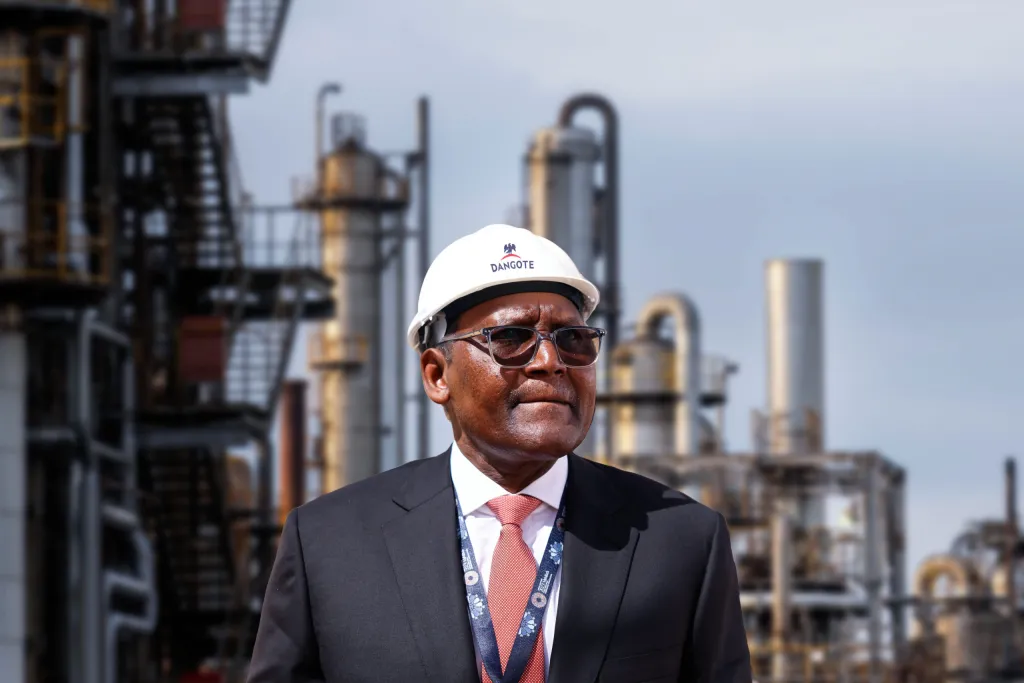
The conventional blueprint for an oil-refining facility in a petro-state is highly predictable: build it at the tail end of a domestic pipeline, feed it a singular, local stream of crude, and supply the immediate domestic market.
Nigeria’s massive Dangote Refinery is explicitly abandoning that script.
According to the facility’s Chief Executive Officer, David Bird, the Lagos-based energy giant is aggressively expanding its operational capacity to handle up to 130 different crude grades, up from its current capability of roughly 40. This technical leap signals a pivot away from a standard domestic processing plant toward a high-volume, merchant-style global trading hub.
Emulating the Singapore Blueprint
The most dominant refining centers on earth, such as Singapore or Rotterdam, do not rely on local oil reserves. Instead, they operate on a fluid, global merchant model—importing a diverse matrix of international crude types, blending them dynamically based on daily price margins, and exporting the refined products worldwide.
By targeting 130 processable grades, Dangote is replicating this exact agility. The facility already blends domestic sweet crude with imports like US WTI Midland. The incoming expansion will allow it to process heavier, high-sulfur streams from the Middle East and other producing regions. This multi-stream flexibility transforms the refinery from a rigid price-taker into a highly opportunistic player capable of executing real-time crude arbitrage.
The Path to a Global Energy Titan
This feedstock diversification lays the groundwork for a massive, multi-billion-dollar expansion program:
-
Current Footprint: The facility recently achieved full baseline operations at its 650,000 barrels-per-day (bpd) nameplate capacity, cementing its status as Africa’s largest refinery.
-
The Next Horizon: A planned $10 billion expansion drive aims to push throughput to a staggering 1.4 million bpd.
At that scale, the facility will match mega-refining complexes like Reliance Industries’ Jamnagar complex in India. To sustain this massive “tsunami of product,” the facility is scaling integrated infrastructure, including advanced petrochemical units, massive storage tank farms, and a new four-berth marine jetty built to accommodate large-scale international vessels. Furthermore, as scale efficiencies kick in, operating costs are projected to drop below $2 per barrel, creating one of the lowest-cost large-scale operations on the planet.
Disrupting the Global Supply Chain
The geopolitical ripple effects of this merchant model are already playing out in international markets. Following recent supply shocks stemming from conflicts in the Middle East and European export restrictions, the refinery pivoted its production matrix into a high-yield aviation fuel stance. Ship-tracking data from S&P Global Commodities at Sea revealed that the facility emerged as the world’s single largest exporter of jet fuel during that period.
Simultaneously, the plant is maximizing its gasoline output by importing alternative blending components like GTL naphtha and condensates. By shifting away from short-term spot market sales to long-term direct-offtake contracts with international airlines, distributors, and foreign governments, the complex is successfully transforming Lagos from a primary resource exporter into an aggressive, globally competitive fuel powerhouse.
