

The debate over what drives hyper-scale private sector growth—whether it is an environment’s initial trading traditions or its access to deep modern capital markets—remains a central theme in economic history. In Nigeria, this discussion has turned into a high-profile debate regarding the commercial histories of the nation’s two largest economic hubs: Lagos, the maritime financial capital, and Kano, the historic trans-Saharan trading center.
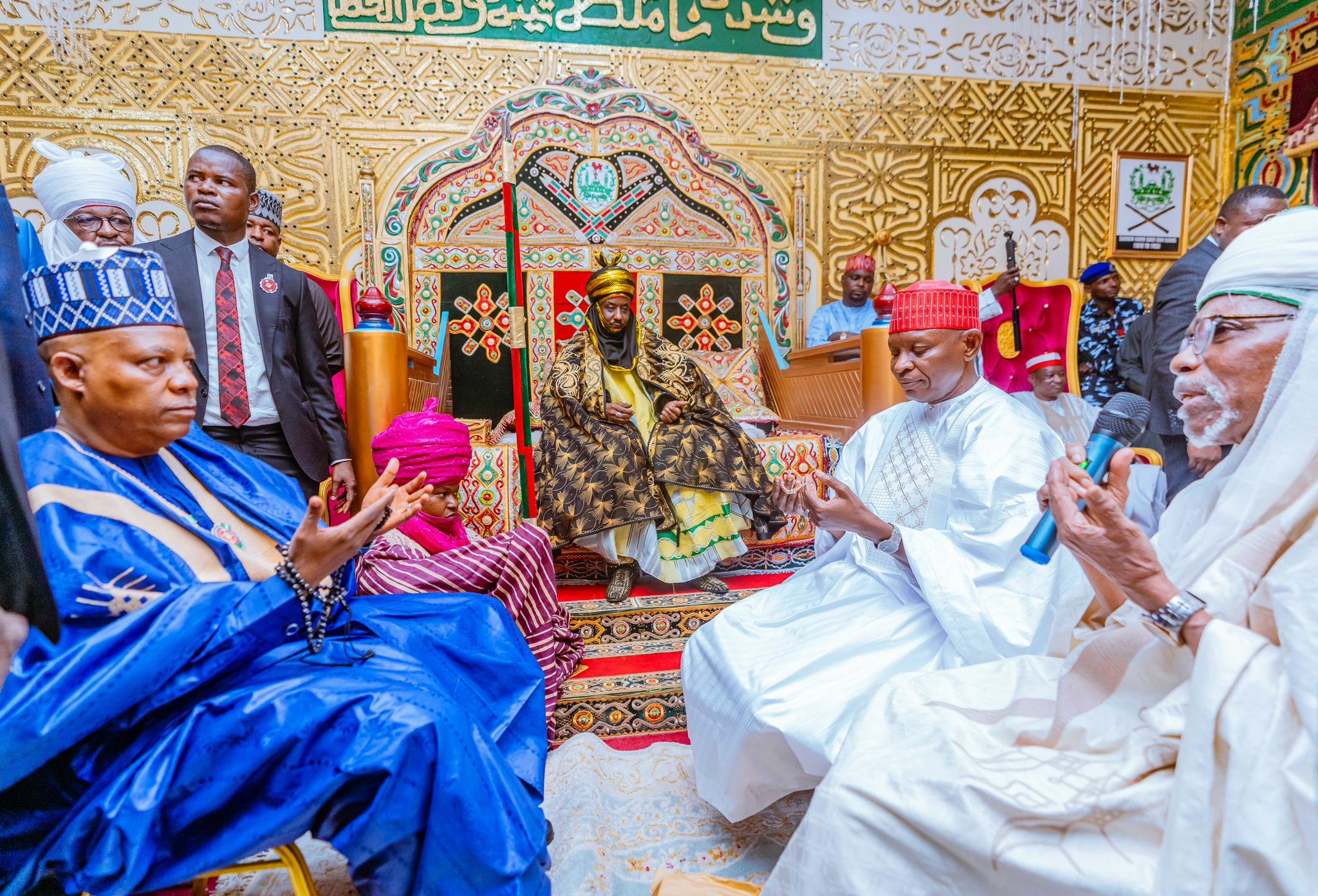
During a meeting with the Institute of Chartered Secretaries and Administrators of Nigeria (ICSAN), the Emir of Kano, Muhammadu Sanusi II, challenged recent statements made by Vice President Kashim Shettima.
The Emir asserted that Kano, rather than Lagos, provided the initial entrepreneurial foundation, seed capital networks, and trading knowledge that produced Africa’s richest man, Aliko Dangote, and BUA Group Chairman, Abdul Samad Rabiu.
The Historical Argument: Kano’s Merchant Syndicate Tradition
Emir Sanusi’s argument is rooted in economic geography and family lineage. Both Aliko Dangote and Abdul Samad Rabiu are descendants of established Kano merchant families. Dangote is the great-grandson of Alhassan Dantata, who was West Africa’s wealthiest merchant during the colonial era through the trade of groundnuts, kola nuts, and commodities.
The Emir explained that the business strategies used by these industrialists were developed long before they moved to the coast:
“These businessmen went to Lagos to expand their operations and leverage its commercial environment, not to learn how to do business from scratch. Kano’s deep commercial heritage has historically produced generations of successful merchants and entrepreneurs, playing a foundational role in shaping Africa’s most prominent business figures.”
From this viewpoint, Kano acted as the primary incubator, providing the initial capital, market networks, and risk-management skills, while Lagos served as an expansion node that allowed these businesses to scale across the continent.
The Structural Counter-Argument: Lagos as a Venture Catalyst
This historical perspective contrasts with statements made by Vice President Kashim Shettima at the Invest Lagos Summit 3.0. The Vice President credited Lagos State’s economic policies, infrastructure, and unique market ecosystem for turning these regional traders into global industrialists.
At the investment summit, Shettima emphasized the state’s dominant role in private sector wealth creation: “Lagos produced Africa’s richest man, not Kano. Aliko Dangote is a Lagos boy. Likewise, it was not Kano that produced Africa’s second-richest man, Abdul Samad Rabiu.”
The analytical basis for the Vice President’s argument relies on the concept of agglomeration economies:
-
The Policy Environment: Lagos provided the regulatory landscape, proximity to financial institutions, and maritime port access necessary to transition from high-volume commodity trading to heavy asset manufacturing (e.g., cement plants, sugar refineries, and oil mega-refineries).
-
Capital Access: Operating within the Lagos financial corridor enabled these groups to secure large syndicated bank loans, issue corporate bonds on the Nigerian Exchange (NGX), and easily access foreign exchange markets.
The Macro Outlook: A Shared Commercial Ecosystem
This debate between Nigeria’s political and traditional leadership highlights how two distinct economic systems complement one another within the wider national economy.
Ultimately, the growth of Nigeria’s largest conglomerates shows that both regional models are interlinked. While Kano’s historic trading networks provided the foundational capital and initial market experience, the financial markets, infrastructure, and corporate landscape of Lagos provided the scale required for global expansion.
As Nigeria aims to accelerate its industrialization, understanding how these two distinct regional advantages work together will be essential to fostering a new generation of hyper-scale enterprises.
