

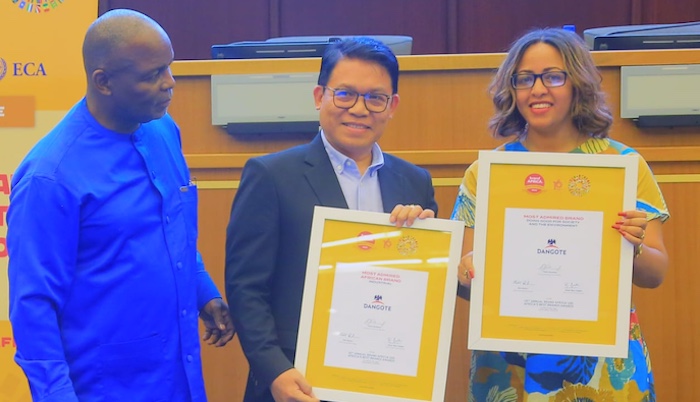
Nigeria’s premier industrial conglomerate, Dangote Industries, has solidified its position at the apex of continental commerce. At the 16th annual Brand Africa 100: Africa’s Best Brands awards gala held in Addis Ababa, Ethiopia, the group was officially named Africa’s Most Admired Indigenous Brand.
In addition to securing the top spot in consumer admiration, the manufacturing giant retained its long-standing title as Africa’s Most Admired Industrial Brand and was recognized as the leading corporate entity actively contributing to a better Africa.
The Data Behind the Rankings
The insights are derived from a comprehensive 2026 pan-African consumer survey conducted across 30 countries. This footprint represents over 85% of the continent’s total population and gross economic output, evaluating consumer sentiment, market relevance, and operational influence.
In the highly competitive aided recall category—where consumers are prompted with a list of corporate names—Dangote emerged as the most recognized and admired homegrown brand on the continent, beating telecommunications giants MTN and Vodacom. In the spontaneous recall category (unprompted brand recognition), the conglomerate secured a strong second-place finish, trailing only MTN while staying ahead of Zambian consumer goods giant Trade Kings.
A Multi-Sector Industrial Footprint
Brand Africa attributed the conglomerate’s high market score to its massive physical infrastructure investments across key sectors of the real economy. Rather than relying on purely digital services, Dangote’s brand equity is built on tangible, high-impact industrial verticals:
-
Heavy Industry & Energy: Dominating continental supply chains via Dangote Cement, advanced fertilizer production networks, large-scale petrochemical refining, and corporate logistics.
-
Consumer Essentials: Maintaining everyday market relevance through major operations in sugar refining, salt processing, and industrial packaging.
The 2026 data also ranked the group second overall among brands acknowledged for making a net-positive impact on society, local communities, and sub-continental environmental initiatives.
The 15% Indigenous Paradox
Despite Dangote’s individual success, the 2026 report highlighted a structural challenge facing the continent’s economic landscape. Homegrown African brands accounted for a meager 15% of the top 100 most admired brands, proving that North American, European, and Asian multinationals continue to hold a dominant share of African consumer markets.
Commenting on the metrics, Thebe Ikalafeng, Founder and Chairman of Brand Africa, emphasized that these numbers should serve as a wake-up call for policy makers. He noted that with local brands holding only 15% of the market share, African nations must deliberately back and celebrate industrial champions like Dangote. He concluded that the conglomerate serves as a key proof point that African companies can build the scale and corporate governance required to project industrial capability on the global stage.
