

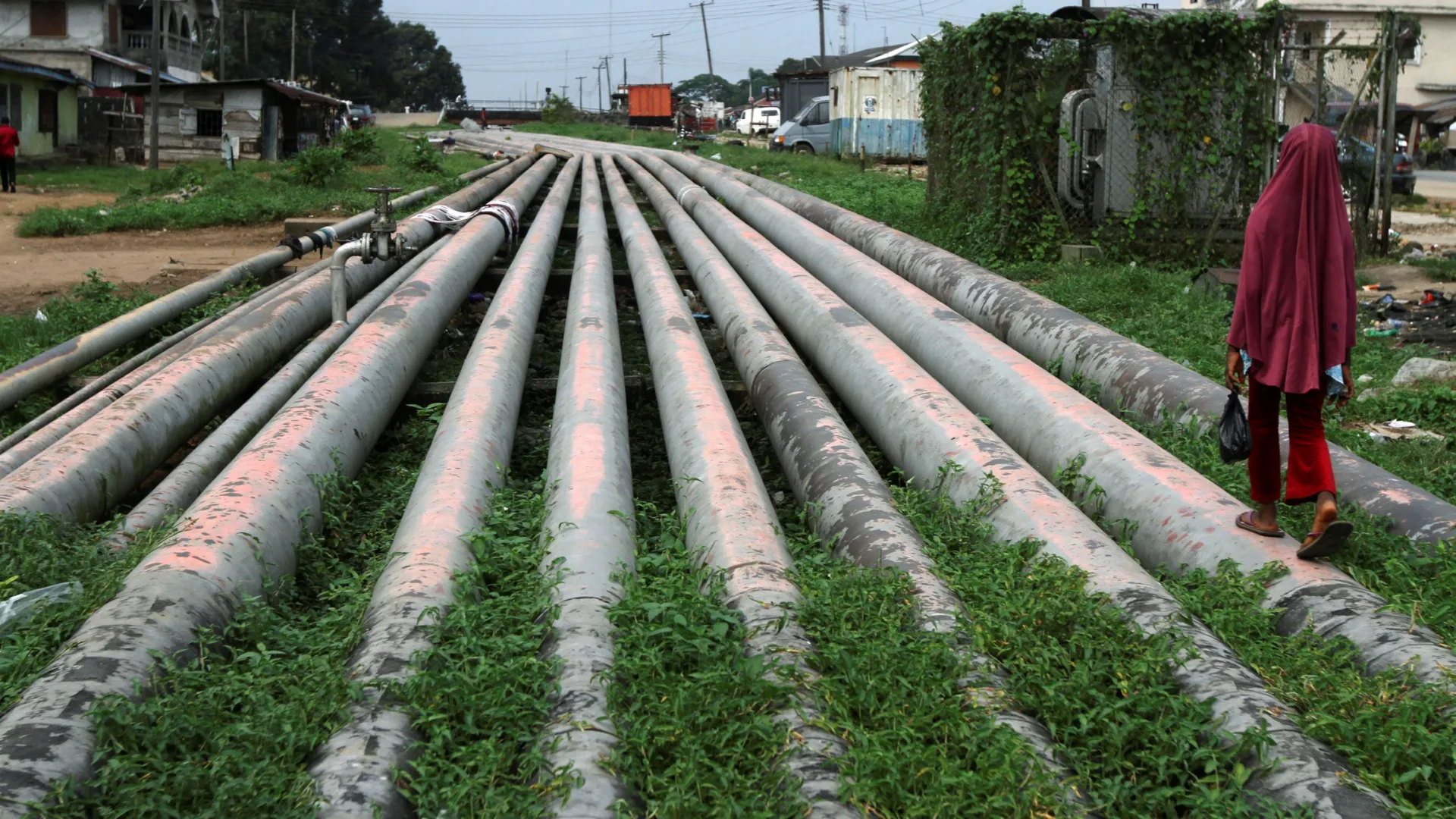
The race to lock down Africa’s massive natural gas reserves for the European energy grid has entered an intensive infrastructure phase.
Algeria’s Ministry of Energy and Mines has officially commenced construction on the Algerian segment of the long-delayed Trans-Saharan Gas Pipeline (TSGP). The multi-billion-dollar midstream megaproject is designed to span over 4,000 kilometers, establishing a high-capacity energy corridor stretching from the gas fields of the Niger Delta, moving north through the Republic of Niger, and cutting across Algeria to the Mediterranean coast.
The commencement of work in Algeria’s Adrar region followed a high-level ministerial meeting of the project’s steering committee in Algiers. During the summit, the petroleum ministers of the three sovereign partners—Mohamed Arkab (Algeria), Ekperikpe Ekpo (Nigeria), and Hamadou Tini (Niger)—alongside the chief executives of state-owned energy monopolies NNPC Limited, Sonatrach, and Sonidep, formally ratified and adopted the final technical and commercial feasibility study drafted by British energy consultancy Penspen.
The Structural Matrix: Capacity, Costs, and Competing Pipelines
The revived project is unfolding within a highly competitive geopolitical environment, as North African rivals Algeria and Morocco execute separate pipeline strategies to capture long-term European export quotas.
| Architectural & Financial Metrics | Trans-Saharan Gas Pipeline (TSGP) | Nigeria-Morocco Gas Pipeline (NMGP) |
| Primary State Backers | Nigeria, Niger, Algeria | Nigeria, Morocco |
| Total Projected Length | Over 4,000 kilometers | Approximately 6,000 kilometers |
| Transit Route | Inland (Inland Sahelian Land Corridors) | Maritime/Coastal (13 Atlantic Seaboard Nations) |
| Throughput Capacity | 20 Billion – 30 Billion $m^3$/Year | Multi-Billion $m^3$/Year (Scalable) |
| Capital Expenditure ($\text{CapEx}$) | $13.0 Billion – $19.5 Billion | $25.0 Billion |
The Macroeconomic Drivers: Filling the Russian Void
The financial justification for the TSGP has fundamentally shifted since its initial launch in 2009, when its cost was budgeted at $10 billion. Rapid global asset inflation and complex security overheads in the Sahel have pushed capital requirements up to an estimated $13 billion to $19.5 billion.
However, the structural reorganization of European energy procurement following the February 2022 invasion of Ukraine has made the pipeline highly bankable. With Western Europe enforcing a strict embargo on Russian gas imports, Algeria has captured a commanding 12% share of European gas imports.
By connecting Nigeria’s deep onshore gas reserves directly to this existing export loop, the TSGP will provide Europe with a stable, pipeline-delivered alternative to maritime Liquefied Natural Gas (LNG). Furthermore, Algeria intends to utilize the pipeline to blend Nigerian throughput with additional volumes harvested from its own newly opened domestic gas fields, such as the high-yield Ahnet basin.
The Onshore vs. Offshore Geopolitical Rivalry
As construction begins on the inland Trans-Saharan route, Morocco is continuing to advance its competing Nigeria-Morocco Gas Pipeline (NMGP). First launched in 2016 and heavily revitalized in 2023, the proposed $25 billion offshore NMGP offers a different operational thesis. By skirting the Atlantic coast across 13 West African countries before linking into the Maghreb-Europe pipeline, Rabat is banking on a lower-risk maritime route that avoids the volatile security realities of the inland Sahel region.
For Nigeria, this dual-track rivalry represents an exceptional macroeconomic win. By maintaining equity stakes and supply commitments in both multi-billion-dollar pipeline networks, the federal government is positioning the NNPC to transform Nigeria into the absolute anchor of energy security for both the African continent and the European Union.
