
Close Menu
  • Home
  • Articles
  • Tools
    • Grant Finder
    • Cashflow Tracker
    • Entrepreneurial Scorecard™
    • Loan Readiness Checklist
    • Export Readiness Checklist
    • Investor Readiness Checklist
  • Contact
  • News
  • Events
  • Tech
  • Start Up
  • Spotlight
  • Marketing
  • Strategy
  • Management
  • Profitability
  • Interviews
  • Leadership
  • Entrepreneurship
ADS

Subscribe to Updates

Get the latest business news, articles, tips and interviews to develop your business IQ!

What's Hot

Built to Last: How Paul Onwuanibe Turned Spaces Into Experiences — and What Every Nigerian Founder Can Learn From It

June 30, 2026

Geopolitical Price Surges Boost Nigeria’s Five-Month Crude Export Revenue to N20.22 Trillion

June 30, 2026

RCCG Throne Room Business Summit Tasks Entrepreneurs on Moving from “Hustling” to Structured Systems

June 30, 2026
Facebook X (Twitter) Instagram YouTube LinkedIn TikTok
  • Home
  • About
  • Articles

    Built to Last: How Paul Onwuanibe Turned Spaces Into Experiences — and What Every Nigerian Founder Can Learn From It

    June 30, 2026

    Geopolitical Price Surges Boost Nigeria’s Five-Month Crude Export Revenue to N20.22 Trillion

    June 30, 2026

    RCCG Throne Room Business Summit Tasks Entrepreneurs on Moving from “Hustling” to Structured Systems

    June 30, 2026

    Anambra Government Reaffirms Strategic Support for Small Businesses

    June 30, 2026

    Juliet Ukpabio Archibong Launches ‘FromAfricaB2B’ to Connect African SMEs with International Markets

    June 30, 2026
  • Insights
  • Tools
    • Grant Finder
    • Cashflow Tracker
    • Entrepreneurial Scorecard™
    • Loan Checklist
    • Export Checklist
    • Investor Checklist
    • NAFDAC Checklist
  • Contact
    • Login
Facebook X (Twitter) Instagram YouTube TikTok LinkedIn
naijapreneur™
Get Featured!
  • News

    Geopolitical Price Surges Boost Nigeria’s Five-Month Crude Export Revenue to N20.22 Trillion

    June 30, 2026

    RCCG Throne Room Business Summit Tasks Entrepreneurs on Moving from “Hustling” to Structured Systems

    June 30, 2026

    Anambra Government Reaffirms Strategic Support for Small Businesses

    June 30, 2026

    Juliet Ukpabio Archibong Launches ‘FromAfricaB2B’ to Connect African SMEs with International Markets

    June 30, 2026

    Stanbic IBTC Bank Launches Four-City Regional SME Tour to Drive Grassroots Enterprise Growth

    June 30, 2026
  • Events

    Stuck Entrepreneurs Find Direction at Lagos ‘Led by God, Not by Guesswork’ Masterclass

    June 29, 2026

    June 2026 Nigeria Business Events Roundup

    June 1, 2026

    May 2026 Nigeria Business Events Roundup

    May 1, 2026

    Lagos To Host The 6th Africa Finance Festival 2026 , Unite The Finance Ecosystem Accros Africa

    April 20, 2026

    The Business Clinic – April Edition

    April 14, 2026
  • Spotlight

    Meet R. J. Musah – From Lagos Street Hustle to Building a Logistics and Transportation Vision, OgaMusah

    April 25, 2026

    Meet Walter Emiedafe – From Side Hustle Survival to Building a Multinational-Focused Construction Company, Sapient Vendors

    April 22, 2026

    Meet Temitope Arogundade – From a One-Bedroom Apartment to Building a Purpose-Driven Nigerian Footwear Brand, BLVC

    April 20, 2026

    Meet Funmilola Adedeji-Bajulaiye – From a Desk Chair Startup to Building a Global Franchise Ecosystem, ACR Global Consulting

    April 16, 2026

    Meet Barbara A. Omoregie – From Creative Curiosity to Building a Multidisciplinary Creative Powerhouse, Graphitti Studios

    April 14, 2026
  • Entrepreneurship

    The Olodo Uprising: Why an Economy That Rewards Noise Over Knowledge Is Quietly Mortgaging Nigeria’s Next Generation of Builders

    June 30, 2026

    Your Kairos Moment: How Smart Entrepreneurs Know When It’s Time to Act

    June 15, 2026

    FROM NAIJA TO THE WORLD: THE 3 MINDSHIFTS NEEDED TO TAKE NIGERIAN BRANDS GLOBAL

    April 29, 2026

    Africa Has the Minerals. Someone Else Has the Margin.

    March 5, 2026

    What Every Entrepreneur Must Refocus on in 2026 to Get Better Results

    February 12, 2026
  • Marketing
    1. e-Marketing
    2. View All

    A Christmas GIFT For Entrepreneurs!

    December 17, 2013

    Free Website CONTENT Review: Does your website SPEAK the language of your TARGET customers?

    September 30, 2013

    e-Commerce FAQs: 8 Frequently Asked Questions About Selling Online

    July 15, 2013

    CASE STUDY: How I Made Close To 1Million In Sales Within 3 Months Of Selling Online!

    May 13, 2013

    The Cost of Invisibility: How African SMEs Lose Revenue Online

    May 5, 2026

    Brand Promises: Pact or Poetry?

    September 4, 2025

    ROI in a Ribbon: Culture, Connection, and Corporate Gifting Rooted in Respect

    July 3, 2025

    Using Customer Data and Insight to Fuel Business Success

    May 22, 2025
  • Start Up
    1. Tech
    2. View All

    Top 5 Tech Blogs in Nigeria

    April 1, 2026

    Top 5 Most Followed Nigerians on Bluesky

    April 1, 2026

    5 Mindset Shifts That Turned Me From Product Manager to Founder

    November 24, 2025

    Enter for the Aurora Tech Award by inDrive for Female Tech Founders

    November 3, 2025

    The Art of the Investor Update—and Why Most Founders Get It Wrong

    June 24, 2026

    Your Pitch Deck Is Not a Sales Document. It Is a Risk Reduction Document.

    May 24, 2026

    You Are Not Just Building a Company. You Are Building an Asset

    May 6, 2026

    The First Cheque Is Easy. Follow-On Capital Is Earned.

    April 28, 2026
  • Management
    1. Finance
    2. Legal
    3. Profitability
    4. Leadership
    5. View All

    Scale Is A Dirty Wor(d)k

    June 24, 2026

    55 Grants & Funding Opportunities for Nigerian SMEs in 2026 (Verified List)

    June 3, 2026

    Not Everyone Has the DNA

    May 28, 2026

    The Trip from Curiosity to Cheque: Building the Infrastructure of Trust

    April 28, 2026

    The Data Protection Law Most SMEs Don’t Know They’re Breaking — and the Fines That Scale With Your Turnover

    April 6, 2026

    The 2026 CBN Fintech Report; Defining The Future Of Fintech In Nigeria

    February 27, 2026

    Recapitalization In The Nigerian Banking Sector: Legal Considerations And Strategic Options

    February 27, 2026

    Decoding The Insurance Reform Act: New Rules, New Realities for Intermediaries

    February 15, 2026

    Africa Has the Minerals. Someone Else Has the Margin.

    March 5, 2026

    5 Strategies for Reinvesting Profits to Grow Your Business

    March 20, 2015

    The MOST IMPORTANT Word In Business

    March 31, 2014

    5 Ways To Reduce Inventory Costs And Boost Profitability

    February 21, 2014

    How Patrick Doyle Transformed Domino’s Pizza: From a $3 Stock to $500

    June 20, 2025

    LEADERSHIP CHECKLIST: 4 Critical Things Every Leader Needs To Do For Their Team

    November 25, 2013

    Business Mastery: The Unusual Qualities Of Highly Successful Entrepreneurs

    October 31, 2011

    The Golden Rule Of Business

    July 18, 2011

    Built to Last: How Paul Onwuanibe Turned Spaces Into Experiences — and What Every Nigerian Founder Can Learn From It

    June 30, 2026

    Nigeria Business Regulations For SMEs: NAFDAC, NCC, SON and the Rest And How To Leverage Them

    May 10, 2026

    The Floating Naira and Your Business: How to Price, Plan and Survive When the Exchange Rate Moves

    March 2, 2026

    CAC in 2026: How to Register for as Little as ₦11,000 — and the New Ownership Rule You Can’t Ignore

    February 10, 2026
  • Strategy

    How to Stay Competitive in the Digital Era

    March 25, 2025

    Nigeria Cement Market Review 2019-2024 and Forecasts 2025-2029.

    March 14, 2025

    Eight prudent ways to invest your 13th-month pay

    January 6, 2025

    Catching Them Young: A CSR Guide for Brands Building Lifelong Connections with Youth

    October 28, 2024

    The SHOW UP Strategy: How to Attract Paying Clients in Tough Economic Times

    October 15, 2024
  • Interviews

    Meet Funmilola Adedeji-Bajulaiye – From a Desk Chair Startup to Building a Global Franchise Ecosystem, ACR Global Consulting

    April 16, 2026

    Meet Olufemi Omotayo – From Lagos Hustle to Building a Legacy-Driven Storytelling Brand, Entplus Digital

    April 9, 2026

    Meet Kehinde Ajose – From Journalism to Building a Media Visibility Business, Visibility Solutions Media Ltd.

    April 6, 2026

    Meet Eloho Zoe Tanho-Attah – From ₦50,000 to Building a Performance Ecosystem, aeea Design Company

    April 1, 2026

    Meet Marvellous Bolarinwa – From ₦45,000 to a Rising Beauty Brand, “Nailedit by Maran”

    March 23, 2026
naijapreneur™
Home»Management»Built to Last: How Paul Onwuanibe Turned Spaces Into Experiences — and What Every Nigerian Founder Can Learn From It
Management

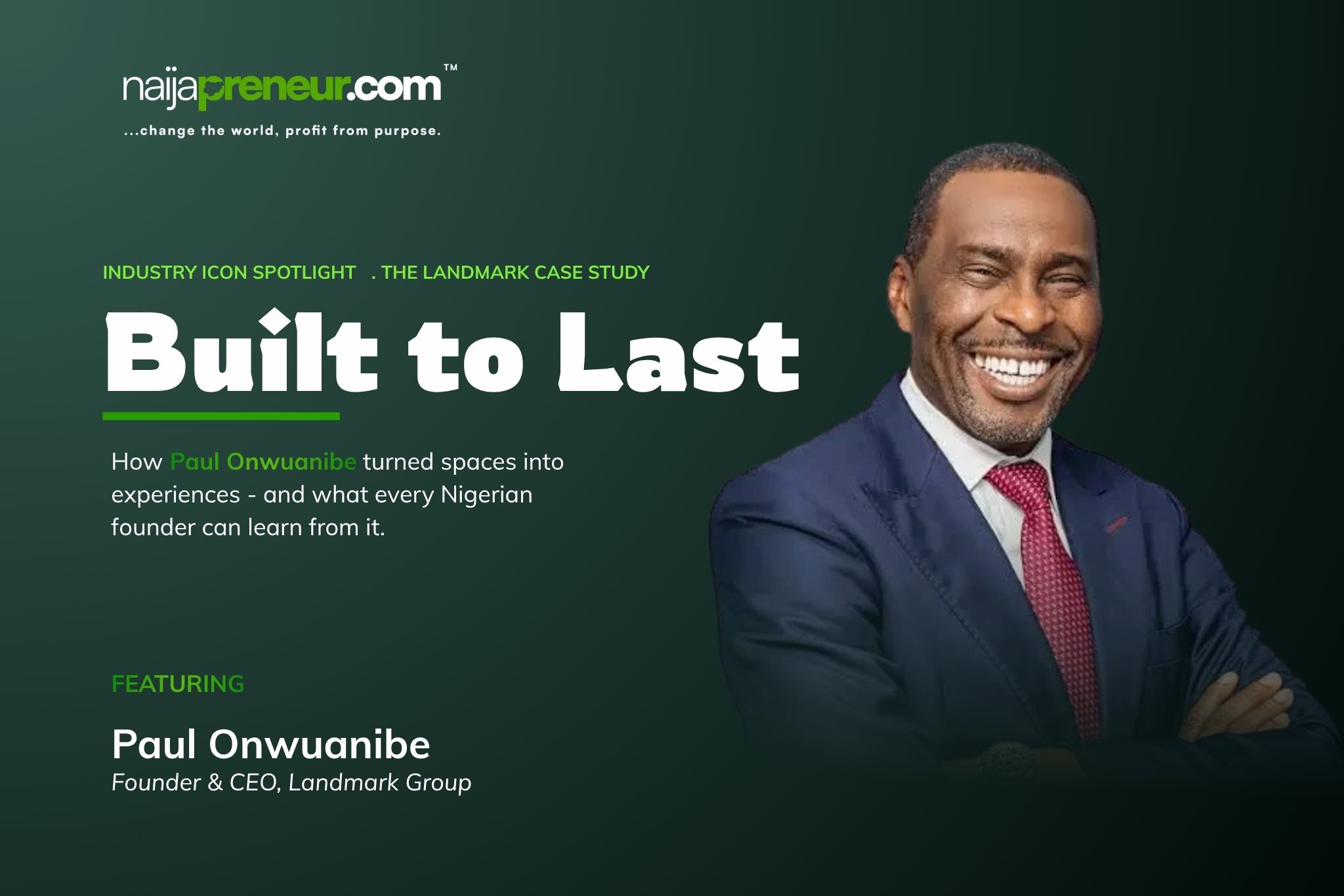
Built to Last: How Paul Onwuanibe Turned Spaces Into Experiences — and What Every Nigerian Founder Can Learn From It

Tito PhilipsBy Tito PhilipsJune 30, 2026011 Mins Read
Share Facebook Twitter Pinterest Copy Link LinkedIn Tumblr Email Telegram WhatsApp
Follow Us
Facebook X (Twitter) Instagram YouTube LinkedIn TikTok
Built to Last: How Paul Onwuanibe Turned Spaces Into Experiences — and What Every Nigerian Founder Can Learn From It
Share
Facebook Twitter LinkedIn Pinterest Email Copy Link WhatsApp

The Landmark Group survived war abroad, a pandemic, a tenfold currency collapse and, finally, a government bulldozer. Behind the hotel and the beach sits a more useful story for the Nigerian founder: a business that reinvented itself three times in three decades — and refused to die.

Written by Tito Philips · Research & interview by Olufemi Omotayo The Landmark Case Study · A naijapreneur Insights feature


In 2024, a bulldozer arrived at one of the most visited destinations in West Africa.

The Lagos–Calabar coastal road needed a right of way, and the Landmark Beach sat in it. When the dust settled, Paul Onwuanibe had lost an estimated three-quarters of his group’s income, after sinking some $30 million of debt-funded investment into the asset. It was the kind of blow that closes most companies.

Landmark did not close. To understand why — and to take something usable from it — you have to look past the hotel, the cinema, the 42 food outlets and the famous beach, and study the operating system underneath. This is a 28-year-old business that has reinvented itself three times, weathered September 11th, a pandemic and a currency that fell from ₦120 to the dollar to roughly ₦1,200, and is now planning its next chapter along the West African coastline.

We sat down with Paul Onwuanibe to dissect how. What follows is not a celebration. It is a case study: the frameworks he actually runs the company on, the decisions that mattered, and the lessons we believe every Nigerian SME can borrow.

Landmark Group: Three businesses in one company

Landmark did not begin as the lifestyle destination Lagosians know today. It started in 1997 in Europe as a service-office business — renting flexible workspace to corporates. When that market turned brutally competitive in Europe and was shaken in New York around September 11th, Onwuanibe made the defining call of his career: in 2003 he brought the business to Africa, opening simultaneously in the continent’s four corners — Lagos for the west, Johannesburg for the south, Nairobi for the east and Cairo for the north — to house the multinationals then discovering the continent, the GEs, Nokias, IBMs and Dells of the world.

The first reinvention was forced by the ground itself. Delivering premium property services in markets with thin facility management, weak tenancy law and unreliable infrastructure left Landmark, in his words, “at the mercy of the landlord.” So around 2009–2010, the group did the capital-intensive, uncomfortable thing: it became a real-estate company itself, to control the very property its service promise depended on.

The second reinvention was a reading of the African consumer. Bricks and mortar exposed the group to every civic and infrastructure failure of a major African city. So Landmark moved again — from bricks into experiences: one place where you could work, eat, sleep, hold a wedding, watch a film and never need to leave.

“Africa has people. The only problem is the people don’t have high purchasing power. They can’t buy big things like houses and cars — but they can buy food, and they can buy experiences.”

That single observation re-priced the entire business. Instead of selling expensive, low-frequency assets to a few, Landmark began selling affordable, high-frequency experiences to everyone — grandparents, parents and children, the lowest common denominator of demand — and turned a property into a destination.

The lesson for Nigerian SMEs: sell what your market can actually afford to buy often. Purchasing power here is real but shallow. The durable businesses lower the price of the smallest unit of value they sell and win on frequency — not on the size of a single transaction.

The Operating System

Strip away the brand and Landmark runs on a small set of repeatable rules. They are not slogans on a wall; Onwuanibe tests his staff on them, and they govern real decisions.

The first is the Three Ps — People, Partners, Purpose. Look after the people who build and use the brand. Don’t try to do everything alone; bring in partners for what they do best. And never act without a purpose — at Landmark, everyone states it identically: bring people here, give them an amazing experience, make sure they tell others.

The second is a deceptively simple rule about measurement: “If you can’t count it, it doesn’t count.” Most property firms count square metres. Landmark counts people — how many come, how long they stay, what they spend while there, and whether they tell others.

“Other real-estate organisations count bricks and mortar. We don’t count square metres. We count people.”

The lesson: your metric is your strategy. Pick the one number that genuinely reflects the value you create, then build everything around moving it. The wrong metric — vanity revenue, raw footprint — quietly steers a company toward the wrong decisions for years.

The Five DREADs

Onwuanibe’s personal decision framework is an acronym he says he is forced to call on at every turning point. It doubles as Landmark’s leadership creed and its hiring filter.

  • Dare to dream. Not every dream comes true, but if you dream enough, some do.
  • Resilience. Expect the unexpected, then meet it. You don’t hit a wall and turn back; you find a way through.
  • Excellence. Choose a standard and be relentlessly consistent with it. In Nigeria, he argues, excellence itself is a currency — competition is thin and the bar is low, so doing things properly is a moat.
  • Adaptability. “You can’t change the cards you’re dealt. You can only change the hand you play.”
  • Staying power. In a city like Lagos, things will try to stop you. The answer is a refusal to leave.

It isn’t posturing. Landmark claims a long list of Nigerian firsts — among them an inner-city private beach and a purpose-built convention destination — each carrying the cost and risk of being first, and each widening the moat.

“We do things not because they’re easy, but because they’re hard — because when they’re hard, very few people have the ability to do them.”

The most important idea in this case study

Here Onwuanibe draws a hard line between two kinds of trouble, and argues that imported business education prepares founders for the wrong one.

Risk is the world of known unknowns — a fire, an accident. You know these can happen; you just don’t know when. They can be modelled, planned for and insured against. Much of business school is a catalogue of risk mitigations.

Uncertainty is the world of unknown unknowns — COVID, September 11th, a road that erases your beach. You cannot plan for the specific event, because you don’t know it exists until it arrives.

His claim is that the ratio inverts between markets. In the West, the mix is roughly 90% risk and 10% uncertainty. In Africa, it flips: about 10% risk and 90% uncertainty. That is why copied playbooks fail here. A founder trained to manage risk lands in a market governed by uncertainty and finds their tools don’t fit.

The lesson: stop trying to predict; build to absorb. If most of your threats are genuinely unknowable, resilience and adaptability are not soft virtues — they are your core competitive strategy. Cash buffers, flexible assets, multiple revenue streams and a culture that embraces change beat any forecast.

Tested to destruction

A philosophy of resilience is cheap until it is billed. Landmark’s was billed in full. The group borrowed in dollars when the naira traded near ₦120; by repayment it had collapsed to roughly ₦1,200 — a tenfold swing in about seven years. Add COVID, add inflation Onwuanibe calls “the big curse on the economy,” then add the demolition of the beach.

What carried the business through was not a hedge. It was a frame of mind. Mid-crisis, on his way before dawn to lobby a government official, Onwuanibe stopped at a friend’s house and learned the friend’s wife had died that morning, their children still abroad and unaware. He had just spent twenty minutes venting about a beach.

“Whatever you lose, you can get back. When someone dies, you don’t get that person back. That one incident mellowed me.”

From there the operating rule is sequential and unsentimental: first survive, then thrive. Treat disaster the way Edison treated his burning factory — as an expensive opportunity to rebuild bigger and better. Move the people who can only see the loss off the project. And hold to principle, because “principle goes into a room long before you get there, and stays long after you’ve left.”

The lesson: don’t borrow your survival in a currency you don’t earn. The dollar-loan trap has killed more Nigerian businesses than bad ideas. And when the unforeseeable hits, the first job is emotional discipline — refuse self-pity and blame, separate what’s lost from what’s recoverable, and act.

Hire for what can’t be taught

Landmark does not advertise jobs and does not prize experience. It hires for raw material and trains the rest — quickly, and with a willingness to part ways just as quickly. Onwuanibe screens for three things, in order: basic intelligence (read as open-mindedness, the ability to think), fearlessness, and desire.

“You can teach things, but you can’t teach desire. You can’t teach passion, resilience, or hard work.”

He hires fast and, when needed, fires fast: within a month you know whether someone is right. Some stay a decade; some last two weeks. The speed keeps the standard intact. His mother’s line is the culture in one sentence — you may be out-talented, but you have no excuse to be out-worked.

And the customer is the final arbiter of everything. Real estate, in his telling, is not about buildings at all — it is hospitality. How people feel when they arrive, while they’re there, and when they leave is the product.

What Nigerian founders should take from Landmark

A case study earns its place only if it transfers. Here is what the Landmark story recommends.

If you build property or physical spaces:

  • Sell experiences, not square metres. The margin is in how a space makes people feel and how often they return — so design for footfall, dwell time and repeat visits.
  • Control what your promise depends on. Landmark moved into ownership because weak third-party systems made its service fragile. Find your single point of dependency and bring it in-house.
  • Build to last and build to change. Treat a structure as a long-life, flexible asset whose use will evolve.

If you run any Nigerian SME:

  • Price the smallest unit your market can buy often; win on frequency and reach.
  • Engineer for uncertainty, not risk — cash buffers, diversified revenue, flexible assets, and no foreign-currency debt against naira income.
  • Make excellence your moat. Where the bar is low, being consistently excellent is a durable advantage.
  • Measure the one thing that is your strategy, and run the whole business off it.
  • Think globally, act locally: import standards of excellence, adapt the service to Nigerian realities.

The Landmark playbook, in eight lines

  1. Adapt faster than the market changes — reinvent before you’re forced to.
  2. Count people, not square metres — your metric is your strategy.
  3. Sell experiences your market can afford often — frequency beats size.
  4. Build to absorb shocks you can’t name — uncertainty is the rule.
  5. Survive first, then thrive — treat disaster as expensive opportunity.
  6. Hire desire, train skill, decide fast — attitude compounds.
  7. Make excellence the moat — in a thin market, consistency wins.
  8. Hold to principle under pressure — it guides the hardest calls.

There is a quote on Onwuanibe’s office wall, attributed to Thomas Jefferson: “If you want something you have never had, you must be willing to do something you have never done.” It is, in the end, the whole case study compressed. In an economy you cannot predict, the winning strategy is not foresight. It is the discipline to adapt, absorb, and stay.

Built to last, by building to change.


*This article is the first in the Case Studies series from naijapreneur Insights, where we dissect the journeys of Nigeria’s most consequential founders into frameworks you can use. Want the full breakdown — frameworks, timeline, data and recommendations in one document? *[Download the complete Built to Last case study (PDF).]*

Know a Nigerian founder whose story should be studied? Tell us at hello@naijapreneur.com — and explore MINE 1000, our drive to profile one thousand Made-in-Nigeria entrepreneurs.

All quotations are drawn from a primary interview conducted by naijapreneur Insights. Figures cited are as stated by the subject and are presented as his account rather than independently audited financials, in line with our methodological-honesty standard.

Share. Facebook Twitter Pinterest LinkedIn Email Copy Link WhatsApp
Previous ArticleGeopolitical Price Surges Boost Nigeria’s Five-Month Crude Export Revenue to N20.22 Trillion
Tito Philips
  • Website
  • Facebook
  • X (Twitter)

Hi! My name is Tito Philips, an unusual Nigerian that is MAD – Making A Difference. I'm the Chief Community Leader here and this is where we raise the bar of entrepreneurship. We are a TRIBE of Unusual Entrepreneurs, we are not your every day entrepreneurs who go into business to put food on the table and pay bills. For us, business is more than making ends meet [survival]. It is our means of doing what we love [passion], changing the world [purpose] and being financially rewarded for it [profit]™. Want to become ONE of us?

Related Posts

The Olodo Uprising: Why an Economy That Rewards Noise Over Knowledge Is Quietly Mortgaging Nigeria’s Next Generation of Builders

June 30, 2026

Stuck Entrepreneurs Find Direction at Lagos ‘Led by God, Not by Guesswork’ Masterclass

June 29, 2026

#71ForTheNextGeneration: Tomi Davies Celebrates 71st Birthday by Fundraising for Public School Children

June 9, 2026
Add A Comment

Comments are closed.

ADS
MINE 1000

SME Toolkit

Book

NBTR
Business Events in Nigeria
Nigeria Business Events Roundup
naijapreneur TV
https://www.youtube.com/watch?v=KC01cJZBJoE&t=34s
Latest Posts

Built to Last: How Paul Onwuanibe Turned Spaces Into Experiences — and What Every Nigerian Founder Can Learn From It

June 30, 2026

Geopolitical Price Surges Boost Nigeria’s Five-Month Crude Export Revenue to N20.22 Trillion

June 30, 2026

RCCG Throne Room Business Summit Tasks Entrepreneurs on Moving from “Hustling” to Structured Systems

June 30, 2026

Anambra Government Reaffirms Strategic Support for Small Businesses

June 30, 2026

Juliet Ukpabio Archibong Launches ‘FromAfricaB2B’ to Connect African SMEs with International Markets

June 30, 2026
1 2 3 … 931 Next
ADS
Stay In Touch
  • Facebook
  • YouTube
  • TikTok
  • Instagram
  • LinkedIn

Subscribe to Updates

Get the latest business news, articles, tips and interviews to develop your business IQ!

Most Trending

From Unemployment to Entrepreneurship: FG Empowers 5,500 Nigerians with Startup Support

March 25, 2025

Zuvy Technologies Joins BAS Group in Push to Bridge Nigeria’s SME Funding Gap

June 27, 2025

Unlock Business Success: Join the INCB Lekki Chapter Meeting for Christian Entrepreneurs

March 12, 2025
1 2 3 … 1,551 Next
Latest Posts

Built to Last: How Paul Onwuanibe Turned Spaces Into Experiences — and What Every Nigerian Founder Can Learn From It

June 30, 2026

Geopolitical Price Surges Boost Nigeria’s Five-Month Crude Export Revenue to N20.22 Trillion

June 30, 2026

RCCG Throne Room Business Summit Tasks Entrepreneurs on Moving from “Hustling” to Structured Systems

June 30, 2026
1 2 3 … 1,551 Next
SME Toolkit

NBTR
Facebook X (Twitter) Instagram YouTube LinkedIn TikTok
  • Entrepreneurship
  • Interviews
  • Marketing
  • Start Up
  • Strategy
  • Management
  • Profitability
  • Leadership
© 2026 naijapreneur™. Powered by M.I.N.E Media Ltd..

Type above and press Enter to search. Press Esc to cancel.