

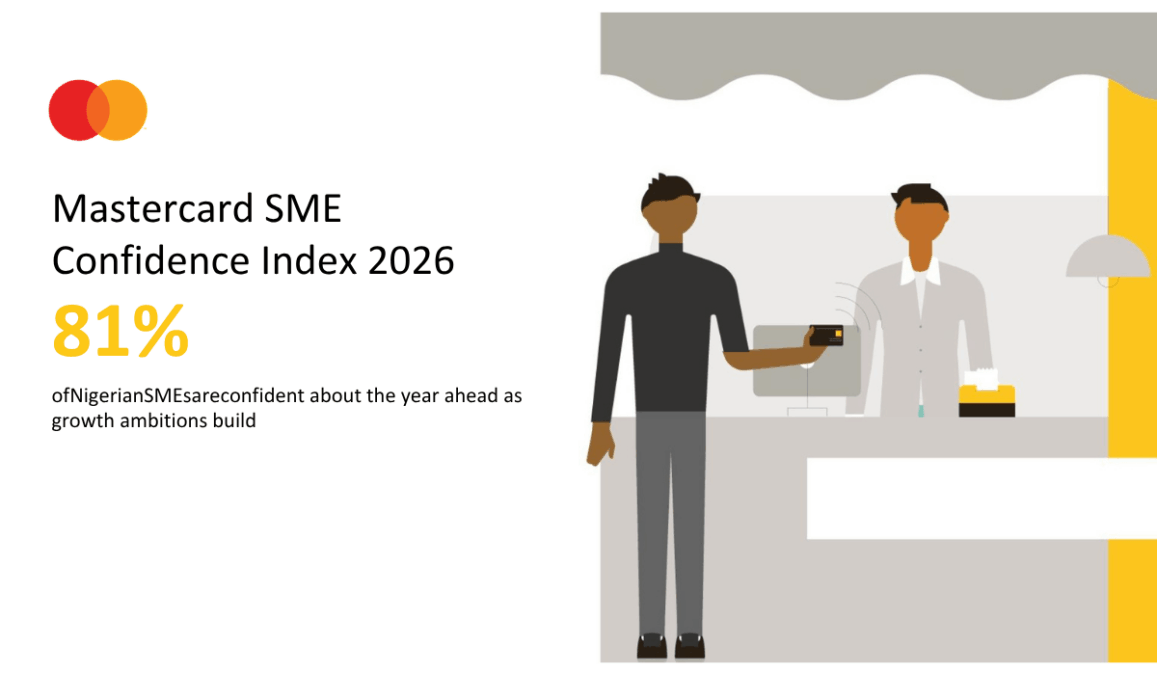
Despite navigating persistent macroeconomic pressures and inflationary headwinds, Nigeria’s small business ecosystem is showing remarkable resilience.
According to the latest Mastercard SME Confidence Index, an impressive 81% of Nigerian small and medium-sized enterprises (SMEs) express confidence in their business prospects over the next 12 months, while 68% confidently project immediate revenue growth.
The multi-market study, which assesses entrepreneur sentiment across Eastern Europe, the Middle East, and Africa, reveals that a staggering 100% of the Nigerian business owners surveyed view digital and online payment systems as essential drivers of their future growth.
The Multi-Channel Digital Adoption Surge
The research highlights a significant shift among local traders away from pure cash dependence toward multi-channel digital systems. Rather than sticking exclusively to traditional storefront operations, 57% of Nigerian SMEs now run a hybrid business model that combines physical and digital sales channels.
The breakdown of preferred digital payment methods among local entrepreneurs includes:
-
Mobile Payments: Led the adoption curve, with 67% of businesses actively accepting mobile-based transfers.
-
Card Terminals: Utilized by 45% of respondents to process point-of-sale transactions.
-
Online Gateways: Adopted by 42% of merchants to secure web-based e-commerce checkouts.
Gabriel Swanepoel, Mastercard’s Division President for Africa, noted that the absolute consensus on the importance of digital payments highlights a massive opportunity to accelerate small business development. He emphasized that the goal now is to back this entrepreneurial ambition with the right digital tools, accessible financing, and strategic local partnerships.
Addressing the Enterprise Credit Gap
While market optimism remains high, finding formal startup capital continues to be a major hurdle for growing firms. The index revealed that 34% of local businesses sought external funding over the past year, while 69% are actively looking for credit lines to back their future expansion projects.
Because specialized corporate loans are often difficult to secure, many entrepreneurs are forced to rely on personal financial tools to stay afloat.
The study found that 63% of business owners use personal payment cards to cover corporate expenses, largely because they are easily accessible and convenient. This reliance points to a massive, unmet demand for dedicated small business financing and commercial payment solutions across the country.
Investing in Upskilling and Digital Security
Nigerian entrepreneurs are also clearly identifying their internal priorities for long-term survival. Workforce development topped the list of growth opportunities, with 79% of respondents prioritizing staff training and upskilling.
Digitizing day-to-day business operations followed closely at 78%, while 73% highlighted multi-channel payment acceptance as a key priority.
Folasade Femi-Lawal, Mastercard’s Country Manager for West Africa, explained that local founders are highly focused on exactly what they need to scale. She noted that by investing heavily in their teams, embedding digital payments, and chasing expansion capital, local businesses are laying a strong foundation for long-term success.
