

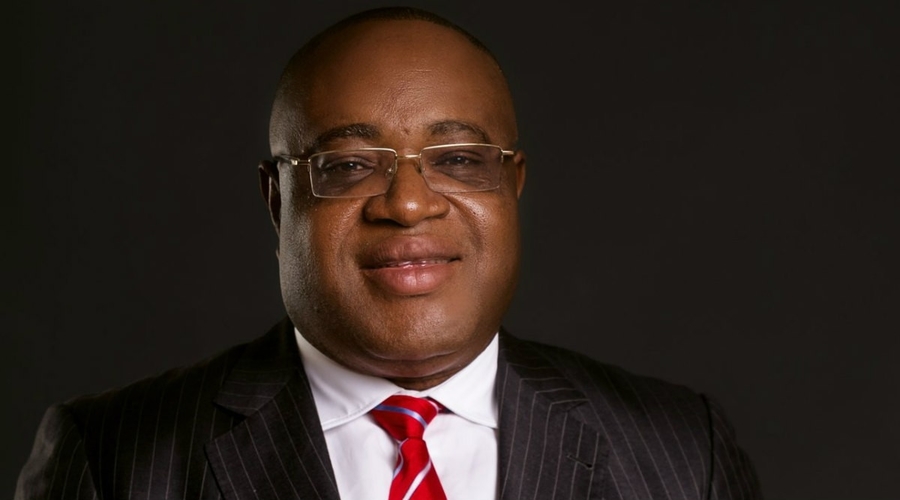
To mark his 60th birthday, the founder and Group Managing Director of the Rainoil Group, Dr. Gabriel Ogbechie (OON), has injected ₦50 million in equity-free seed capital into Nigeria’s startup ecosystem. At an entrepreneurship symposium held in Lagos, Ogbechie selected 10 early-stage entrepreneurs to receive ₦5 million each, shifting his anniversary celebration into a practical exercise in venture incubation and corporate philanthropy.
The symposium served as a strategic platform for established industrialists to discuss survival tactics for volatile markets. Highlighting Nigeria’s population of over 200 million consumers, Ogbechie argued that current macroeconomic challenges are accompanied by massive consumer demand across logistics, housing, agritech, and retail commerce.
1. The Downstream Blueprint: Scaling from ₦300,000 to an Energy Conglomerate
Sharing his personal journey, Ogbechie urged young founders to focus on operational discipline and long-term planning rather than immediate profits. He recalled founding Rainoil in 1997 with a modest startup capital of just ₦300,000, utilizing insights he gained during five years of working as a sales and operations executive in an indigenous oil company.
Instead of acquiring expensive retail assets upfront, the company initially focused on niche product sourcing and wholesale distribution logistics. Over nearly three decades, that model has evolved into an integrated energy giant:
-
Bulk Storage Assets: Three ultra-modern, 50-million-liter multi-product depots strategically positioned in Oghara (Delta State), Calabar (Cross River State), and Ijegun-Egba (Lagos State).
-
Retail Expansion Matrix: A nationwide network featuring over 200 retail stations, major liquefied petroleum gas (LPG) plants, and a distribution fleet of more than 400 specialized tank trucks.
-
Corporate Acquisitions: Expanding its energy market share through its investment vehicle, Preline Limited, which acquired a controlling stake in publicly traded Eterna PLC to capture market share in aviation lubricants.
2. Aligning Macro-Demographics with Market Opportunities
Ogbechie challenged the common focus on macroeconomic risks, pointing out that Nigeria’s population size creates reliable, baseline demand across several core sectors:
| Core Consumption Pillars | Real-Economy Market Demand Drivers |
| Food & Agro-Processing | Meeting the daily nutritional needs of over 200 million consumers. |
| Mobility & Logistics | Moving goods, commuters, and wholesale freight across urban trade routes. |
| Textiles & Apparels | Scaling domestic garment production to replace expensive imported apparel. |
| Real Estate & Housing | Building affordable urban housing and commercial business infrastructure. |
3. The State’s Role: Providing the Regulatory “Oxygen” for Capitalism
Contributing to the policy discourse, the Executive Chairman of AA Holdings Group, Austin Avuru, outlined the limits of private philanthropy in isolation. Avuru emphasized that while private grants offer vital short-term runways for startups, long-term economic growth requires the government to actively support business activities.
He stated that a responsible government must act as the “oxygen” for entrepreneurship by providing reliable national security, simplifying business regulations, and maintaining stable monetary policies. By building a predictable business environment, the state can help micro-SMEs scale from small, seed-funded experiments into sustainable employers that drive national productivity.
