

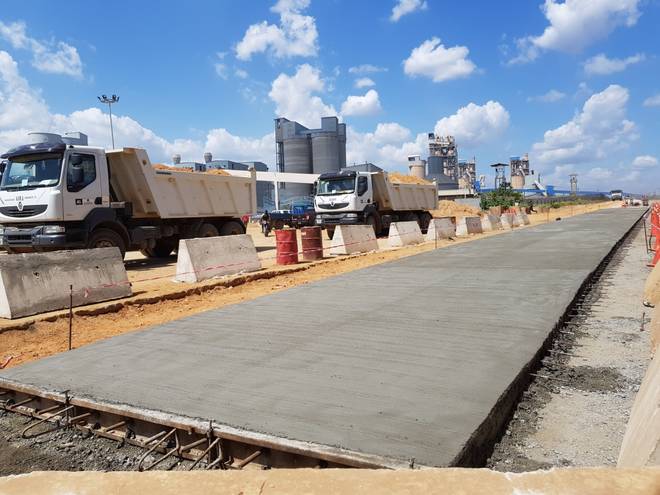
To address high maintenance costs and make roads more resilient to changing weather patterns, the Federal Ministry of Works has shifted its road construction strategy toward high-durability technology. Speaking at the 2026 International Civil Service Conference in Abuja, the Permanent Secretary of the Ministry, Mr. Adeladan, announced the mandatory adoption of Continuously Reinforced Concrete Pavement (CRCP) for major high-traffic federal trade corridors.
The change in engineering policy comes at a time when the federal government is moving away from shouldering the full cost of infrastructure development. Facing a large infrastructure deficit, the state is increasingly using Public-Private Partnerships (PPPs) and long-term concessions to bring in private capital for the construction, management, and upkeep of primary economic routes.
1. The Engineering Mechanics of CRCP Technology
While traditional jointed concrete and flexible asphalt designs are prone to surface ruts, potholes, and water damage under heavy axle loads, CRCP uses a different structural approach. The technology relies on a continuous network of longitudinal steel reinforcing bars placed through the entire length of the pavement slab.
The engineering design works on several core structural principles:
-
Elimination of Transverse Joints: By removing traditional expansion and contraction joints—except at bridge connections—CRCP eliminates the weak structural points where water typically seeps into the road base and causes base failures.
-
Controlled Micro-Cracking: The design allows the concrete layer to develop very fine, tightly held transverse cracks spaced between 0.6 and 1.8 meters apart. These micro-cracks safely relieve internal thermal and structural stresses without lowering the road’s load-bearing capacity.
-
High Aggregate Interlock: The internal steel rebar matrix keeps these microscopic surface cracks tightly bound (typically under 0.5 mm wide). This ensures high aggregate interlock and continuous load transfer across the slab, resulting in a smooth driving surface that can handle heavy vehicles for up to 50 years.
2. Lifecycle Cost Optimization and Local Content Integration
Adeladan acknowledged that CRCP roads require significantly higher upfront capital investments compared to standard asphalt overlays. However, a Lifecycle Cost Analysis (LCCA) shows that the technology delivers substantial long-term savings by virtually eliminating routine maintenance, pothole patching, and structural resurfacing.
| Pavement Structural Metric | Traditional Flexible Asphalt | Continuously Reinforced Concrete (CRCP) |
| Initial Capital Expenditure | Relatively Lower Upfront Cost Floor. | Higher Initial Capital Outlay Requirement. |
| Design Service Lifespan | 10 to 15 Years Before Major Overhaul. | 50+ Years of Operational Service. |
| Routine Maintenance Needs | High (Frequent pothole patching & resealing). | Minimal (Virtually zero joint or surface repairs). |
| Climate Change Resilience | Vulnerable to water logging, rutting, and heat waves. | Highly resistant to flooding, extreme heat, and heavy traffic loads. |
| Local Raw Material Synergy | Dependent on imported bitumen fractions. | Built entirely on locally sourced cement and steel. |
Furthermore, the CRCP framework supports Nigeria’s local content development goals. Unlike asphalt construction, which relies on imported bitumen, concrete roads use locally manufactured Portland cement, domestic aggregates, and locally rolled steel rebar. This helps conserve foreign reserves and creates direct jobs for local laborers.
3. De-Risking Projects Through Capital Concessions
To bypass public funding constraints, the Infrastructure Concession Regulatory Commission (ICRC) is working to improve investor confidence by building a more stable business environment. The federal government has already successfully concessioned two major high-volume trade routes to private consortia under Design-Build-Finance-Operate-Maintain (DBFOM) frameworks
Supporting this shift, the Permanent Secretary of the State House, Temitope Peter Fashedemi, and the Permanent Secretary of the Ministry of Water Resources and Sanitation, Emanso Umobong, emphasized that modern infrastructure planning must move away from short-term fixes. By combining smart city concepts, community participation, and climate-conscious engineering designs, Nigeria can protect its transport networks against severe flooding and erosion, ensuring public investments deliver reliable, long-term economic value.
