

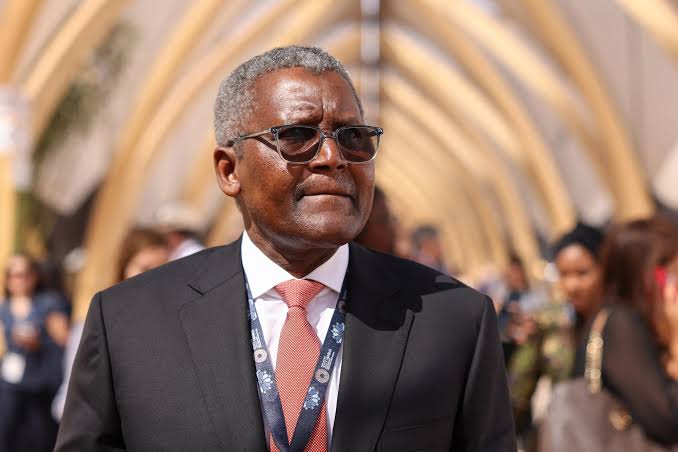
Aliko Dangote arrived at the Federal University of Technology Owerri to deliver a lecture. He left having committed N550 million to the institution — and having made an argument about Nigeria’s economic future that the students in that hall would do well to carry with them.
The Dangote Industries president announced the construction of a student hostel valued at N550 million for FUTO, alongside a N25 million cash donation disbursed directly to students through their Student Union Government. The hostel, when completed, will address a longstanding accommodation shortage at one of Nigeria’s premier technology universities — a practical intervention that goes beyond the symbolic gestures that often accompany high-profile campus visits.
But it was the lecture itself — themed around Enterprise, Leadership and Service to Humanity — that carried the more consequential message.
Dangote traced his own trajectory from cement distributor to Africa’s wealthiest industrialist, not as biography but as illustration. The pivot that defined his business career, he told students, was the decision to stop importing finished products and start manufacturing them locally — a process he called backward integration. That decision, repeated at scale across multiple industries, is the template he believes Nigeria’s economy must follow.
His framing of the alternative was characteristically blunt: importing finished products into Nigeria is equivalent to importing poverty, inflation, and unemployment. Every finished good that enters Nigeria instead of being produced here represents jobs created in the exporting country, value captured by foreign workers, and development funded by Nigerian consumer spending. The arithmetic is simple and the implications are uncomfortable for a country that remains heavily dependent on imported manufactured goods.
“A major key in industrialisation is looking inwards,” he said. “Investors in the industrial sector should come from the citizens.”
He drew the comparison with Asia deliberately. The economic transformation of countries like South Korea, Japan, China, and more recently Vietnam was not driven by foreign capital waiting to be attracted — it was driven by domestic investors who decided their countries were worth building. “Asian economies were powered by Asians, not foreign investment. They are the ones who invested in their countries. They did not wait for foreigners to come and develop their economies.”
The implication for Nigeria was direct: if Nigerian investors of means refuse to deploy capital at home, they cannot reasonably expect foreign investors to fill the gap. Dangote positioned his own investment decisions — the refinery, the fertiliser plant, the cement operations — as a deliberate rejection of that abdication.
He also offered the students a data point about Nigerian talent that cuts against persistent narratives of graduate underpreparedness. Young engineers trained at the Dangote Refinery and Fertiliser plant are being actively recruited by Gulf region companies, he noted, who treat them as expatriates — the same designation reserved for foreign specialists. The implication is that Nigerian engineering graduates, properly trained and exposed to world-class industrial environments, are globally competitive. The question is not whether the talent exists. It is whether Nigeria builds the industrial base to retain and deploy it domestically.
For FUTO students studying engineering and technology, the combination of a N550 million hostel commitment, a N25 million student fund, and a lecture from Nigeria’s most prominent industrialist amounted to more than a campus event. It was an argument — backed by the speaker’s own balance sheet — that manufacturing, local investment, and industrial thinking are not abstract policy positions. They are the decisions that determine whether an economy grows or stagnates.
Dangote made his choice in that direction decades ago. The lecture was an invitation for the next generation to make the same one.
