

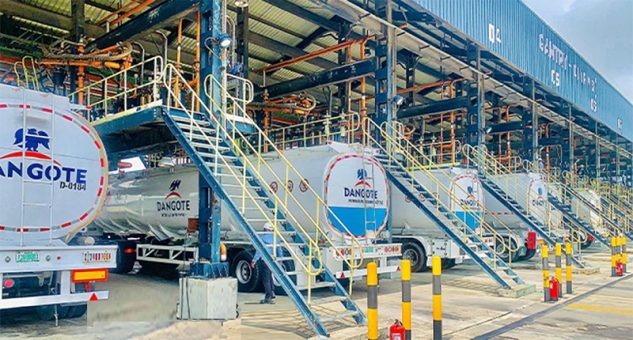
The Dangote Petroleum Refinery is already the largest on the African continent. If the expansion announced by Aliko Dangote proceeds as planned, it will become the largest on the planet.
Speaking in Lagos during his induction as an honorary fellow of the Nigerian Academy of Engineering, Dangote disclosed that the planned expansion of the refinery to 1.4 million barrels per day capacity will employ approximately 95,000 skilled workers at peak construction — a workforce figure that rivals the headcount of some of Nigeria’s largest employers.
“At the peak of construction for this expansion, we expect to have about 95,000 skilled workers on site,” Dangote said, framing the announcement not just as an industrial milestone but as a deliberate employment and capacity-building exercise rooted in Nigerian expertise.
The scale of what is being proposed is worth sitting with. The refinery currently operates at 650,000 barrels per day — already the highest capacity on the continent. Expanding to 1.4 million barrels per day would surpass India’s Jamnagar refinery, currently recognised as the world’s largest. For a country that spent decades exporting crude oil and importing refined petroleum products at significant foreign exchange cost, the trajectory represents a structural reversal of a dependence that has constrained Nigeria’s economy for generations.
Dangote was explicit about the intention to draw on Nigerian talent rather than import the workforce for the expansion. Engineers, technicians, artisans, and other skilled professionals will form the core of the construction workforce — a commitment that carries implications well beyond the refinery gates. Large-scale infrastructure projects that deliberately build local capacity create knowledge transfer effects that outlast the construction phase, leaving behind a more skilled workforce that subsequent projects can draw from.
Beyond the employment numbers, the expansion is expected to deepen Nigeria’s oil and gas value chain, stimulate local manufacturing supply chains, enhance technology transfer, and materially improve the country’s fuel security position. Nigeria’s foreign exchange burden from petroleum imports has been a persistent pressure point — one that the existing refinery has already begun to ease. A refinery operating at more than double the current capacity would extend that relief significantly.
“The scale of this expansion reflects our confidence in Nigerian capacity and our belief that Africa can build world-class infrastructure that meets global standards,” Dangote said.
Prof. Rahamon Bello, President of the Nigerian Academy of Engineering, captured the broader significance of the recognition conferred on Dangote at the event: “What makes this recognition fitting is not only what has been built but also what has been inspired.”
That framing is apt. The refinery’s existence has already shifted the conversation about what private Nigerian capital can accomplish at industrial scale. Its expansion — if executed — shifts it further. A Nigerian-built refinery becoming the world’s largest is not just an infrastructure story. It is a statement about the ceiling of African industrial ambition, and who gets to set it.
The construction timeline and detailed execution plan were not disclosed at the event. What was disclosed is the destination — and at 1.4 million barrels per day, it is an unambiguous one.
