

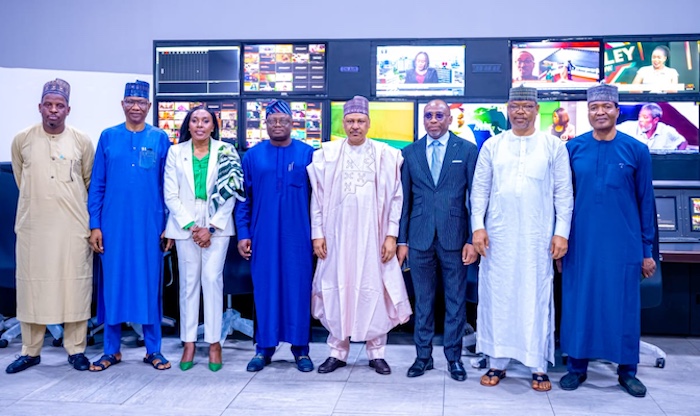
The Federal Government has officially launched its revamped Digital Switch Over ($\text{DSO}$) platform, FreeTV, at the Abuja headquarters of the Nigerian Communications Satellite Limited ($\text{NIGCOMSAT}$). The launch marks a structural shift away from legacy analogue transmissions toward a unified, data-secure digital broadcasting network.
The initiative aims to transition millions of households into a modern media network without requiring consumers to purchase new television sets. Existing equipment will remain compatible through authorized $\text{DVB-T2}$ or $\text{DVB-S2}$ digital set-top box decoders.
The platform will broadcast more than 100 national, regional, and state-level channels free of charge, offering dedicated Yoruba, Hausa, and Igbo stations alongside news, educational content, and sports entertainment.
Building a Hybrid Network and Promoting Local Manufacturing
Addressing an audience of signal distributors, local electronics manufacturers, and media executives, the Minister of Information and National Orientation, Mohammed Idris, clarified that the $\text{DSO}$ framework is not meant to phase out existing private digital platforms. Instead, it is designed to increase choice and lower entry barriers for local content producers.
The government is pursuing a hybrid broadcasting model that combines Digital Terrestrial Television ($\text{DTT}$) with Direct-to-Home ($\text{DTH}$) satellite links and web-based applications.
By anchoring the platform on local production, the Ministry expects the fully operational $\text{DSO}$ ecosystem to stimulate local hardware manufacturing, expand broadcasting audiences, and create thousands of jobs across the media supply chain. Extensive talks with the Broadcasting Organisations of Nigeria ($\text{BON}$) and the Advertising Regulatory Council of Nigeria ($\text{ARCON}$) helped secure industry-wide backing for the nationwide rollout.
Fibre Infrastructure and the Trillion-Dollar Target
The Minister of Communications, Innovation and Digital Economy, Bosun Tijani, placed the FreeTV rollout within the context of the country’s long-term digital growth goals. He noted that the platform acts as a key building block for the administration’s plan to build a trillion-dollar domestic economy.
To support this digital transition, Tijani highlighted key ongoing infrastructure investments:
-
Fibre Network Expansion: Plans are underway to deploy 90,000 kilometers of fiber-optic cables across the federation to improve internet speeds and data transmission.
-
Satellite Upgrades: The presidency has approved the acquisition and launch of two new communication satellites to expand $\text{NIGCOMSAT}$’s regional coverage.
-
Rural Connectivity: Using advanced satellite arrays to bring broadband internet to underserved and rural communities, providing a boost to local tech startups and digital creators.
A New Architecture for Media Revenue
The project was designed as a collaborative effort across several federal entities. $\text{NBC}$ Director-General Charles Ebuebu and $\text{NIGCOMSAT}$ Managing Director Jane Egerton-Idehen described FreeTV as a national communications architecture built to democratize access to digital services.
The platform’s underlying technology gives local content creators direct access to a larger, verified audience, making it easier for them to secure sustainable advertising revenue through $\text{ARCON}$-approved frameworks.
Deputy Speaker of the House of Representatives, Benjamin Kalu, attending as the special guest of honor, praised the inter-agency collaboration that brought the platform to life.
Historically, high import tariffs on digital decoders and fragmented signal standards have slowed the country’s migration away from analogue broadcasting.
By eliminating ongoing subscription fees for end-users, subsidizing the production of local set-top boxes, and investing heavily in fiber-optic backbones, the government is building a more resilient digital economy. This infrastructure upgrade helps move informal media production into a structured, trackable commercial market capable of driving local investment and accelerating digital transformation across West Africa.
