

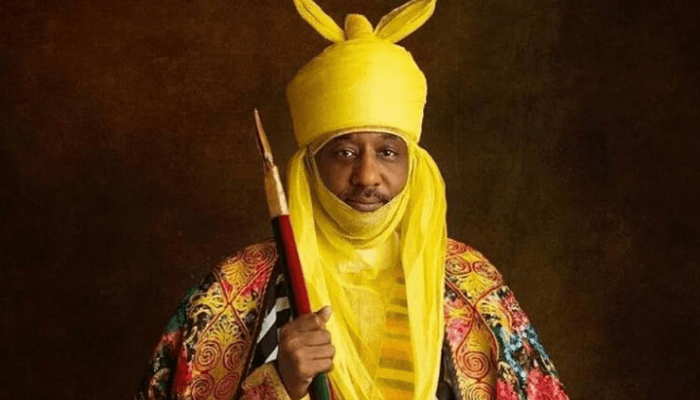
He was the man who first sounded the alarm on missing oil revenues. He later governed the Central Bank through some of its most turbulent years. Now, as Emir of Kano, Muhammadu Sanusi II is doing what he has always done best — asking the uncomfortable question in public, loudly enough that it can’t be ignored.
The question this time is simple. Brutal, even.
If Nigeria removed the fuel subsidy — a policy that was costing the government hundreds of billions of naira every month — where exactly is that money going? Because the borrowing hasn’t stopped. If anything, it has accelerated.
Speaking during an interview on News Central TV, Sanusi laid out the contradiction at the heart of Nigeria’s current fiscal posture with characteristic directness. “We’ve removed the subsidy. We’re now spending it. What we should not see is fiscal consolidation. You cannot remove wastages and continue borrowing. If you’re not paying the subsidy and you’ve got the money, why are we still borrowing and borrowing? What are we borrowing for?”
It’s a question that the numbers make very hard to deflect.
The Federal Government recently increased its 2026 borrowing plan by ₦11.31 trillion, pushing total projected borrowing for the year to ₦29.20 trillion. President Tinubu has separately written to the Senate seeking approval for a $516 million external loan to finance the proposed Sokoto-Badagry Super Highway. Meanwhile, Nigeria’s total debt service bill hit approximately ₦16 trillion in 2025 — a 22.9% jump from the ₦13.02 trillion recorded the year before. Federal Government bonds alone accounted for roughly ₦5.35 trillion of domestic interest payments.
These are not the numbers of a government that has found fiscal breathing room. They are the numbers of a government borrowing at pace while simultaneously arguing that removing the subsidy has created savings.
Sanusi’s position on the subsidy itself is unambiguous — he has long maintained that the regime was indefensible. “We cannot continue supporting foreign refineries. We’re an oil-producing country,” he said, pointing to the Dangote Refinery’s growing local output as evidence that the structural case for imported petroleum is weakening. On the economics of the subsidy removal and the exchange rate liberalisation, he is broadly supportive. His challenge is not to the policy — it is to the execution and the fiscal discipline, or lack of it, that followed.
“For me, removing subsidy or liberalising exchange rates — these are good interventions,” he said. “Were they done at the right time? Those are certain questions. Were there other things that should be done that have not been done? These are other issues.”
That nuance is important. Sanusi is not arguing that the subsidy should have stayed. He is arguing that removing it was supposed to create fiscal space — and that nearly three years later, the benefits should be visible in the government’s borrowing behaviour. They are not.
The Senate Appropriation Committee has claimed Nigeria is saving over ₦10 trillion annually from subsidy removal. If accurate, that figure makes the continued borrowing trajectory even harder to explain. A government saving ₦10 trillion a year does not need to expand its borrowing plan by ₦11 trillion in a single budget cycle — not without a very detailed account of where the savings are actually going.
That account has not been provided publicly. And that, ultimately, is Sanusi’s point.
