

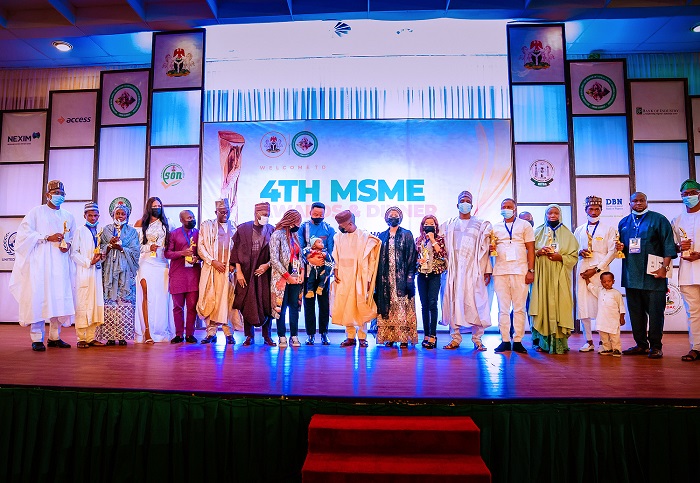
The Alliance for Economic Research and Ethics has issued a sharp critique of the Federal Government’s recently announced ₦1 billion Micro, Small, and Medium Enterprises (MSME) awards scheme. Labeling the initiative as a “kalokalo” (lottery) rather than a substantive economic strategy, the group argues that rewarding a small handful of businesses fails to address the systemic collapse facing millions of entrepreneurs.
As part of the 2026 National MSME Awards, the Presidency plans to distribute cash prizes to 100 selected businesses. However, the Alliance contends that this “photo opportunity” does nothing to bridge the staggering ₦13 trillion financing gap identified by the Central Bank of Nigeria (CBN).
Critique of the “Grant Competition” Model
The research group highlighted a massive disconnect between the scale of the government’s response and the depth of the economic crisis.
-
Statistical Mismatch: With MSMEs accounting for nearly 50% of Nigeria’s GDP and the bulk of its workforce, the group argues that 100 winners represent a statistically insignificant fraction of the sector.
-
Structural Needs vs. One-off Prizes: Small businesses are currently battling high energy costs, currency volatility, and double-digit interest rates. The Alliance insists that stable, predictable policies are more valuable than a “lucky” cash injection.
-
The “Photo Op” Narrative: The group warned that the scheme serves as a public relations exercise that masks the absence of long-term structural reforms.
Institutional Erosion and Accountability Gaps
A significant portion of the critique focused on governance and legality, specifically the rising influence of presidential advisory offices over established ministries.
“A Special Adviser has no legal standing to execute government policy.” — Alliance for Economic Research and Ethics
Key Governance Concerns:
-
Bypassing Agencies: The group noted a trend where initiatives are run from advisory offices rather than the ministries and agencies legally mandated to manage public funds.
-
Accountability Risks: By operating outside the established civil service structure, the group warns of a “weakening of institutions” and a lack of proper oversight and transparency.
-
Inefficiency: The reliance on advisors to execute policy creates overlapping responsibilities and undermines the long-term capacity of the Nigerian civil service.
A Call for Structural Overhaul
Instead of a competitive grant model, the Alliance urged the Federal Government to redirect its focus toward broad-scale economic enablers.
Recommended Policy Priorities:
-
Affordable Credit: Creating mechanisms to bridge the ₦13 trillion funding gap for all viable businesses, not just award winners.
-
Stable Exchange Rates: Reducing the uncertainty that hampers long-term planning and inventory procurement.
-
Reliable Power: Addressing the primary operational cost for Nigerian manufacturers and retailers.
-
Institutional Strengthening: Ensuring that the Ministry of Industry, Trade, and Investment and the Small and Medium Enterprises Development Agency of Nigeria (SMEDAN) lead MSME policy, rather than ad-hoc advisory committees.
The Economic Reality Check
| Metric | The Government’s Award Scheme | The National Reality |
| Total Funding | ₦1 Billion | ₦13 Trillion (Financing Gap) |
| Beneficiaries | 100 Businesses | Millions of Struggling SMEs |
| Duration | One-off Event | Continuous Economic Crisis |
| Lead Execution | Presidential Advisory Offices | Ministries & Legal Agencies |
The Alliance concluded by stating that for the millions of entrepreneurs who will not be “among the lucky hundred,” the economy remains a hostile environment. They maintain that the path to “Renewed Hope” for the sector lies in systemic ease of doing business, not the luck of the draw.
