

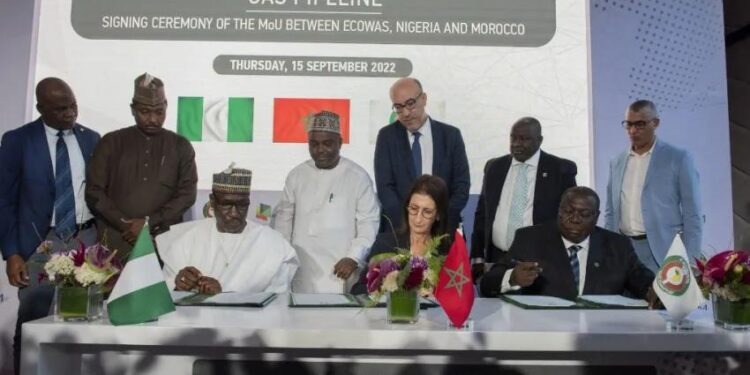
The African Atlantic Gas Pipeline is no longer just a conceptual drawing; it is evolving into a massive infrastructure reality. Spanning roughly 6,900 km, this hybrid offshore-onshore network is designed to link Nigerian gas fields to European markets via Morocco.
-
Total Capacity: Up to 30 billion cubic meters (bcm) of gas annually.
-
Distribution Split: 15 bcm is earmarked for Morocco’s domestic consumption and European exports, while the remainder fuels West African development.
-
Economic Catalyst: Beyond just moving gas, the pipeline is engineered to jumpstart mining, industrial hubs, and massive electricity generation across 13 nations.
Governance and Execution Framework
To manage a project of this scale, a dual-layered leadership structure is being established:
-
Political Oversight (Nigeria-based): A “High-Level Authority” will be seated in Nigeria, comprising ministers from all 13 participating ECOWAS countries to align regulations.
-
Operational Muscle (Morocco-based): A joint venture between NNPC Limited and Morocco’s ONHYM will handle the actual financing, construction, and engineering.
The Phased “Value-First” Rollout
Unlike traditional mega-projects that require one massive “Final Investment Decision,” the AAGP is being built in modular stages. This allows specific regions to start seeing economic returns before the entire line is finished.
This pipeline isn’t the first time these two giants have teamed up. It builds on a deep-seated bilateral relationship that already includes:
-
The Fertilizer Alliance: A massive joint venture combining Nigerian gas with Moroccan phosphate to turn Nigeria into a regional fertilizer powerhouse.
-
Energy Security: As Nigeria leverages its status as Africa’s largest oil producer (and home to the Dangote Refinery), this pipeline allows it to finally monetize its vast, underutilized gas reserves.
