

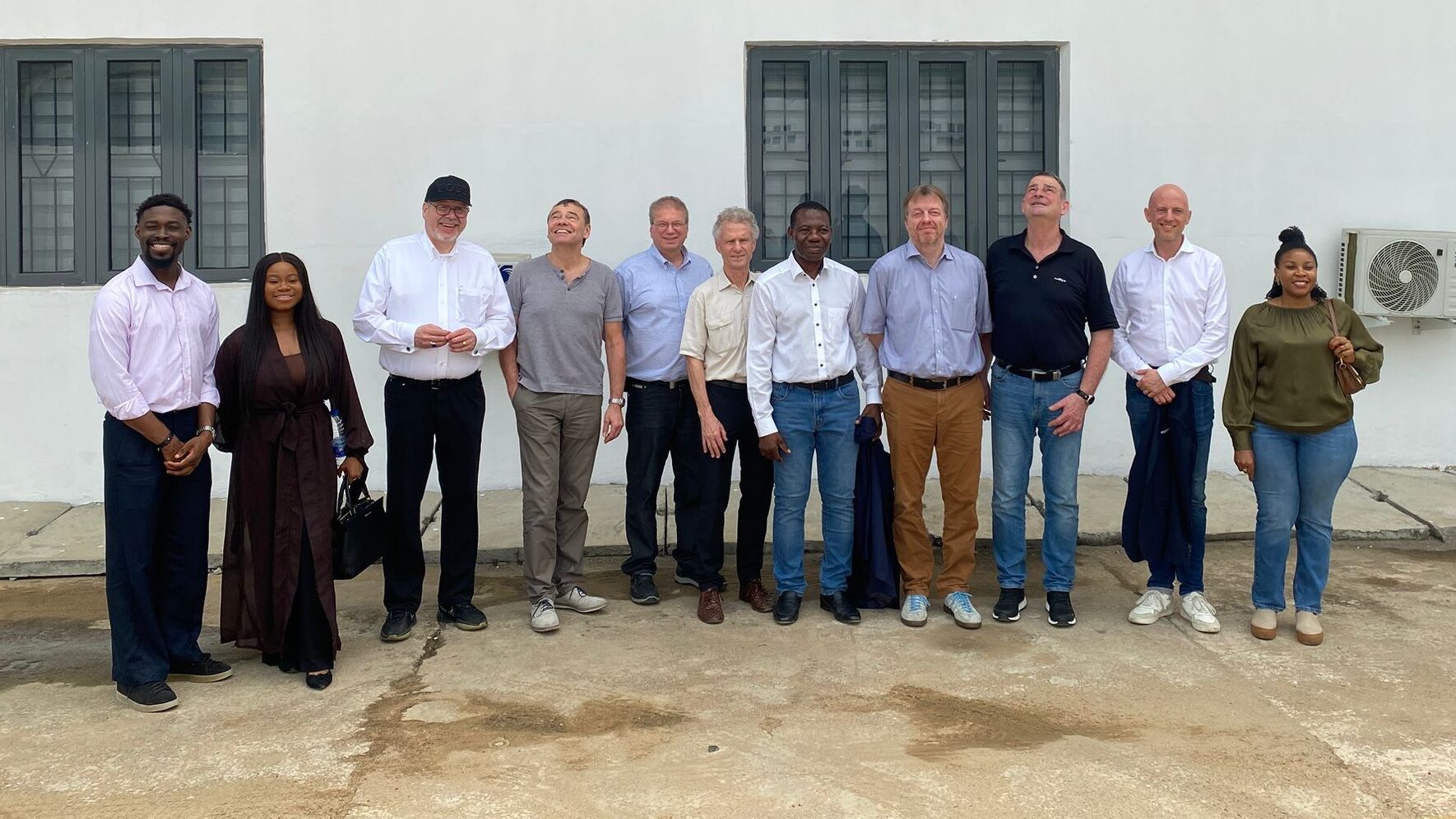
Seven German companies flew into Lagos with a specific brief: find Nigerian partners, identify local representatives, and access the talent pool that German firms are increasingly looking toward Africa to fill. The delegation, facilitated by the Delegation of German Industry and Commerce in Nigeria, signals something more structured than the typical bilateral trade conversation — this is market entry in motion.
Speaking at a business conference on technological developments in Lagos, Catherine Nwaiku, General Manager of DGIC International Business Service Limited, explained that the mission was designed to match the seven German companies — all active in ICT and labour mobility — with suitable Nigerian counterparts. The project is funded by Germany’s Federal Ministry of Economic Affairs and Energy, giving it the institutional backing that separates a serious market entry initiative from an exploratory visit.
The focus areas are telling. ICT and labour mobility are not arbitrary choices. Germany has a well-documented skilled labour shortage — one that has become a structural constraint on its economy and a driver of increasingly active outreach to talent markets across Africa and beyond. Nigeria, with its large and growing population of technically trained graduates, represents exactly the kind of talent pipeline German companies are trying to access. The bilateral framing of the mission — solving a Nigerian market entry problem for German firms while simultaneously addressing a talent deficit problem for the German economy — makes the partnership logic genuinely mutual rather than extractive.
Khadi Camara, Head of Countries and Markets at the German-African Business Association, was direct about what the German companies are navigating. “Some of the companies do not know where to start or what kind of partners to work with. Others are desperately looking for talent to introduce to German companies,” she said. The delegation’s role is to provide the connective tissue — identifying reliable local representatives, structuring business-to-business interactions, and following up to support the establishment of formal representation in Nigeria.
That follow-through commitment matters. Many foreign business delegations visit Nigeria, attend conferences, exchange cards, and produce nothing durable. Camara’s explicit mention of post-visit support — helping companies open local representation and establish real partnerships — suggests a more patient and structured approach than the standard trade mission format.
The Nigerian side of the conversation raised its own pointed observations. Boye Ademola, founder of Bazara Technologies, used the panel session to push back on a tendency toward passivity in how Nigerian firms present themselves globally. “We need to build world-class products. Germany built a design. We need to do a lot of design and create a product that works,” he said — a challenge directed at Nigerian tech companies to compete on product quality rather than simply positioning as a market or a talent source.
Oluwanifemi Akinwamide, Head of Global Operations at AltSchool Africa, identified perception as a persistent barrier. “Our German counterparts have come here and seen a different angle of how Nigerians actually are, seeing that we are not as bad as people claim that we are. More of this is what is missing.” The observation points to a reputational gap between how Nigeria is perceived in international business circles and the reality on the ground — a gap that direct engagement, of the kind this delegation represents, is better positioned to close than any marketing campaign.
The ICT sector is the natural meeting point for this partnership. Nigeria’s tech ecosystem has demonstrated genuine capacity at the product and talent level. Germany’s industrial and engineering sectors have the scale, the market access, and now the active need to absorb skilled professionals and establish partnerships in high-growth emerging markets. The alignment of interests is clear.
What converts a Lagos conference into a lasting bilateral business relationship is execution — the follow-up meetings, the signed agreements, the local offices eventually opened. The delegation has laid the groundwork. Whether the seven German companies find what they came for will be the story worth tracking over the next twelve months.
