

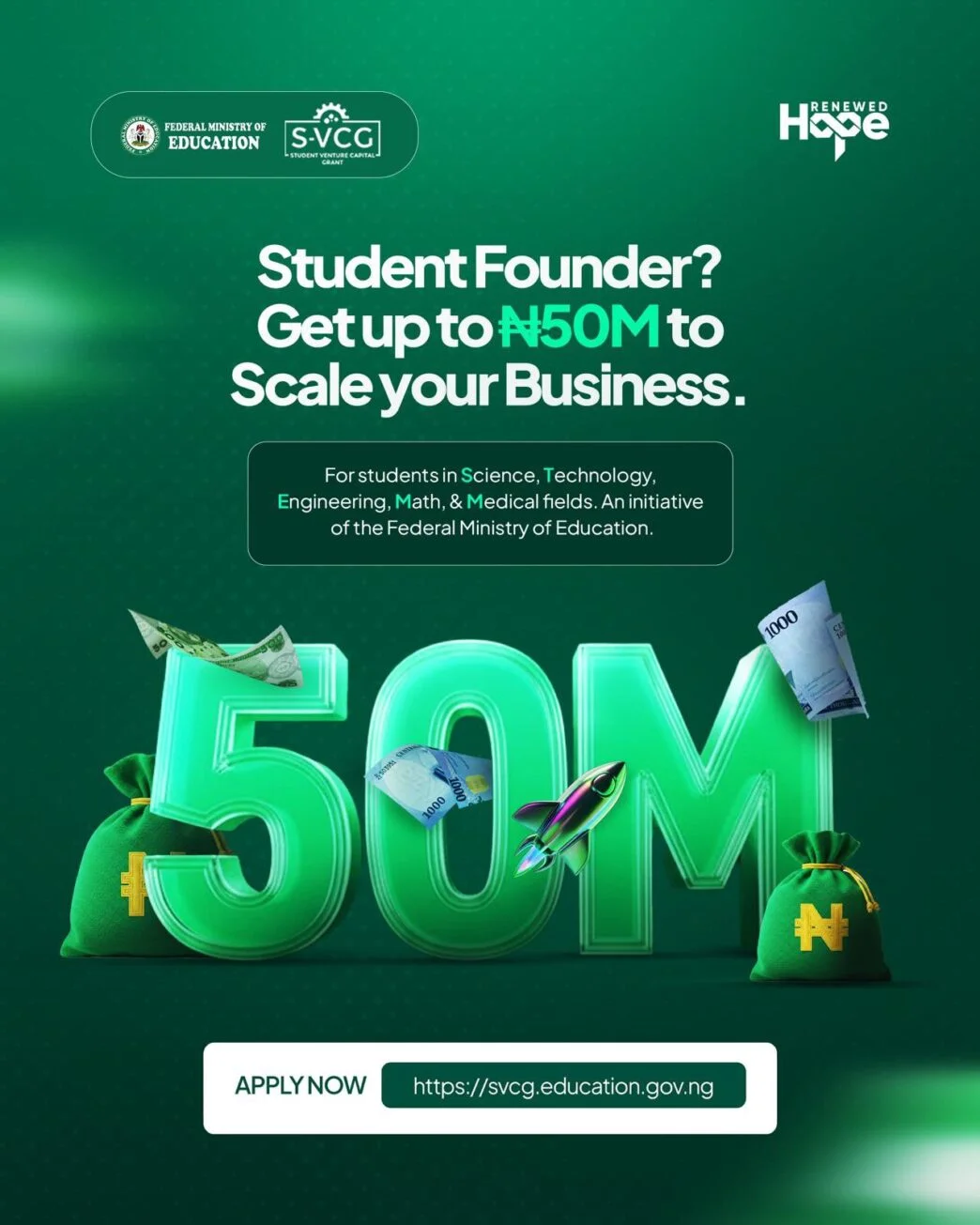
The Federal Government’s ambition to transition from a consumer economy to an innovation-led powerhouse has reached a critical bottleneck: the selection of the “Final 65.” Out of an overwhelming sea of 30,639 applicants across 404 tertiary institutions, only 0.2% of Nigeria’s student entrepreneurs have survived the rigorous vetting for the Student Venture Capital Grant (S-VCG).
This isn’t just another government handout; it is a high-stakes competitive play in partnership with the Bank of Industry (BOI) to identify ventures ready for the global stage.
The “Algorithmic” Gatekeeper
The selection process was a masterclass in modern institutional transparency. To manage the massive influx of data, the Ministry deployed AI-enabled screening to strip away human bias and verify eligibility at scale. This was followed by a “Triple-Helix” review involving industry titans, academic researchers, and professional investors. The criteria were ruthless:
-
Scalability: Can this business grow beyond the campus?
-
Feasibility: Is the technology or model realistic in the current 2026 market?
-
Founder Capability: Does the student have the “grit” to manage ₦50 million?
The 72-Hour “Venture Forge”
Between March 26 and March 29, 2026, the 65 finalists will be thrust into an intensive development bootcamp. This is designed to be a “simulated VC environment,” featuring:
-
Investor-Style Feedback: Direct critiques from real-world venture capitalists.
-
Pitch Sessions: High-pressure delivery to prove their commercial viability.
-
Live Evaluations: Real-time assessments that will determine who walks away with the ₦50 million equity-free funding.
The Macro View: Building a “Sovereign Pipeline”
Education Minister Dr. Tunji Alausa is framing the S-VCG as a “strategic investment” rather than an expense. By offering equity-free capital, the government is effectively de-risking these startups, making them highly attractive to private Series A investors later on.
The climax of this initiative arrives on Sunday, March 29, 2026, at the Beneficiary Awards Day. Beyond the ₦50 million checks, the true value lies in the message being sent to the world: Nigeria’s next generation of “Unicorns” is no longer waiting for graduation to start building.
