

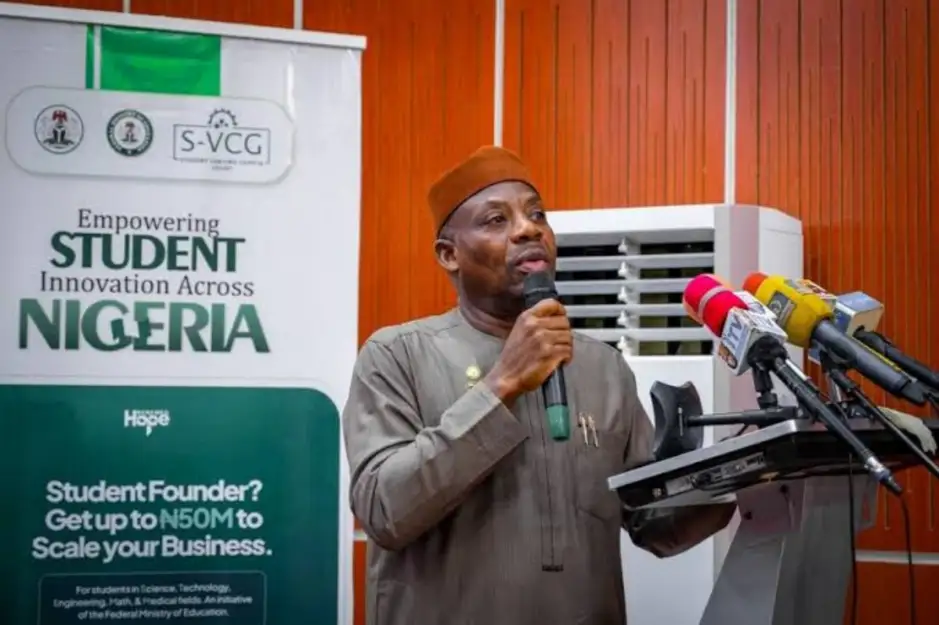
In a fundamental shift in Nigeria’s educational philosophy, the Federal Government has transitioned from “certification-based” learning to “innovation-driven” enterprise. Under the newly launched Student Venture Capital Grant (SVCG), 45 student-led startups have each been awarded ₦50 million, totaling a ₦2.25 billion injection into the nation’s youngest academic entrepreneurs.
The ceremony, held at the UNDP Innovation Hub, marks a strategic move to reposition tertiary institutions not merely as factories for diplomas, but as incubators for global solutions.
A Competitive Surge in Intellectual Capital
The scale of interest in the SVCG reveals a massive, untapped reservoir of talent within Nigeria’s academic walls:
-
The Volume: Over 30,000 applications were submitted.
-
The Reach: Founders emerged from more than 400 tertiary institutions nationwide.
-
The Shift: Education Minister Dr. Tunji Alausa emphasized that the government is actively steering graduates away from the traditional “job seeker” mindset toward becoming “job creators.”
More Than a Grant: The Incubation Ecosystem
Recognizing that capital without guidance often fails, the SVCG is structured as a comprehensive support system rather than a simple cash disbursement. Beneficiaries receive:
-
Structured Incubation: Professional environments to refine business models.
-
Strategic Mentorship: Direct access to industry veterans and ecosystem leaders.
-
Digital Toolkits: Access to high-end technological resources required to scale software or hardware innovations.
The Global Partnership: Education Meets Investment
The United Nations Development Programme (UNDP) has hailed the initiative as a “strategic national system” that finally connects the dots between research, innovation, and investment.
Resident Representative Elsie Attafuah noted that the program’s design ensures sustainability, aiming to convert:
-
Ideas into Enterprises
-
Enterprises into Jobs
-
Jobs into Industries
Economic Diversification Through the Classroom
The Minister of State for Education, Prof. Suwaiba Sa’id Ahmad, highlighted that student entrepreneurship is a critical pillar for Nigeria’s broader economic diversification. By empowering students to solve real-world problems while still in school, the government is building a “resilient human capital” base that can weather global economic shifts.
This initiative aligns with other massive federal plays, such as the ₦12 billion research cluster proposal and the drive toward a $1 trillion economy, signaling that Nigeria’s path to prosperity is now being paved by its student innovators.
