

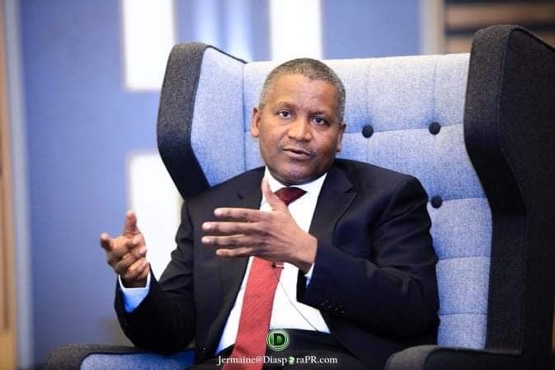
Africa’s richest businessman, Aliko Dangote, has renewed calls for deeper regional integration, warning that Africa’s economic ambitions will remain limited unless governments dismantle the bureaucratic barriers restricting the movement of people, goods, and services across the continent.
Speaking during a high-level discussion with Makhtar Diop, Dangote said the inability of African entrepreneurs to move freely across borders continues to undermine the goals of the African Continental Free Trade Area.
According to him, despite decades of conversations around integration and economic cooperation, practical progress remains slow due to excessive visa restrictions and trade bottlenecks.
Dangote disclosed that he currently requires visas for 38 African countries, describing the process as a major contradiction to the continent’s stated vision of a unified market.
He noted that Africa’s business environment cannot truly thrive when investors and entrepreneurs face such severe mobility restrictions within their own region.
The industrialist said this frustration inspired the creation of the African Renaissance Group, a coalition of leading African corporate executives focused on promoting unrestricted movement across African markets.
The group is pushing for reforms that would allow easier access for business leaders, investors, and professionals while strengthening regional commerce.
Dangote argued that inefficient border systems are raising costs for consumers and businesses alike, making intra-African trade unnecessarily expensive.
He cited logistics inefficiencies as a major obstacle, noting that moving goods between African countries can cost significantly more than importing products from Europe.
As an example, he observed that shipping cargo from Spain to Lagos is often cheaper and faster than transporting goods from Lagos to Ghana, despite the much shorter regional distance.
He also pointed to air travel costs as another barrier to integration, stating that flights between neighbouring West African countries remain prohibitively expensive for many entrepreneurs and students.
According to him, these high transport costs discourage cross-border business expansion and weaken the continent’s competitiveness.
With support from the International Finance Corporation, Dangote said the African Renaissance Group is working to remove these structural obstacles and promote a business environment similar to the European Union, where capital and labour can move freely across borders.
He stressed that Africa’s challenge is no longer a lack of opportunity or market demand but the inability to efficiently deliver integration in practice.
Dangote added that Africa’s long-term economic future depends on replacing policy declarations with concrete implementation that enables businesses to operate seamlessly across national boundaries.
He said unlocking free movement would empower a new generation of African entrepreneurs and accelerate industrial growth across the continent.
