

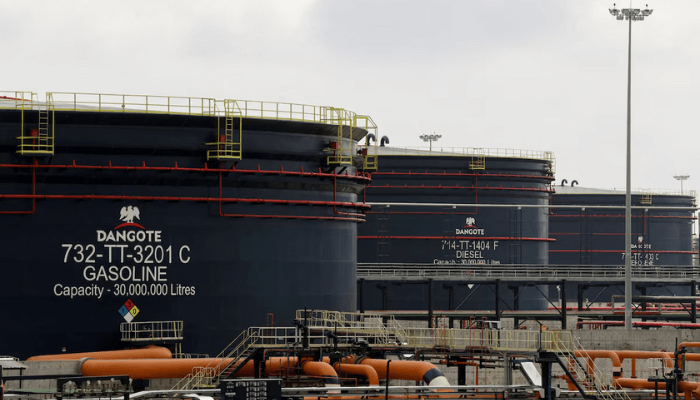
Africa’s largest refinery is running at full capacity, exporting record volumes of jet fuel to European buyers, and generating margins that analysts estimate at more than double what European refiners are earning on the same product. It is, by any commercial measure, a remarkable success story.
It is also, depending on where you sit, a crisis.
Nigerian airlines are threatening to halt all flights. Jet fuel prices at the pump — accounting for logistics and storage — have climbed to ₦3,300 per litre, nearly triple what they were in February before the outbreak of the Iran war triggered unprecedented energy market disruption. The government moved last week to approve debt relief for local carriers and ordered emergency talks aimed at negotiating lower prices. The situation is urgent enough that the state had to intervene.
And at the centre of it all sits the Dangote refinery — fully operational since the start of 2026, producing at its maximum capacity of 650,000 barrels per day, and navigating a set of commercial incentives that point firmly away from solving Nigeria’s domestic aviation fuel problem.
The mechanics of the situation are worth understanding clearly. Dangote, as a private refinery operating in a fully deregulated market, prices its products in response to global market conditions. Nigeria removed fuel subsidies, meaning there is no government mechanism softening the impact of international price movements on domestic consumers. When European buyers — stocking up ahead of peak summer travel season — are willing to pay a premium for jet fuel, Dangote can and does sell to them. European imports from Nigeria averaged between 78,000 and 96,000 barrels per day in April, according to data from Kpler and LSEG — the highest on record.
Alan Gelder, Senior Vice President for refining at Wood Mackenzie, estimated that European refiners were earning around $15 per barrel on jet fuel. Dangote’s margins, he estimated, are more than double that — a function of the refinery’s scale, sophistication, and access to Nigerian crude. The profits from jet fuel production hit a record on international markets in March.
But here is the complication that makes the story more than a straightforward commercial triumph. Dangote is not primarily running on Nigerian crude — and that is not entirely by choice. The state oil company, NNPC, has long-standing debt repayment agreements that tie much of Nigeria’s roughly 1.5 million barrels per day of production to oil-backed loans and pre-export deals with international oil majors, banks, and traders. Analysts estimate these obligations consume approximately 400,000 barrels per day. NNPC does not publicly disclose its full obligations.
The result is that Dangote imports most of its crude from the United States, with some from other African producers and Brazil — a situation that adds freight costs and complicates the refinery’s ability to maximise its cost advantage. Dangote Group Vice President Davekumar Edwin confirmed the import dependency without providing precise figures, noting that the bulk of the refinery’s 24 million litres of daily jet fuel production is shipped to Europe, while also claiming the refinery largely covers Nigerian airlines’ estimated daily requirement of 2.1 million litres.
That last claim sits awkwardly alongside the aviation industry’s declared crisis. The Airline Operators of Nigeria has been unambiguous: prices have become unsustainable, and flights may stop. Nigeria’s energy regulator says Dangote is selling jet fuel at ₦1,879 per litre — comparable to the ₦1,900 per litre cost of imported fuel delivered to Lagos. The gap between that figure and the ₦3,300 per litre airlines are actually paying reflects the logistics and storage costs layered on top — costs that the refinery’s domestic presence has not, in practice, eliminated.
The broader promise of the Dangote refinery was always threefold: end Nigeria’s dependence on fuel imports, improve domestic fuel availability, and shield the economy from global energy shocks. On the first two counts, progress is real. On the third, the Iran war has exposed the limits of what even the continent’s largest refinery can deliver when it operates in a fully deregulated market with global price exposure and a state crude supply chain encumbered by decades of debt obligations.
Building a large refinery, as Gelder noted plainly, “does not automatically mean fuel prices fall.”
Dangote is also planning to list shares in the coming months and is expanding the complex toward 1.4 million barrels per day capacity — a scale that could make it the world’s largest refinery by the end of the decade. The commercial trajectory is clear and ambitious.
What is less clear is how Nigeria resolves the tension between a world-class private refinery optimising for global market returns and a domestic aviation sector that cannot survive the prices those returns require.
That is not a refinery problem. It is a policy problem. And it is one the government’s emergency talks have not yet solved.
