

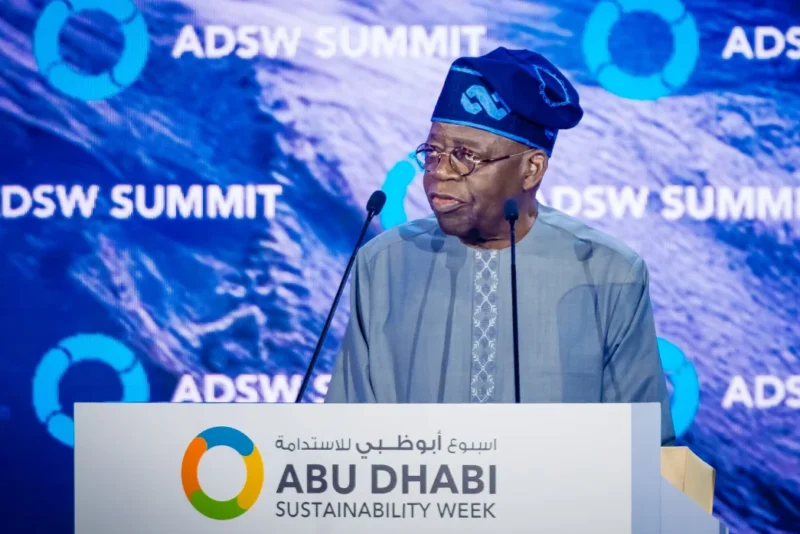
The conclusion of the 2026 Abu Dhabi Sustainability Week (ADSW) has marked a historic realignment of Nigeria’s economic and environmental foreign policy. President Bola Ahmed Tinubu’s return to Abuja on Saturday, January 17, following the signing of a Comprehensive Economic Partnership Agreement (CEPA) with the United Arab Emirates, signals a decisive shift toward “Climate Capital” and high-value non-oil exports.
The CEPA Framework: A Gateway to Global Markets Signed by the Minister of Industry, Trade and Investment, Dr. Jumoke Oduwole, the CEPA is far more than a standard trade pact. It creates a “Global Hub” for Nigerian goods through the UAE’s world-class logistics network.
-
Tariff Elimination: Immediate duty-free access for over 7,000 Nigerian product lines, including agricultural produce, chemicals, and pharmaceuticals.
-
Phased Industrial Integration: Tariffs on machinery, electrical equipment, and vehicles will be eliminated over a three-to-five-year horizon.
-
Business Mobility: A breakthrough in visa policy allows Nigerian business owners to stay in the UAE for up to 90 days annually, with renewable three-year permits for intra-corporate transferees (ICTs).
Targeting $30 Billion in Climate Finance Under the theme “The Nexus of Next: All Systems Go,” President Tinubu utilized the ADSW platform to invite a fundamental shift in global finance. He announced Nigeria’s ambition to mobilize $30 billion annually in climate and green industrial finance. This strategy aims to decouple Nigeria’s growth from oil dependence by focusing on:
-
The National Climate Change Fund: Targeting a $2 billion capitalization.
-
The Climate Investment Platform: Aiming for $500 million in climate-resilient infrastructure.
-
Critical Minerals: A call for partnerships in the lithium and minerals sector, specifically focusing on local value-addition and battery production.
Investopia Lagos: The Next Chapter To bridge the gap between policy and implementation, Nigeria will co-host the Investopia Summit in Lagos this February. This UAE-backed global platform is designed to convert the momentum of the Abu Dhabi trip into concrete, bankable investments on Nigerian soil.
The Strategic Outlook The administration’s focus on “blended finance” and “first-loss capital” mechanisms reflects an attempt to bypass the restrictive sovereign guarantees that often hinder developing nations. By positioning Nigeria as the gateway to the African Continental Free Trade Area (AfCFTA) for Gulf investors, the 2026 Abu Dhabi trip has laid the groundwork for a more diversified, green-led industrial future.
