

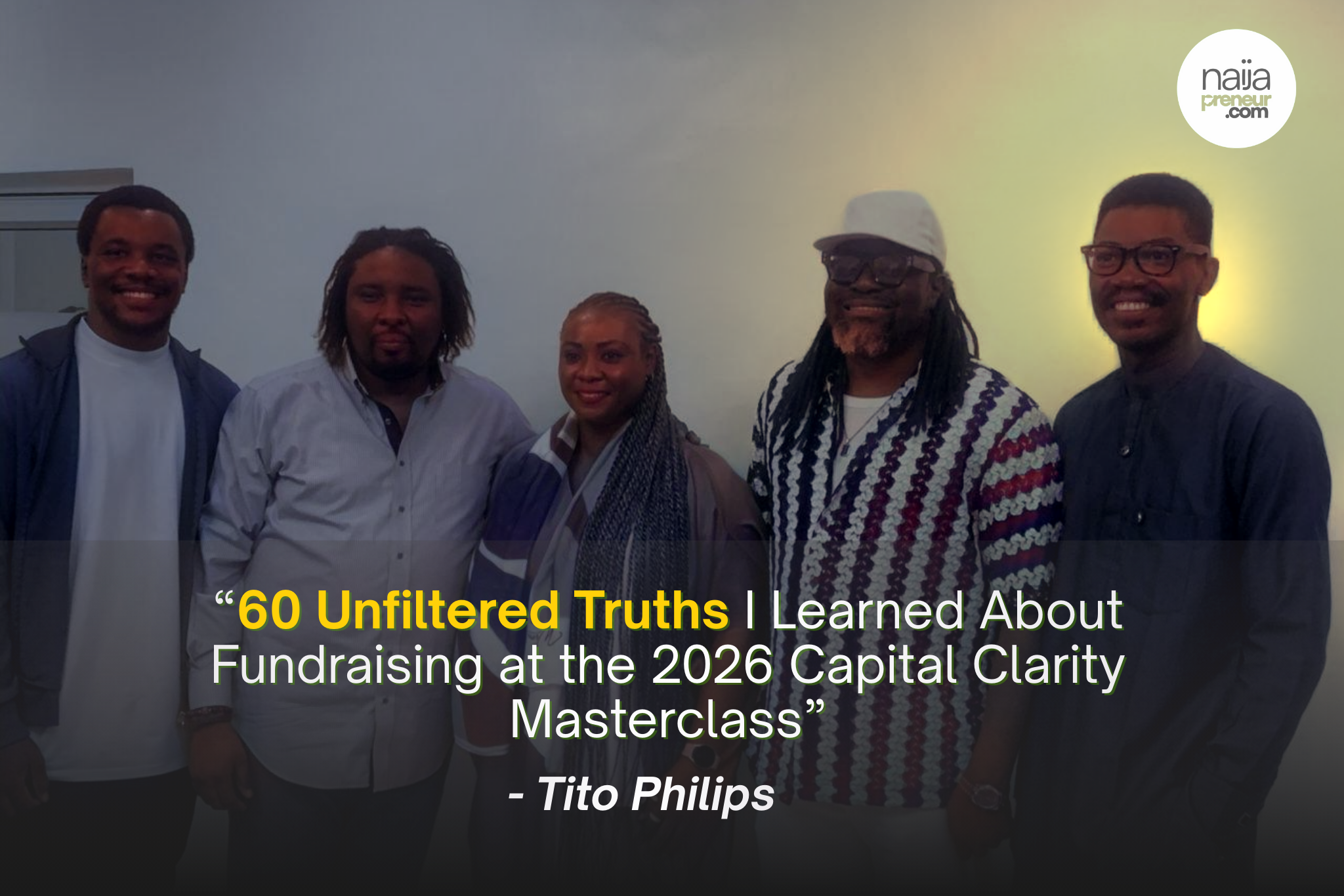
On the 20th of December 2025, I had the privilege of attending the Capital Clarity Masterclass, a powerful learning experience curated by my mentor, Dr. Solomon King. It wasn’t another motivational talk or surface-level fundraising seminar. It was a deep, unfiltered dive into the mindset, mechanics, myths, and realities of raising capital and building a truly fundable business.
The session was rich with brutal honesty, strategic frameworks, and foundational wisdom drawn from years of real-world experience. Alongside Dr. Solomon King were two outstanding voices in the capital ecosystem—Audrey Odogu and David Lanre Messan (DLM)—each bringing clarity from different but complementary angles.
Whether you are bootstrapping, applying for grants, or preparing for investor conversations, the lessons shared were practical, timeless, and deeply instructive.
Below are 60 key truths from the masterclass that every entrepreneur should internalize.
Part 1: The Foundation of Capital – With Dr. Solomon King
-
We often disrespect capital—we want it but don’t understand or honor it enough to attract it.
-
Truth produces results only for those who truly understand it.
-
In the world of capital, reputation is everything.
-
Your first and most important capital is creativity.
-
Faith, hope, love, and courage are all forms of intangible capital.
-
Capital goes beyond cash—take a full inventory of what you already have.
-
Fundraising is a relationship business, and relationships thrive on value.
-
Serving others authentically is not foolishness; it’s strategy.
-
Value recognizes value—never reduce people to tools.
-
Service is the seed that produces honor and access.
-
When passion fades, deliberately seek new inspiration through learning and mentorship.
-
Myth: Cash is the only capital.
-
Myth: Investors invest out of goodwill.
-
Myth: Capital is selective—it is actually strategic.
-
Myth: Capital automatically equals success.
-
Long-term equity is often better than dragging short-term debt.
-
The real price of equity is control.
-
Not all money is good money—be selective.
-
Money can stop you from thinking; systems must force strategy.
-
Cash flow is good, but profit is ultimate.
-
Research is one of the most underestimated tools in entrepreneurship.
-
Regularly audit your capital inventory—relationships, skills, teams, memberships.
-
Ask critical questions: Who knows you? What game are you playing? How do you retain earnings?
-
Authority attracts capital—become known in your industry.
-
You cannot outwork poor structure.
-
Consistency is a powerful but underrated business skill.
-
Every business has two sides: profit and impact.
Part 2: The Grant Strategy – With Audrey Odogu
-
There is free money—grants—for almost everything.
-
People give money to people they know; visibility matters.
-
You control your positioning, even if you don’t control selection.
-
Comparative advantage is often the final, uncontrollable filter in grant decisions.
-
ESG (Environmental, Social, Governance) is non-negotiable for grants.
-
Humanize your business by clearly defining its social impact.
-
Deep and broad research is the gateway to finding the right grants.
-
Position your business as an extension of the funder’s mission.
-
Funders prefer partnerships and institutional affiliations.
-
Grants are awarded to organizations, not individuals.
-
Age-limited grants are often testing grants designed for motivation and validation.
Part 3: The Unfiltered Playbook – With David Lanre Messan (DLM)
-
There is conventional fundraising (with templates) and unconventional fundraising (without them).
-
Before strategy, gain clarity on your business stage and appropriate funding sources.
-
Readiness covers documentation, mindset, network, and research.
-
Fundraising is continuous, not a one-off event.
-
Know exactly why you need the money—allocation is critical.
-
A solid use-of-funds structure typically looks like:
-
Product/Tech (35%)
-
Sales/Marketing (30%)
-
Operations (20%)
-
Team (10%)
-
Contingency (5%)
-
Investor KPIs such as MRR, CAC, churn, and burn rate are non-negotiable.
-
Minimum Viable Testing (MVT) reveals whether real demand exists.
-
MVT is rooted in human-centered product design.
-
Build with an exit in mind—acquisition or IPO clarifies ROI.
-
Clearly define your revenue model: first purchase, repeat purchase, and LTV.
-
No automatic demand means your problem or model needs rethinking.
-
Boards are for scaling businesses, not idea-stage ventures.
-
At the idea stage, you need experts, consultants, and venture builders.
-
Vision flows from a clearly defined customer problem.
-
Fundraising ultimately rests on strategy, readiness, and networking.
-
Investors love founders who report proactively.
-
Build your personal brand alongside your business.
-
Expect rejection—about 99% of the time.
-
The new Ps of marketing are Platforms, People, Products, and Paradigm.
-
Community is one of the strongest modern marketing tools.
-
Ads fail when there’s no storytelling and no audience readiness filtering.
Final Thoughts
The Capital Clarity Masterclass was a powerful reminder that capital attraction starts internally—with clarity, structure, credibility, and genuine relationship-building. Money follows understanding, not desperation.
My sincere appreciation goes to Dr. Solomon King, Audrey Odogu, and David Lanre Messan for sharing insights that cut through noise and expose the real work behind sustainable fundraising.
Which of these truths resonates most with your current journey?
Join the conversation in the comments.
