

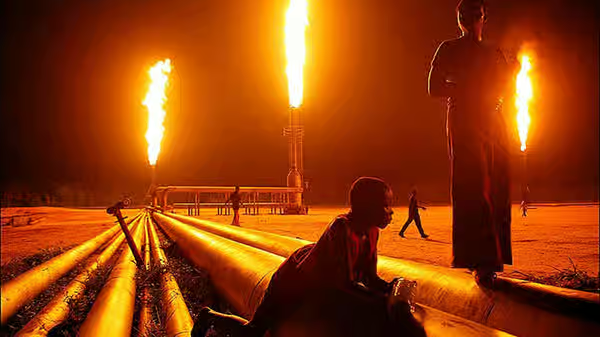
Nigeria has launched a decisive campaign to convert a massive environmental hazard—gas flaring—into a powerful economic and energy asset. Under the Nigerian Gas Flare Commercialisation Programme (NGFCP), the government has awarded permits to 28 companies to capture and commercialise gas that was previously burned off as waste by the oil industry.
This initiative is a critical step in harnessing Nigeria’s vast gas reserves, which historically have been flared because capturing them was deemed commercially unviable. The NGFCP is poised to unlock up to billion in foreign investment and create over 100,000 direct and indirect jobs.
Monetizing Methane: Economic and Environmental Gains
The Nigerian Upstream Petroleum Regulatory Commission (NUPRC) confirmed that the permits were awarded after receiving 42 bids across 49 flare sites in the oil-producing Niger Delta. Gbenga Komolafe, head of NUPRC, announced that the program aims to capture a staggering 250 to 300 million standard cubic feet of gas that would otherwise pollute the atmosphere.
The commercialization effort delivers dual benefits crucial to Nigeria’s future:
-
Emission Reduction: The NUPRC estimates the initiative will cut roughly six million tons of carbon dioxide () emissions annually, significantly contributing to the national pledge to achieve net-zero emissions by 2060.
-
Energy Generation: The captured gas holds the potential to support nearly three gigawatts (3 GW) of new electricity generation, addressing the nation’s energy deficit while diversifying its power sources.
A Shift from Waste to Wealth
Nigeria, Africa’s largest crude oil producer, holds gas reserves that surpass its oil reserves. Historically, about 7.6% of its gas output was flared, as reported by NUPRC in October.
The NGFCP fundamentally alters this paradigm by offering incentives for the industry to invest in capture and sales technology. By transforming a wasteful process into a commercial venture, the program not only boosts government revenue but positions gas as a foundation for economic development and industrial growth, finally maximizing the country’s vast hydrocarbon resources.
