

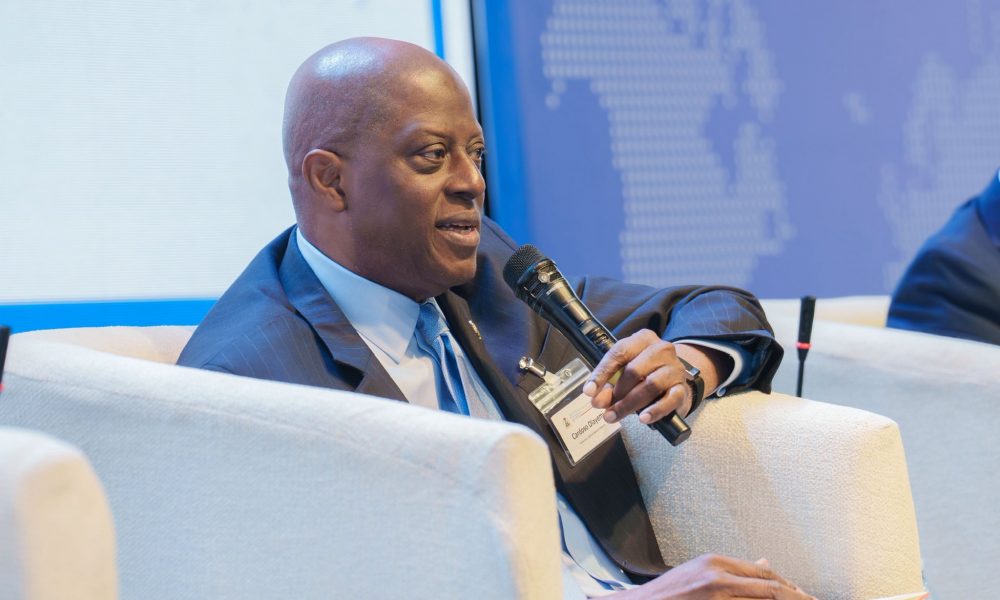
ABUJA — At the Intergovernmental Group of Twenty-Four (G-24) meetings on February 19, 2026, Nigeria’s top economic leaders delivered a stark message to the global community: the world’s “financial plumbing” is broken for emerging markets. Central Bank Governor Olayemi Cardoso and Finance Minister Wale Edun argued that high costs and settlement delays are no longer just technical nuisances—they are systemic barriers to economic sovereignty.
“Payment Systems are the Heart of Inclusion”
Governor Cardoso framed the modernization of payment systems as a prerequisite for national development. Under the Payment System Vision 2028, Nigeria has moved to replace aging infrastructure with the National Payment Stack (NPS).
The 2025/2026 Reform Impact:
-
ISO 20022 Adoption: The shift to this global messaging standard allows Nigeria’s systems to communicate seamlessly with international banks while handling multiple currencies in real-time.
-
Remittance Surge: Monthly inflows have stabilized at $600 million, with a strategic goal of $1 billion per month by the end of 2026.
-
South-South Integration: Cardoso emphasized that digital systems enable “local-currency settlement,” reducing Nigeria’s dependence on traditional reserve currencies like the US Dollar and strengthening trade links with other developing nations in Asia and Latin America.
The “Age of Competition” and Debt Distress
Finance Minister Wale Edun provided a sobering counterpoint, warning that the global economy is entering an “Age of Competition” marked by geopolitical rivalries and shrinking multilateral cooperation.
The EMDE Financing Crisis:
-
Market Access: Over 25% of Emerging Market and Developing Economies (EMDEs) have lost access to international capital markets.
-
Debt Distress: More than half of low-income countries are currently in or approaching debt distress.
-
African Marginalization: Despite hosting 17% of the global population, Africa accounts for only 3% of global trade and 2.5% of GDP.
Edun noted that Nigeria is actively pivoting away from a debt-driven growth model toward an investment-led model, aiming to push GDP growth to 7% and raise national investment to 30% of GDP.
“Measured Resilience, Constrained Ambition”
Iyabo Masha, Director of the G-24 Secretariat, described the current state of developing economies as one of “measured resilience” but cautioned that ambition is being stifled by limited fiscal space. With external debt for developing nations hitting $487 billion, the G-24 is calling for:
-
IMF Safety Net Expansion: Strengthening the global financial backstop.
-
Concessional Lending: Increasing the flow of low-interest loans for climate and infrastructure.
-
Human Capital Investment: Prioritizing health and education despite tightening global financial conditions.
Summary: Rewriting the Rules of Participation
| Reform Pillar | Objective | 2026 Target |
| National Payment Stack | Real-time, multi-currency settlement. | Full industry migration to ISO 20022. |
| Remittance Tools | Simplify diaspora family and investment transfers. | $1 Billion monthly inflow. |
| Local-Currency Trade | Reduce dependence on reserve currencies. | Expansion of PAPSS and South-South trade. |
| Investment Model | Shift from debt-driven to equity-driven growth. | 7% GDP growth rate. |
