

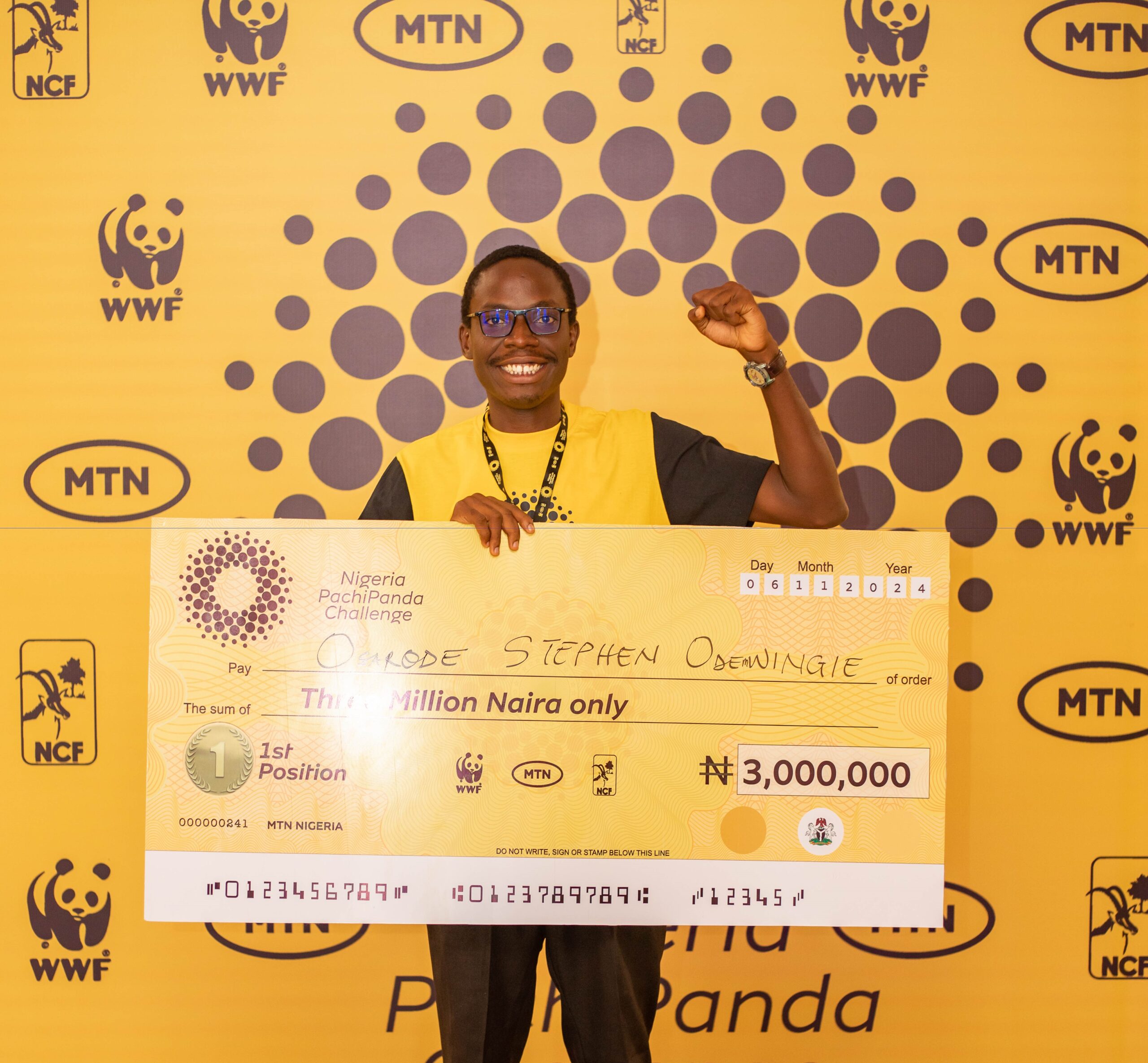
As Nigeria moves closer to its Sustainable Development Goals (SDGs) for 2030, the results of the 2024–2025 Africa PachiPanda Challenge have highlighted a new generation of “ecopreneurs” turning environmental crises into viable business models.
Launched by MTN Group in partnership with the World Wide Fund for Nature (WWF), the challenge serves as a continental incubator for tech-based solutions targeting the “food-energy-water” nexus. The most recent continental finals, held in Johannesburg, saw top honors go to innovators from Cameroon and Nigeria.
1. The Winners: From Farm Management to Waste Transformation
The challenge identified and scaled solutions that move beyond theory into high-impact, community-led tools:
-
1st Place: Moses Afopezi (Cameroon) – AgricFresh
-
The Problem: Cameroon loses up to 40% of its harvest to post-harvest decay, particularly in conflict-affected regions.
-
The Solution: An IoT-enabled, solar-powered mobile cold storage system. AgricFresh extends the shelf life of perishable crops (like tomatoes) from 5 days to 21 days. It also features a digital marketplace that connects farmers directly to buyers.
-
Impact: Reduces food waste and ensures farmers receive fair prices by eliminating the “desperation sales” caused by rotting produce.
-
-
2nd Place: Olabisi Rafatu Emmanuel (Nigeria) – Reusable Menstrual Products
-
The Problem: In cities like Lagos, plastic waste is a mounting menace (over 2,000 tonnes of plastic consumed daily). Disposable menstrual products contribute significantly to non-biodegradable landfill waste.
-
The Solution: A waste-transformation model that produces high-quality, reusable menstrual products.
-
Impact: Tackles “period poverty” while providing a circular economy solution that diverts thousands of tons of waste from Nigerian drainage systems and landfills.
-
2. Strategic Support: Beyond the Prize Money
While the winners received cash grants ($5,000 for 1st place and $3,000 for 2nd place), the PachiPanda Challenge is designed as a long-term growth platform:
-
Incubation: Finalists undergo intensive “sprint weeks” involving human-centered design, business modeling, and market testing.
-
Global Mentorship: Ongoing support from the UNDP, GSMA, and MTN to help scale these solutions across borders.
-
Institutional Alignment: In Nigeria, the project aligns with NESREA’s recent calls for tech-based waste management and the National Energy Transition Plan.
Africa’s Rising PachiPanda Footprint
Since expanding from Zambia in 2022, the program has grown significantly:
| Country | Key Focus Area (2025) | Local Winner Example |
| Nigeria | Waste & Pollution | Olabisi Rafatu (Waste Transformation) |
| Cameroon | Food Security | AgricFresh (Smart Storage) |
| Uganda | Climate Data | FarmGate Digital (Market Linkage) |
| South Africa | Sustainable Agri | Jean Blaise Seka (Agri-tech) |
The “Bankable Innovation” Shift
A critical theme of the 2026 outlook for African SMEs is the transition from “brilliant ideas” to “bankable businesses.” MTN leadership has emphasized that for Africa to reach its sustainability targets, youth-led innovations must be economically self-sustaining.
“Financial inclusion is not achieved by infrastructure alone; it is achieved when people and institutions are equipped to use that infrastructure responsibly, productively, and sustainably.” — Tobe Okigbo, Chief Corporate Services Officer,
