

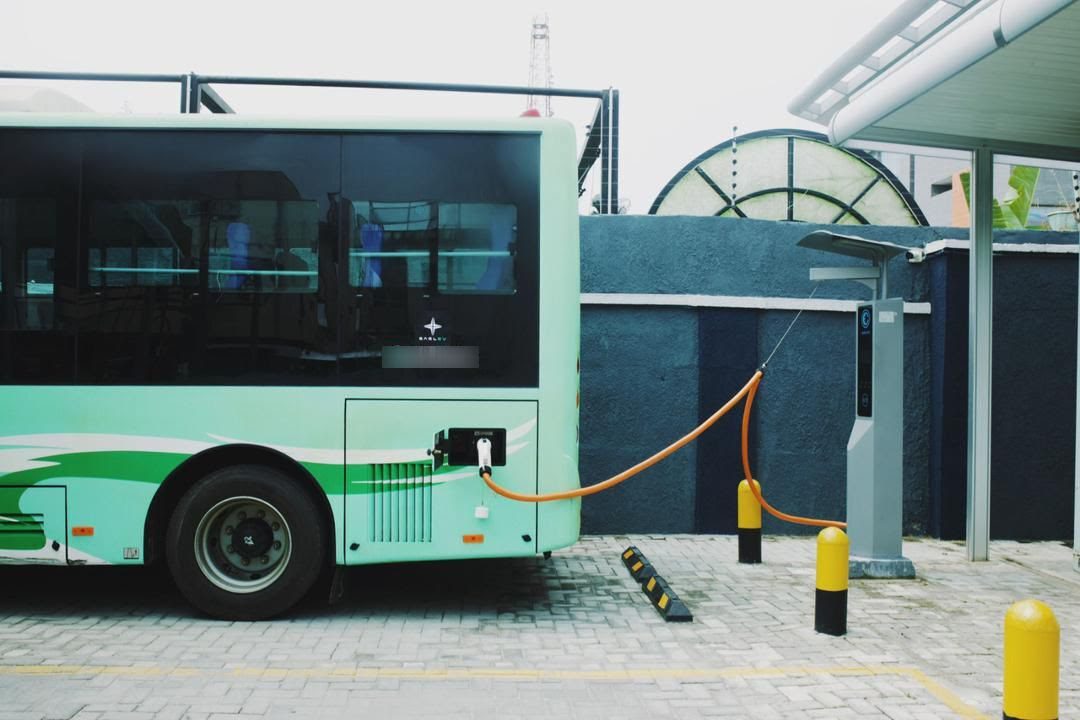
LAGOS — As fuel prices continue to squeeze Nigerian households and businesses, a quiet industrial shift is taking place in the outskirts of Lagos. SAGLEV, a homegrown electric vehicle (EV) assembler, has emerged as a key player in the nation’s transition away from fossil fuels through a strategic partnership with Chinese automotive giant Dongfeng.
The collaboration is being hailed as a “low-hanging fruit” for Nigeria’s industrial sector, leveraging affordable Chinese technology to build a sustainable local transport ecosystem.
Scaling Local Assembly in Imota
At the heart of this movement is SAGLEV’s 5,000-square-metre assembly facility in Imota, Ikorodu. Unlike traditional importers, SAGLEV focuses on local integration using Semi-Knocked-Down (SKD) kits.
In early 2026, the company reached a major milestone by delivering Nigeria’s first locally assembled 18-seater fully electric passenger van—the Dongfeng E Star V9 EV—to Stanbic IBTC Bank. This delivery signals a shift from “experimental” concepts to viable corporate fleet solutions.
Key Facility Stats:
-
Annual Capacity: Currently 2,500 units, with the infrastructure to scale to 10,000 units via multi-shift operations.
-
Model Diversity: The plant is equipped to assemble up to 17 different EV models, including the luxury M-HERO SUV and compact sedans optimized for ride-hailing.
-
Technical Growth: The facility employs a growing team of specialized EV technicians capable of full vehicle disassembly and reassembly.
The Economics of the Switch
In an interview with The Africa EV Show, SAGLEV CEO Dr. Sam Faleye emphasized that the removal of fuel subsidies has fundamentally changed the math for Nigerian drivers.
“Our models showed EVs would make economic sense at ₦400 per litre,” Faleye noted. “With prices now far exceeding that, the transition is a no-brainer.”
For ride-hailing drivers in cities like Lagos, the daily operational savings are staggering. While a petrol-powered car may cost between ₦30,000 and ₦40,000 to fuel daily, an EV can be powered for roughly ₦6,000, representing an 80% reduction in running costs.
Overcoming Infrastructure Hurdles
Recognizing that a car is only as good as its charging network, SAGLEV is moving beyond manufacturing to infrastructure. The company’s strategy includes:
-
Strategic Charging Hubs: Collaborating with fuel retailers like Ardova and Enyo to install charging points at existing petrol stations.
-
Off-Grid Solutions: Developing solar-powered charging systems to bypass grid reliability issues, ensuring that “zero-emission” also means “zero-dependence” on the national power grid.
-
Fleet Financing: Partnering with commercial banks to provide dedicated financing desks, making the initial purchase price—often the biggest barrier to entry—more manageable for transport operators.
A Continental Blueprint
By localizing the “China-to-Lagos” value chain, SAGLEV is positioning Nigeria as a regional hub for e-mobility in West Africa. The company argues that by assembling locally rather than importing finished units, it can offer vehicles at prices significantly lower than luxury imports while creating high-tech industrial jobs for Nigerians.
As Dr. Faleye puts it, the mission is simple: to prove that electric mobility in Africa is not just a futuristic dream, but a practical, scalable solution for the challenges of today.
