

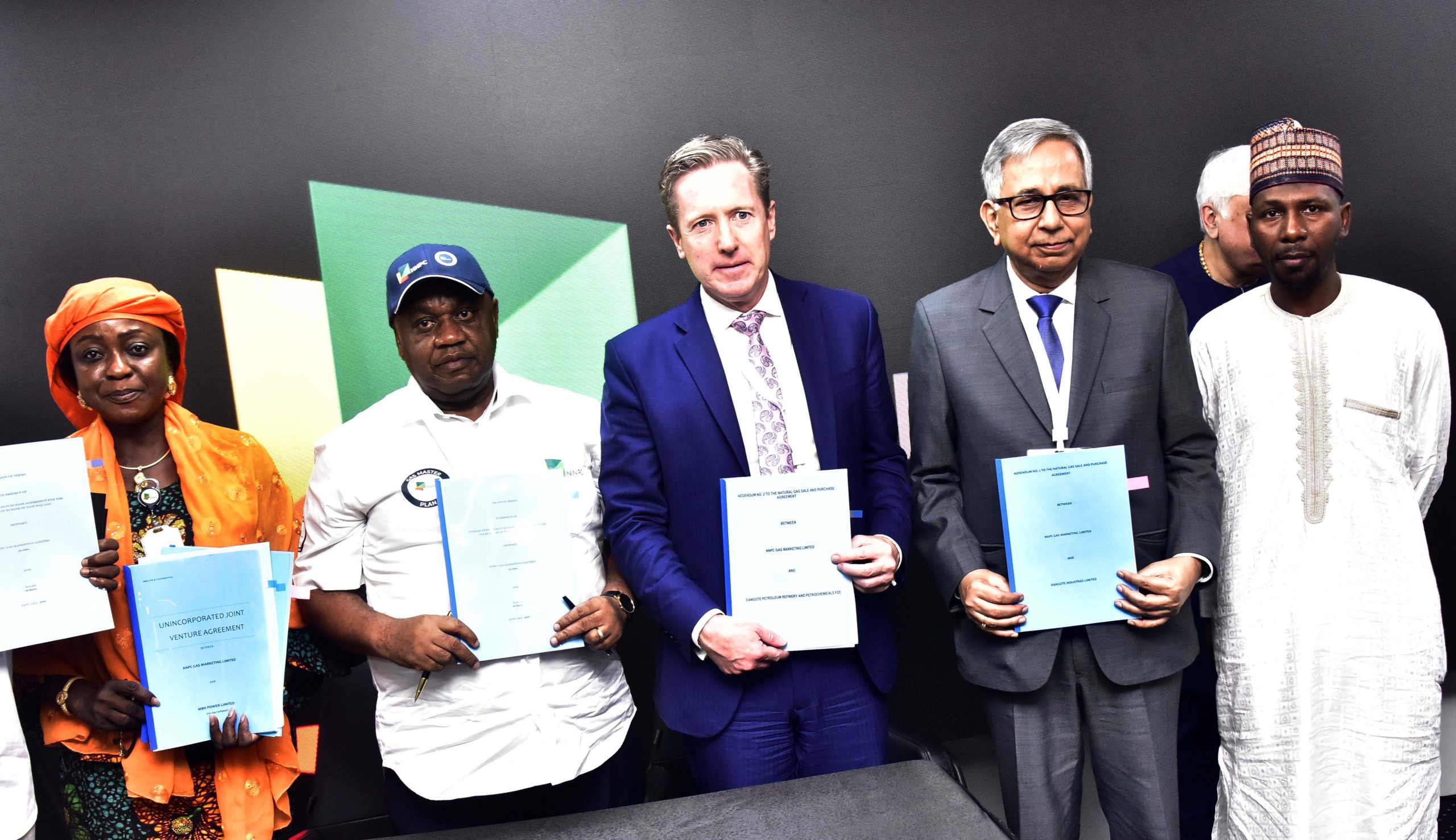
Nigeria’s industrial landscape received a massive boost on Monday as three major subsidiaries of the Dangote Group—Refinery, Fertilizer, and Cement—signed expanded gas supply agreements with the NNPC Ltd. These deals are a cornerstone of the newly launched Nigeria Gas Master Plan (NGMP) 2026, a roadmap designed to turn the country’s 210 trillion cubic feet of gas reserves into an industrial engine.
The contracts, signed at the NNPC Towers in Abuja, align with Nigeria’s “Decade of Gas” initiative and the group’s own Vision 2030 strategy.
1. The Three-Pronged Industrial Push
The expanded Gas Sale and Purchase Agreements (GSPAs) target three critical sectors of the Dangote conglomerate:
-
Dangote Petroleum Refinery: Secures long-term gas requirements for its anticipated production increase. Gas is essential for powering the refinery’s massive utility plants and hydrogen production.
-
Dangote Fertiliser Plant: As natural gas is the primary feedstock for urea production, this deal guarantees the raw material needed for planned capacity expansions.
-
Dangote Cement Plc: The agreement supports the company’s shift toward CNG (Compressed Natural Gas) as “Autogas” for its massive transport fleet, significantly lowering logistics costs and carbon emissions.
2. Inside the Nigeria Gas Master Plan 2026
Unveiled just last Friday (January 30, 2026), the NGMP 2026 marks a shift from “policy drafting” to “disciplined execution.” Led by the Minister of State for Petroleum Resources (Gas), Ekperikpe Ekpo, and NNPC Group CEO Bashir Bayo Ojulari, the plan sets aggressive targets:
| Metric | Current (Early 2026) | 2027 Target | 2030 Target |
| Gas Production | ~8 bcf/d | 10 bcf/d | 12 bcf/d |
| Investment Goal | — | — | $60 Billion+ |
| Commercialisation | ~60% | 75% | 80% |
| Flaring Goal | Ongoing | Zero Routine Flaring | Net-Zero Alignment |
3. Why This Matters for the Economy
NNPC GCEO Bashir Bayo Ojulari described the plan as a “bold roadmap” to elevate Nigeria into a globally competitive gas hub. By prioritizing cost optimization and willing-buyer/willing-seller pricing, the government aims to solve the “delivery gap” that hindered the 2008 version of the plan.
Key Infrastructure Projects Under the Plan:
-
African Atlantic Gas Pipeline: A massive expansion project to transport 3,000 mmscf/d within three years.
-
Regional Gas Hubs: Development of dedicated hubs in the West Delta (Warri), Obiafu (Port Harcourt), and Akwa Ibom for gas processing.
-
20 Million LPG Cylinders: A separate initiative unveiled alongside the plan to scale clean cooking access across Nigeria by 2030.
The Bottom Line
The Dangote-NNPC partnership is the first major “litmus test” for the 2026 Master Plan. If these industrial giants can secure reliable, market-priced gas, it sets a precedent for the entire manufacturing sector to follow, potentially saving billions in energy costs and positioning Nigeria as a net exporter of gas-based products.
