

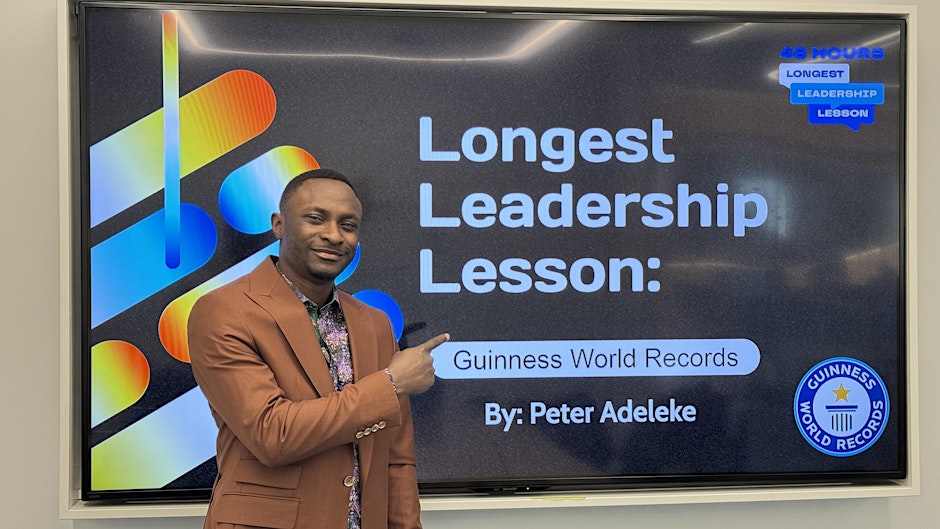
Guinness World Record holder Peter Adeleke, renowned for the longest marathon leadership lesson, has concluded a high-impact, multi-city leadership and business tour. Spanning the United States and Nigeria, the tour aimed to bridge the gap between “talent and potential” for emerging leaders and entrepreneurs through practical, accessible education.
Adeleke’s message throughout the tour was clear: leadership is not just a title but a “foundational infrastructure” necessary for any business or society to survive and thrive.
Global Reach: From the U.S. to Lagos
The tour utilized a hybrid model of in-person and virtual sessions to maximize its reach across different continents and industries:
-
Lagos, Nigeria (Dec 6): Hosted at the MFM International headquarters, the session drew a massive crowd of 1,000 participants, ranging from corporate executives and entrepreneurs to students and creatives.
-
Baltimore, Maryland (Nov 15): A diverse session that engaged over 290 participants (40 in-person and 250 virtual).
-
Washington, D.C. (Dec 12): Concluded the U.S. leg with 80 specialized participants focused on high-level organizational growth.
The Cost of Poor Leadership
Adeleke argued that organizational failure is rarely about a lack of opportunity, but rather a lack of intentional leadership development. He highlighted the “public consequences” of leadership gaps:
-
Organizational Failure: Businesses collapse when leaders aren’t equipped to manage growth.
-
Social Instability: Societies suffer when leadership capacity is not developed early in individuals.
-
Stalled Innovation: Without a leadership mindset, creative ideas fail to scale into sustainable solutions.
“Born to Lead, Called to Serve”
A central feature of the tour was Adeleke’s book, “Born to Lead, Called to Serve,” which provides a framework for the “Servant Leadership” model he advocates. By offering his sessions for free, Adeleke aimed to prove that leadership education is a high-value asset that should be made accessible to the masses to drive broader economic and social development.
