

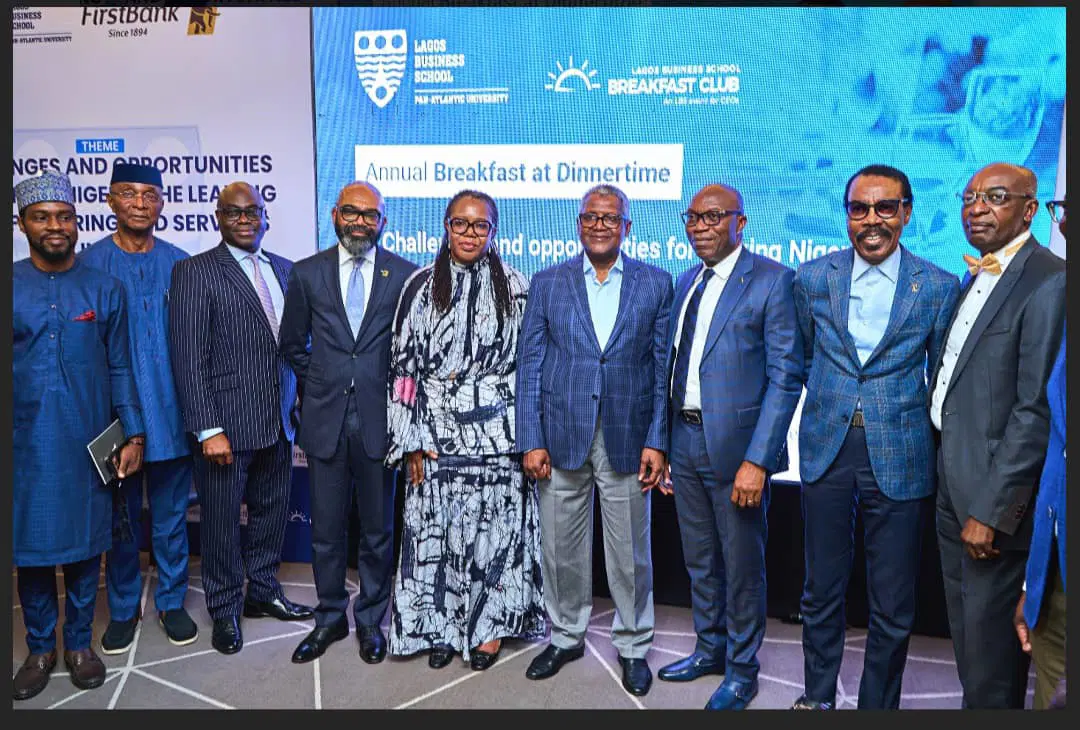
At a high-level fireside chat hosted by the Lagos Business School (LBS) Breakfast Club, Nigeria’s foremost industrialist, Aliko Dangote, and renowned economist Bismarck Rewane converged to outline a roadmap for transforming Nigeria into Africa’s premier manufacturing and services hub.
The event, themed “Challenges and Opportunities for Making Nigeria the Leading Manufacturing and Services Hub in Africa,” provided a data-driven look at the 2026 economic landscape and the structural shifts required for long-term industrial sovereignty.
The Pillars of Sustainable Industrialization
Aliko Dangote, Chairman of the Dangote Group, emphasized that Nigeria’s path to becoming a regional powerhouse depends on two critical strategies: Local Production and Backward Integration.
-
Reducing Import Reliance: Dangote argued that a “manufacturing hub” cannot exist while heavily dependent on foreign goods.
-
Backward Integration: He described this as the “foundation for competitive industries,” where companies control their supply chains from raw materials to finished products.
-
AfCFTA Readiness: While the African Continental Free Trade Area opens doors to a massive market, Dangote warned that only “efficient and cost-competitive” Nigerian firms would actually survive the continental competition.
2026 Economic Outlook: Stability and Policy Alignment
Bismarck Rewane, Managing Director of Financial Derivatives Company (FDC), opened the session with an analysis of Nigeria’s 2026 Economic Outlook. His forecast highlighted several critical factors for the coming year:
-
Macroeconomic Stability: Expansion depends on aligning stable currency and inflation trends with productivity-boosting policies.
-
Private Sector Confidence: Long-term growth requires clear policy indicators that encourage investment rather than survival-mode operations.
-
Infrastructure Synergy: A call for stronger alignment between government infrastructure spending and private-sector needs.
Innovation as the Final Piece
Professor Olawale Ajai, who moderated the session, noted that physical infrastructure alone isn’t enough. He pointed to Technology, Innovation, and Human Capital as the ultimate deciders of whether Nigeria leads Africa’s manufacturing and services sectors. The consensus was clear: for Nigeria to win, it must combine industrial grit with a workforce ready for the fourth industrial revolution.
A Collaborative Future
The LBS Breakfast Club continues to serve as a “strategy laboratory” for Nigeria’s C-suite executives. This 2025 end-of-year session was supported by a coalition of financial leaders, including First Bank of Nigeria, Optimus Bank, Cowry Asset Management Limited, and Afrinvest Limited, reinforcing a collective commitment to a robust, private-sector-led business environment.
