

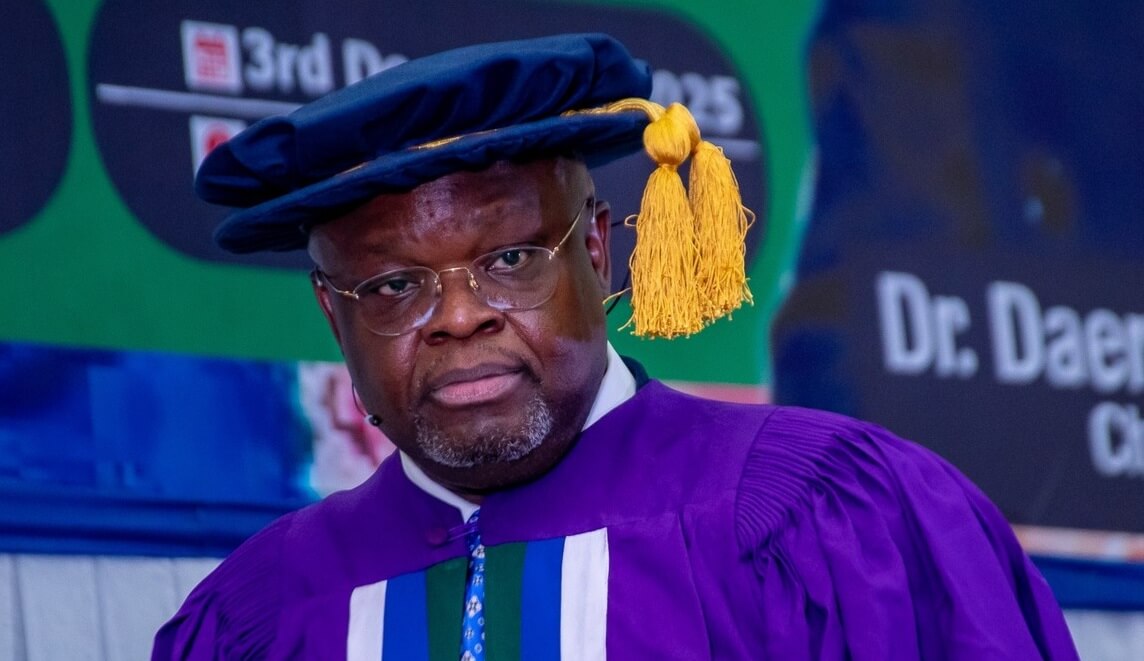
During the combined 37th and 38th convocation ceremony at Rivers State University (RSU), entrepreneur Dr. Daere Akobo delivered a keynote address that sharply critiqued Nigeria’s current innovation landscape and proposed a path to reform. The lecture, titled “Joint University-Industry Ventures: The Entrepreneurship, Technology, Sustainability and People Nexus for Rivers State University,” urged the academic community to embrace a joint venture model anchored in four key pillars: entrepreneurship, technology, sustainability, and people.
Addressing a large gathering of 13,242 graduates and university leaders at the Nkpolu-Oroworukwo campus, Akobo, an RSU Applied Physics alumnus, declared that innovation is essential for the “oversized” country and must begin with critical thinking. He drew inspiration from his own journey, which saw him rise from being General Electric Nigeria’s top talent in Africa to building PANA Holdings, a conglomerate spanning multiple high-tech sectors.
Akobo starkly contrasted Nigeria’s output—just two patents per million people annually—with the performance of institutions like MIT and IIT Madras, which have successfully built entire economic ecosystems by commercializing intellectual property. He noted that even major national institutions like the NNPC hold no more than three patents, collectively.
The founder of PE Energy Ltd challenged RSU’s traditional academic metrics, asking: “How can we move from using tests to graduate students to using patents to graduate students?” He asserted that patents generate revenue and represent long-term commercial value, enabling students to become innovators with marketable intellectual property. Akobo positions himself as a “commercialization agent,” turning university lab inventions into viable businesses, citing a 2017 agricultural patent he pitched as a solution to farmer-herder conflicts.
He championed the ‘triple helix’ model—a collaborative framework where academia, industry, and government work together to drive knowledge transfer and economic growth. He argued that modern universities cannot be isolated; they must integrate industry realities into curricula and co-create technology.
Akobo specifically challenged RSU’s petroleum engineering faculty to develop indigenous software to replace the more than 750 foreign-developed platforms currently dominating the industry, noting that proprietary software is crucial to generating GDP and competing globally. He stressed that universities like MIT are powerful economic forces—often referred to as the “47th world” due to the immense wealth generated by their entrepreneurs—demonstrating the potential RSU should strive for, not in size, but in the quality of ideas it exports.
The entrepreneur also addressed the role of the Rivers State government, urging Governor Siminalayi Fubara to focus on directive capacity—the ability to strategically channel resources toward state priorities—rather than just extractive capacity (tax collection).
Drawing inspiration from IIT Madras’s success in attracting massive research grants and corporate facilities from giants like Shell and Schlumberger, Akobo challenged RSU to establish a campus technology hub to attract similar partnerships. He connected this to the university’s existing work in clean energy, urging them to convert this academic output into commercial, real-world solutions, such as community water systems.
Akobo concluded by addressing the “mental box” that limits regional ambition, citing the need to reject self-deprecation and the local tendency to undermine successful local enterprises. He reaffirmed his personal commitment to the region, noting his Port Harcourt office (employing 150 people) was a deliberate choice despite the banking advantages of Lagos.
Finally, he introduced his Five P’s of business success: Purpose (prevents abuse), Philosophy (guides decisions), Process (execution), Product (solutions offered), and Profit and Prosperity (generating genuine gratitude). He also cautioned graduates against the “three F’s” to avoid: Family, Friends, and Fools (those who discourage dreams). He closed with a call for immediate action, echoing Steve Jobs’ famous advice, “Stay hungry, stay foolish,” defining “foolish” as perseverance and consistency.
