

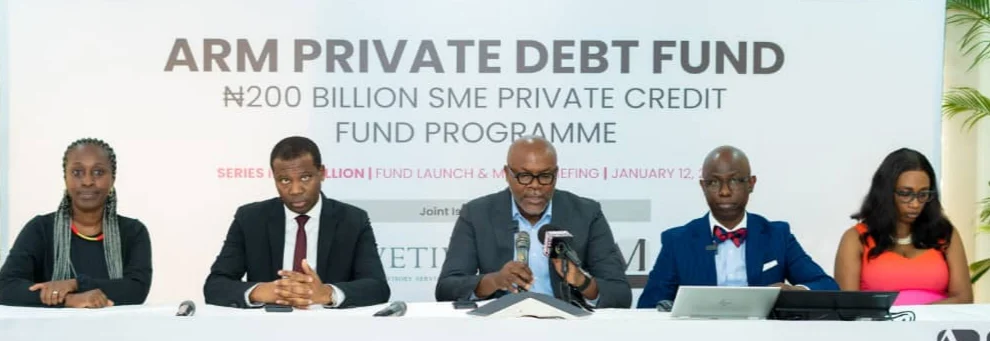
ARM Investment Managers has officially disrupted the traditional lending landscape with the launch of the ARM Private Debt Fund. This ₦200 billion shelf programme represents one of the most significant moves toward non-bank financing in sub-Saharan Africa, specifically engineered to provide “patient capital” to a segment long neglected by commercial banks.
The fund arrives at a pivotal moment. While Nigerian SMEs contribute nearly 50% of the GDP, they face a staggering $158 billion financing gap. With traditional banks constrained by a 20-22% Monetary Policy Rate (MPR) and rigorous regulatory hurdles, private credit is emerging as the essential bridge for industrial growth.
Strategic Anatomy of the ARM Private Debt Fund
Unlike traditional mutual funds, this is a closed-ended private credit vehicle domiciled in Mauritius. It is designed to deploy both Naira and hard currency, offering a multi-currency hedge for investors and a lifeline for exporters.
Key Structural Highlights:
-
Series I Target: An initial raise of ₦25 billion to kickstart deployments.
-
Investment Benchmark: Targeted returns of 300 basis points (3%) above the prevailing 10-year Federal Government Bond yield (which sits at approximately 16.86% as of mid-January 2026).
-
Capital Protection: A minimum of 80% of the portfolio is mandated for senior secured, asset-backed lending with strict covenant protections.
-
Liquidity Mechanism: Uniquely, the fund allows for up to 20% of assets to be partially redeemed through the securitization of loan portfolios, providing a rare liquidity window for a 10-year instrument.
The “Missing Middle”: Who Qualifies?
ARM is targeting high-quality “mid-sized” businesses that have outgrown microfinance but remain too “risky” for traditional tier-1 banks.
| Qualifying Criteria | Requirement |
| Operational Track Record | Minimum 3 years of proven business history. |
| Profitability Threshold | EBITDA typically between ₦500 million and ₦2 billion. |
| Sector Focus | Manufacturing, Logistics, Tech-enabled services, and Agribusiness value chains. |
| Exclusions | Primary agriculture (crop production) and speculative ventures. |
Risk Management: The S&P Partnership
To maintain institutional standards, ARM has integrated S&P Global’s analytical framework into its credit appraisal process. This “kick the tires” approach combines global data metrics with local due diligence—visiting factories and auditing governance structures—to ensure that the ₦200 billion shelf actually reaches “viable” and “bankable” entities.
2026 Macro Impact: Reducing Import Dependency
According to CEO Deji Opeola, the fund isn’t just about lending; it’s a macroeconomic tool. By funding businesses that focus on import substitution (producing locally what was previously imported), the fund aims to ease the chronic pressure on Nigeria’s foreign exchange reserves.
“Africa faces a $400 billion SME credit gap. This fund is the foundation of a long-term platform that will play a defining role in financing Africa’s next phase of growth.” — Deji Opeola, CEO, ARM Private Debt Fund
