





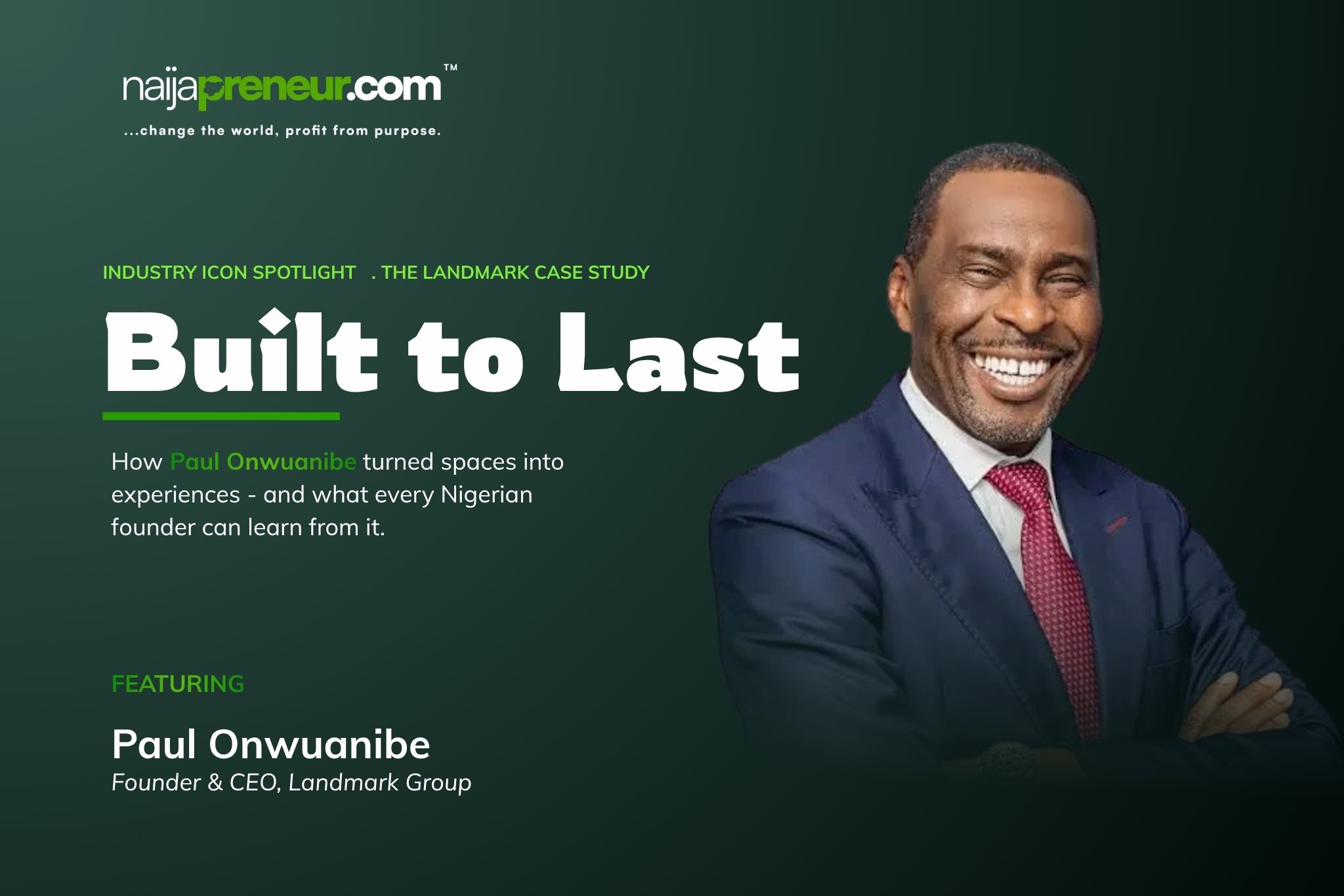
The Landmark Group survived war abroad, a pandemic, a tenfold currency collapse and, finally, a government bulldozer. Behind the hotel and the beach sits a more useful story for the Nigerian founder: a business that reinvented itself three times in three decades — and refused to die.
Written by Tito Philips · Research & interview by Olufemi Omotayo The Landmark Case Study · A naijapreneur Insights feature
In 2024, a bulldozer arrived at one of the most visited destinations in West Africa.
The Lagos–Calabar coastal road needed a right of way, and the Landmark Beach sat in it. When the dust settled, Paul Onwuanibe had lost an estimated three-quarters of his group’s income, after sinking some $30 million of debt-funded investment into the asset. It was the kind of blow that closes most companies.
Landmark did not close. To understand why — and to take something usable from it — you have to look past the hotel, the cinema, the 42 food outlets and the famous beach, and study the operating system underneath. This is a 28-year-old business that has reinvented itself three times, weathered September 11th, a pandemic and a currency that fell from ₦120 to the dollar to roughly ₦1,200, and is now planning its next chapter along the West African coastline.
We sat down with Paul Onwuanibe to dissect how. What follows is not a celebration. It is a case study: the frameworks he actually runs the company on, the decisions that mattered, and the lessons we believe every Nigerian SME can borrow.
Landmark Group: Three businesses in one company
Landmark did not begin as the lifestyle destination Lagosians know today. It started in 1997 in Europe as a service-office business — renting flexible workspace to corporates. When that market turned brutally competitive in Europe and was shaken in New York around September 11th, Onwuanibe made the defining call of his career: in 2003 he brought the business to Africa, opening simultaneously in the continent’s four corners — Lagos for the west, Johannesburg for the south, Nairobi for the east and Cairo for the north — to house the multinationals then discovering the continent, the GEs, Nokias, IBMs and Dells of the world.
The first reinvention was forced by the ground itself. Delivering premium property services in markets with thin facility management, weak tenancy law and unreliable infrastructure left Landmark, in his words, “at the mercy of the landlord.” So around 2009–2010, the group did the capital-intensive, uncomfortable thing: it became a real-estate company itself, to control the very property its service promise depended on.
The second reinvention was a reading of the African consumer. Bricks and mortar exposed the group to every civic and infrastructure failure of a major African city. So Landmark moved again — from bricks into experiences: one place where you could work, eat, sleep, hold a wedding, watch a film and never need to leave.
“Africa has people. The only problem is the people don’t have high purchasing power. They can’t buy big things like houses and cars — but they can buy food, and they can buy experiences.”
That single observation re-priced the entire business. Instead of selling expensive, low-frequency assets to a few, Landmark began selling affordable, high-frequency experiences to everyone — grandparents, parents and children, the lowest common denominator of demand — and turned a property into a destination.
The lesson for Nigerian SMEs: sell what your market can actually afford to buy often. Purchasing power here is real but shallow. The durable businesses lower the price of the smallest unit of value they sell and win on frequency — not on the size of a single transaction.
The Operating System
Strip away the brand and Landmark runs on a small set of repeatable rules. They are not slogans on a wall; Onwuanibe tests his staff on them, and they govern real decisions.
The first is the Three Ps — People, Partners, Purpose. Look after the people who build and use the brand. Don’t try to do everything alone; bring in partners for what they do best. And never act without a purpose — at Landmark, everyone states it identically: bring people here, give them an amazing experience, make sure they tell others.
The second is a deceptively simple rule about measurement: “If you can’t count it, it doesn’t count.” Most property firms count square metres. Landmark counts people — how many come, how long they stay, what they spend while there, and whether they tell others.
“Other real-estate organisations count bricks and mortar. We don’t count square metres. We count people.”
The lesson: your metric is your strategy. Pick the one number that genuinely reflects the value you create, then build everything around moving it. The wrong metric — vanity revenue, raw footprint — quietly steers a company toward the wrong decisions for years.
The Five DREADs
Onwuanibe’s personal decision framework is an acronym he says he is forced to call on at every turning point. It doubles as Landmark’s leadership creed and its hiring filter.
- Dare to dream. Not every dream comes true, but if you dream enough, some do.
- Resilience. Expect the unexpected, then meet it. You don’t hit a wall and turn back; you find a way through.
- Excellence. Choose a standard and be relentlessly consistent with it. In Nigeria, he argues, excellence itself is a currency — competition is thin and the bar is low, so doing things properly is a moat.
- Adaptability. “You can’t change the cards you’re dealt. You can only change the hand you play.”
- Staying power. In a city like Lagos, things will try to stop you. The answer is a refusal to leave.
It isn’t posturing. Landmark claims a long list of Nigerian firsts — among them an inner-city private beach and a purpose-built convention destination — each carrying the cost and risk of being first, and each widening the moat.
“We do things not because they’re easy, but because they’re hard — because when they’re hard, very few people have the ability to do them.”
The most important idea in this case study
Here Onwuanibe draws a hard line between two kinds of trouble, and argues that imported business education prepares founders for the wrong one.
Risk is the world of known unknowns — a fire, an accident. You know these can happen; you just don’t know when. They can be modelled, planned for and insured against. Much of business school is a catalogue of risk mitigations.
Uncertainty is the world of unknown unknowns — COVID, September 11th, a road that erases your beach. You cannot plan for the specific event, because you don’t know it exists until it arrives.
His claim is that the ratio inverts between markets. In the West, the mix is roughly 90% risk and 10% uncertainty. In Africa, it flips: about 10% risk and 90% uncertainty. That is why copied playbooks fail here. A founder trained to manage risk lands in a market governed by uncertainty and finds their tools don’t fit.
The lesson: stop trying to predict; build to absorb. If most of your threats are genuinely unknowable, resilience and adaptability are not soft virtues — they are your core competitive strategy. Cash buffers, flexible assets, multiple revenue streams and a culture that embraces change beat any forecast.
Tested to destruction
A philosophy of resilience is cheap until it is billed. Landmark’s was billed in full. The group borrowed in dollars when the naira traded near ₦120; by repayment it had collapsed to roughly ₦1,200 — a tenfold swing in about seven years. Add COVID, add inflation Onwuanibe calls “the big curse on the economy,” then add the demolition of the beach.
What carried the business through was not a hedge. It was a frame of mind. Mid-crisis, on his way before dawn to lobby a government official, Onwuanibe stopped at a friend’s house and learned the friend’s wife had died that morning, their children still abroad and unaware. He had just spent twenty minutes venting about a beach.
“Whatever you lose, you can get back. When someone dies, you don’t get that person back. That one incident mellowed me.”
From there the operating rule is sequential and unsentimental: first survive, then thrive. Treat disaster the way Edison treated his burning factory — as an expensive opportunity to rebuild bigger and better. Move the people who can only see the loss off the project. And hold to principle, because “principle goes into a room long before you get there, and stays long after you’ve left.”
The lesson: don’t borrow your survival in a currency you don’t earn. The dollar-loan trap has killed more Nigerian businesses than bad ideas. And when the unforeseeable hits, the first job is emotional discipline — refuse self-pity and blame, separate what’s lost from what’s recoverable, and act.
Hire for what can’t be taught
Landmark does not advertise jobs and does not prize experience. It hires for raw material and trains the rest — quickly, and with a willingness to part ways just as quickly. Onwuanibe screens for three things, in order: basic intelligence (read as open-mindedness, the ability to think), fearlessness, and desire.
“You can teach things, but you can’t teach desire. You can’t teach passion, resilience, or hard work.”
He hires fast and, when needed, fires fast: within a month you know whether someone is right. Some stay a decade; some last two weeks. The speed keeps the standard intact. His mother’s line is the culture in one sentence — you may be out-talented, but you have no excuse to be out-worked.
And the customer is the final arbiter of everything. Real estate, in his telling, is not about buildings at all — it is hospitality. How people feel when they arrive, while they’re there, and when they leave is the product.
What Nigerian founders should take from Landmark
A case study earns its place only if it transfers. Here is what the Landmark story recommends.
If you build property or physical spaces:
- Sell experiences, not square metres. The margin is in how a space makes people feel and how often they return — so design for footfall, dwell time and repeat visits.
- Control what your promise depends on. Landmark moved into ownership because weak third-party systems made its service fragile. Find your single point of dependency and bring it in-house.
- Build to last and build to change. Treat a structure as a long-life, flexible asset whose use will evolve.
If you run any Nigerian SME:
- Price the smallest unit your market can buy often; win on frequency and reach.
- Engineer for uncertainty, not risk — cash buffers, diversified revenue, flexible assets, and no foreign-currency debt against naira income.
- Make excellence your moat. Where the bar is low, being consistently excellent is a durable advantage.
- Measure the one thing that is your strategy, and run the whole business off it.
- Think globally, act locally: import standards of excellence, adapt the service to Nigerian realities.
The Landmark playbook, in eight lines
- Adapt faster than the market changes — reinvent before you’re forced to.
- Count people, not square metres — your metric is your strategy.
- Sell experiences your market can afford often — frequency beats size.
- Build to absorb shocks you can’t name — uncertainty is the rule.
- Survive first, then thrive — treat disaster as expensive opportunity.
- Hire desire, train skill, decide fast — attitude compounds.
- Make excellence the moat — in a thin market, consistency wins.
- Hold to principle under pressure — it guides the hardest calls.
There is a quote on Onwuanibe’s office wall, attributed to Thomas Jefferson: “If you want something you have never had, you must be willing to do something you have never done.” It is, in the end, the whole case study compressed. In an economy you cannot predict, the winning strategy is not foresight. It is the discipline to adapt, absorb, and stay.
Built to last, by building to change.
*This article is the first in the Case Studies series from naijapreneur Insights, where we dissect the journeys of Nigeria’s most consequential founders into frameworks you can use. Want the full breakdown — frameworks, timeline, data and recommendations in one document? *[Download the complete Built to Last case study (PDF).]*
Know a Nigerian founder whose story should be studied? Tell us at hello@naijapreneur.com — and explore MINE 1000, our drive to profile one thousand Made-in-Nigeria entrepreneurs.
All quotations are drawn from a primary interview conducted by naijapreneur Insights. Figures cited are as stated by the subject and are presented as his account rather than independently audited financials, in line with our methodological-honesty standard.


