





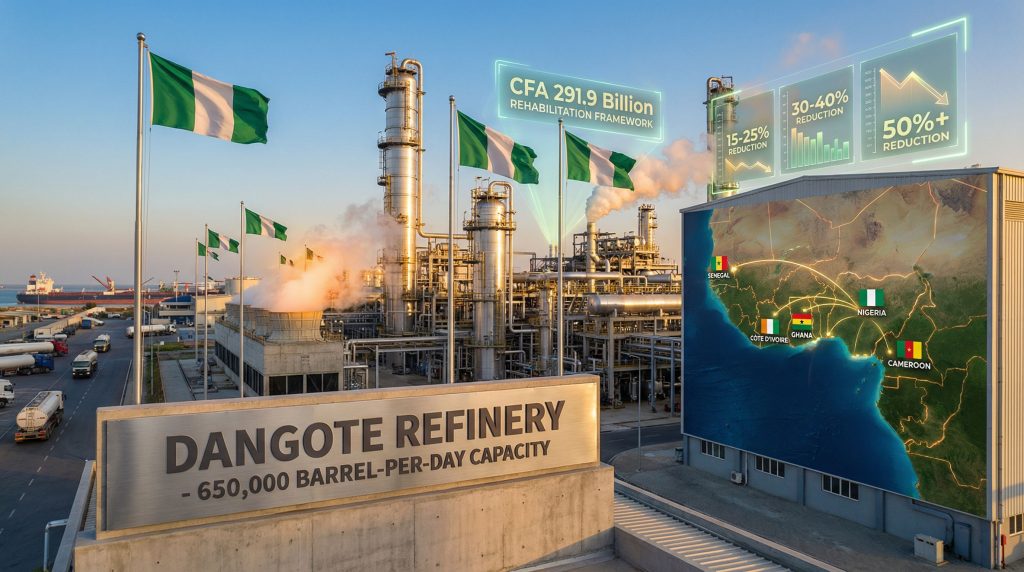
On February 5, 2026, during the Nigeria International Energy Summit (NIES) in Abuja, the CEO of Ghana’s National Petroleum Authority (NPA), Godwin Kudzo Tameklo, confirmed that Ghana is positioning itself as a primary “offtake market” for the Dangote Petroleum Refinery.
As Nigeria transitions from a fuel importer to a regional exporter, this partnership signifies a major shift in West African energy dynamics, driven by proximity, quality, and the scale of the 650,000 barrels per day (bpd) facility.
1. The Refining Gap: Why Ghana is Looking East
Ghana’s current refining capacity is categorized by Tameklo as “insignificant” compared to the sheer scale of the Dangote facility.
-
Limited Domestic Capacity: Ghana operates two small refineries and a modular unit of roughly 6,000 bpd, which fails to meet its national demand.
-
The TOR Revival: While the Tema Oil Refinery (TOR) resumed operations in late 2025 after a four-year hiatus, it currently processes about 28,000 bpd—only 62% of its nameplate capacity.
-
Proximity Advantage: Sourcing refined products from neighboring Nigeria is expected to significantly reduce freight costs and delivery timelines for Ghana compared to European imports.
2. Diversified Feedstock: Ghana’s Crude for Nigeria’s Fuel
The relationship is not one-way. The Dangote Refinery has begun diversifying its feedstock by sourcing crude from Ghana’s offshore fields.
-
Sankofa Shipment: In November 2025, the refinery received its second shipment of crude from Ghana’s Sankofa field.
-
Mutual Benefits: This regional integration allows Ghana to monetize its crude while securing a stable supply of high-quality refined petrol (PMS) and diesel (AGO).
3. Production Milestones (Early 2026)
The Dangote Refinery is entering its most critical phase of operation this month:
-
Full-Capacity Tests: In February 2026, the refinery is scheduled to conduct performance test runs at its full nameplate capacity of 650,000 bpd.
-
Current Output: The facility is operating at roughly 85% capacity, churning out 70 million liters of fuel daily (45 million liters of petrol and 25 million liters of diesel).
-
Export Surplus: With Nigeria only requiring about 50% of the refinery’s output to meet total domestic demand, the surplus is earmarked for West African neighbors like Ghana and Cameroon.
4. Macroeconomic Stability & Regulation
Tameklo stressed that the success of this cross-border trade depends on two non-negotiable factors:
-
Uniform Regulation: Standardizing fuel quality and safety protocols across ECOWAS.
-
Exchange Rate Stability: Ensuring that volatility in the Naira or Cedi does not wipe out the economic gains of the partnership.
Comparative Refining Landscape: West Africa (2026)
| Country | Major Refinery | Capacity (bpd) | Status (Feb 2026) |
| Nigeria | Dangote Refinery | 650,000 | Full-capacity tests underway. |
| Ghana | Tema Oil Refinery (TOR) | 45,000 | Operating at ~28,000 bpd (Phased restart). |
| Cameroon | SONARA | 42,000 | In talks with Dangote for restart funding. |
| Ghana | Modular Refineries | ~6,000 | Fully operational but limited scale. |
“As regulators, our priority is to ensure that Ghanaians have access to cheaper, affordable, and quality products. A partnership with refineries like Dangote… will help us deliver value to our people.” — Godwin Kudzo Tameklo, CEO of Ghana NPA.


