






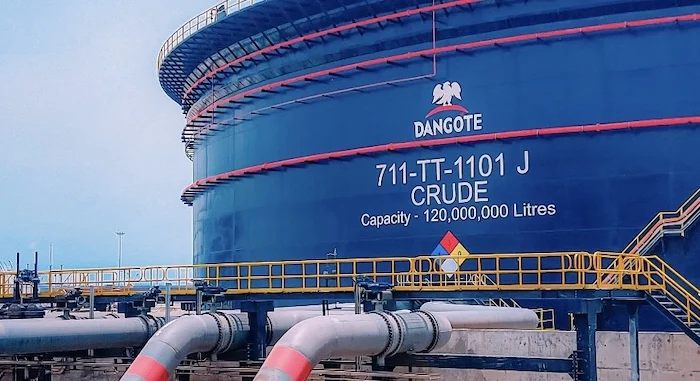
Nigeria’s Dangote Petroleum Refinery has adapted its crude sourcing strategy by procuring its first two cargoes of Middle Eastern crude oil from ADNOC of the United Arab Emirates (UAE). This structural shift breaks the facility’s historical reliance on local and United States inputs; a 2025 S&P Global Commodity Insights analysis showed that Dangote had previously covered 70% of its feedstock via Nigerian crude and 24% from US grades. The sudden pivot to the Middle East capitalizes on a global supply easing through the Strait of Hormuz following an interim peace agreement between the United States and Iran.
The shift into international merchant buying comes despite a “naira-for-crude” framework with the Nigerian National Petroleum Company (NNPC) intended to supply 13 to 15 domestic cargoes monthly. Persistent upstream constraints, regulatory bottlenecks, and infrastructure deficits at local export terminals have restricted NNPC deliveries to roughly 5 to 7 monthly shipments, forcing the mega-refinery to explore cross-border alternatives like Libyan and Emirati grades. Operationally, the plant recently crossed a significant milestone by processing 700,000 barrels of crude per day (bpd) during performance tests, effectively exceeding its initial 650,000 bpd design capacity. Executives have mapped out a 30-month expansion timeline to double processing capacity to 1.4 million bpd, a target that would solidify the complex as the largest single-train refining facility in the world


