

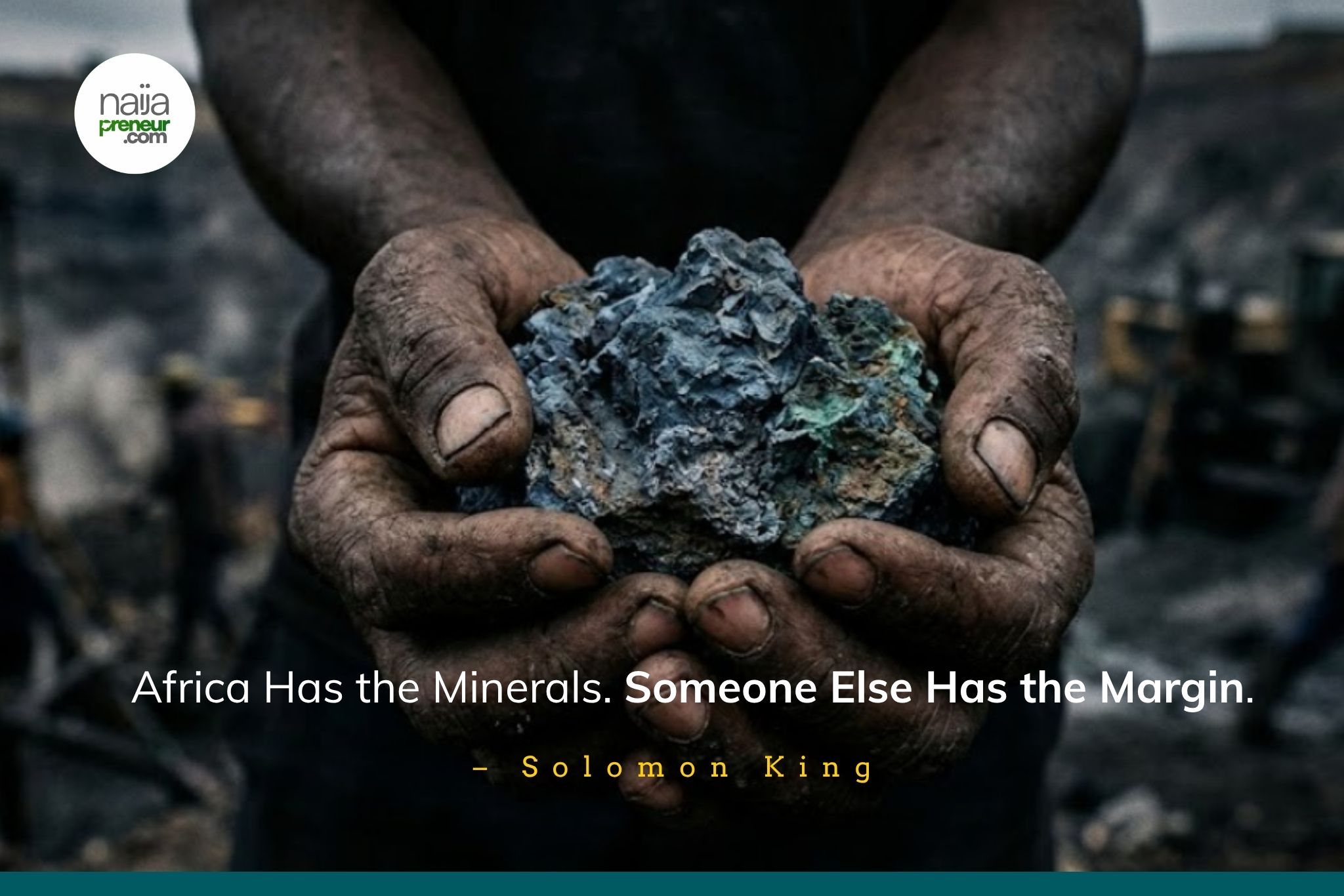
This morning, I was listening to a Bloomberg Next Africa report on critical minerals. The conversation circled lithium, cobalt, copper, and nickel — the materials now powering the global transition to electric vehicles, renewable energy, and high-performance computing.
And as I listened, a familiar feeling settled in.
Africa sits atop a remarkable share of the minerals the world suddenly needs. The DRC produces most of the world’s cobalt. Zimbabwe is emerging as a lithium powerhouse. Zambia is a copper country. South Africa dominates platinum group metals. Across West Africa, lithium and rare earth deposits are quietly attracting serious attention.
Yet the structure of the mineral economy still looks strangely familiar. We export rocks. Other countries export technology.
I’ve seen this pattern before. We all have.
We grow cocoa — Switzerland makes the chocolate. We grow cotton — someone else makes the shirts. We ship crude — someone else refines the petrol. (Though that’s changing — the audacity of the Dangote refinery, and the several modular refineries now coming up across the continent, is exactly the kind of structural shift I’m talking about.)
And now, with minerals, the same structure is quietly repeating itself. Different commodity. Same architecture. But here’s what caught my attention. The next opportunity in Africa’s mineral economy may not be in the mines.
It may be in the systems around the mines.
The Pattern That Built the Most Valuable Companies
If you’ve been paying attention to how modern industries actually work, you’ve noticed something interesting.
The most valuable companies rarely sit at the extraction layer. They sit on the infrastructure layer.
Banks once controlled everything in finance. Then Paystack and Flutterwave built the rails that let money move digitally — and became more valuable than many of the banks they were serving.
- Hotels owned the rooms. Airbnb built the marketplace.
- Taxi companies owned the cars. Uber built the platform.
- The winners didn’t dig the well. They built the pipes.
And when you look at Africa’s mineral economy through that lens, the gap becomes obvious. There is no real operating system yet.
What’s Actually Happening on the Ground
Here’s something that doesn’t make it into most Bloomberg reports.
Millions of Africans are already mining. Not in massive industrial operations with foreign capital and imported equipment — but in artisanal and small-scale operations across West and Central Africa. Gold, cobalt, tin, coltan. Physically demanding, often informal, and almost entirely disconnected from global markets.
Some estimates put the number of Africans involved in artisanal mining at over 10 million, supporting tens of millions of dependents.
The problem isn’t production. The minerals are coming out of the ground. The problem is everything between the miner and the market is broken — fragmented, opaque, and wildly inefficient.
That’s not just a social problem. That’s a business problem. And business problems attract entrepreneurs.
Who’s Starting to Build
A few companies are beginning to lay pieces of this missing infrastructure.
Metalex Commodities Inc., led by Ayo Sopitan, is one worth watching. Rather than operating as a traditional mining company, Metalex works as a bridge — aggregating production from artisanal miners, introducing traceability, and connecting supply to international buyers. It’s not mining. It’s market-making. I sat down with Ayo to understand exactly how this works — watch that conversation here.
Circulor is attacking a different piece of the same puzzle: provenance. Global manufacturers — especially EV brands — want to know exactly where their cobalt came from, and increasingly, they’re being required by law to prove it. Circulor uses blockchain-based tracking to follow minerals from mine to manufacturer. In a world that’s gotten very serious about supply chain accountability, that’s not a nice-to-have. It’s a prerequisite.
Then there’s KoBold Metals, backed by Gates and Bezos, which applies AI to geological data to predict where valuable deposits are likely to exist. They’re not digging. They’re building the data layer of the entire industry.
These aren’t mining companies in the traditional sense. They’re infrastructure companies that happen to operate in mining.
- Data.
- Traceability.
- Aggregation.
- Market access.
- Financing.
- Logistics.
Taken together, they look like the early architecture of something much bigger.
This Moment Feels Familiar
Timing matters in economic history.
When mobile internet arrived in Africa, it created the conditions for fintech to flourish. The gap between people and financial services was enormous, and a generation of builders showed up to close it. Paystack. Flutterwave. Piggyvest. Wave . The infrastructure layer got built, and it got built fast.
Today, the electrification of the global economy is creating a similar opening — but for minerals.
Electric vehicles, battery storage, renewable energy systems, advanced electronics — all of it runs on critical materials. And a meaningful share of those materials is sitting beneath African soil.
The geological advantage is real. But the real opportunity isn’t geological.
It’s structural.
Whoever builds the platforms that map mineral deposits, track supply chains, finance small producers, and connect buyers to African mineral markets will have done what Paystack did for money movement — made the system work for the first time.
And if history is any guide, that’s where the most valuable companies get built.
The Question I’m Sitting With
Africa has spent decades debating the ownership of natural resources. Governments negotiate concessions. Companies fight for mining rights. Communities argue over land. Those debates will continue — and they should.
But a quieter transformation may be unfolding alongside them.
A generation of entrepreneurs and operators may be building the invisible architecture that makes the mineral economy actually function — the data platforms, traceability systems, financing networks, and logistics tools that turn scattered production into organised markets.
If that happens — and I think it will — the most valuable companies in Africa’s mineral economy won’t necessarily be the ones digging the minerals out of the ground.
They’ll be the ones who built the operating system around them.
That’s where I’d be paying attention.
